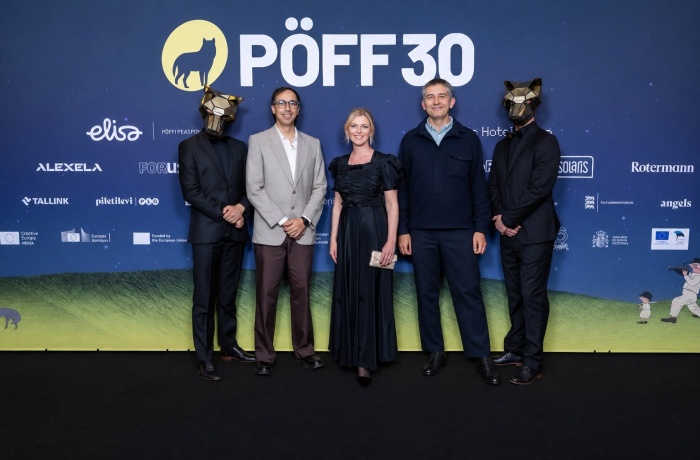
Read Docudays UA’s weekly column about our team’s journeys to international film festivals and industry events. This time, we spoke with director Roman Bondarchuk about the Tallinn Black Nights Film Festival (PÖFF), where he was invited to serve as a member of the international documentary jury.
Festival Atmosphere, a Table for Documentary Filmmakers and the Tradition of Winter Swimming
It is truly a remarkable phenomenon: here, you don't just watch films — you discover a culture, meet people and immerse yourself in the life of the city and Estonia as a whole.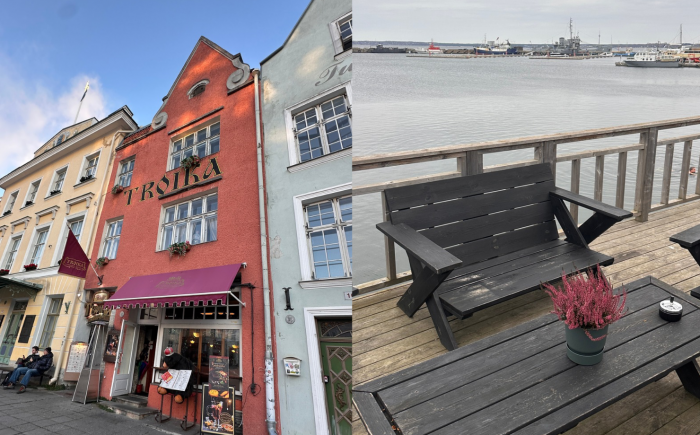
Walking around Tallinn. Photo: Roman Bondarchuk
What's more, Black Nights is the only Class A festival in Northern Europe, meaning it is accredited by FIAPF as a competitive feature film festival, on a par with festivals in Berlin, Cannes, Venice and Karlovy Vary. It is a premiere festival, and its awards are highly valued, helping films secure places at other festivals and find distributors. Its short film section, PÖFF Shorts, is also an Oscar-qualifying festival.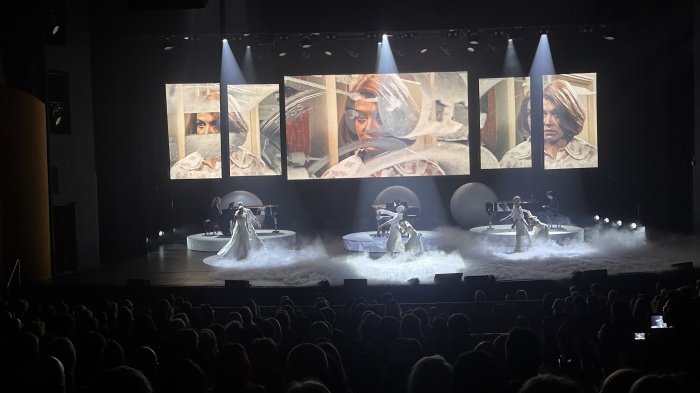
Festival opening. Photo: Roman Bondarchuk
Last year, the festival welcomed more than 1,800 film industry professionals and journalists from around the world, while total attendance reached almost 95,000. At the same time, it retains a remarkably warm and cosy atmosphere. I don't know how they manage it. Even the opening gala features theatrical performances, and you get to see the Estonian and Baltic film communities, along with guests from other countries, dressed in almost carnival-like black outfits to play on the festival's name.
The festival is also full of behind-the-scenes activities that don't appear in the programme but that you discover once you're there. For example, at the hotel where most participants stay, a separate table is set aside for documentary filmmakers, so that everyone working in documentary film can spot one another, get acquainted and make connections over breakfast. For a festival of this scale, it's an exceptionally good and important idea.
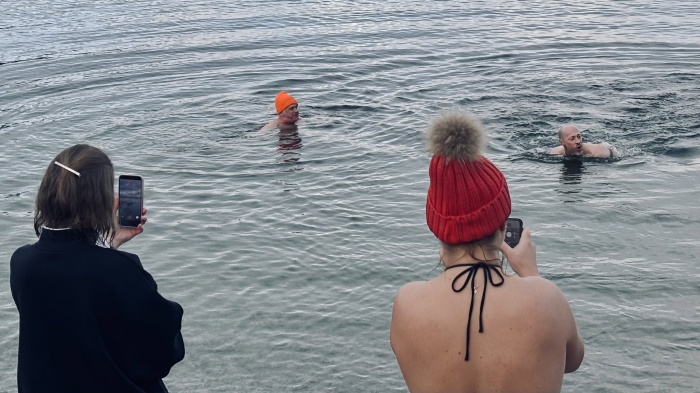
Winter swimming. Photo: From Uldis Cekulis’s Facebook page
The festival also has a tradition of winter swimming, which began during the COVID-19 pandemic. Every other day, guests are taken by a comfortable bus from the hotel to a small sauna village for a swim. They are advised to go into the water without warming up beforehand, although those who feel apprehensive or want to warm up first can visit the sauna. A medical professional accompanies the group to make sure nobody feels unwell and advises against putting your head underwater: you should keep it warm at all times.
Award-Winning Films in the International Documentary Competition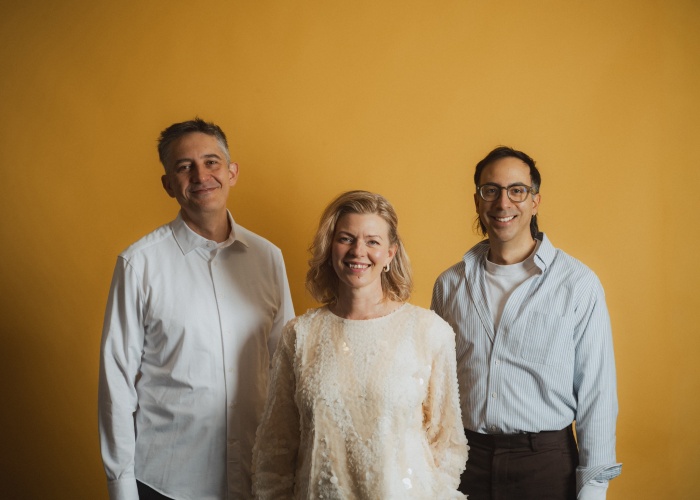
Roman Bondarchuk and the International Documentary Jury of the Black Nights Film Festival
Together with my two fellow jury members — Israel Bañuelos Loreto from Mexico and Karin Pennanen from Finland — I watched 11 films from countries around the world and selected three for awards. We presented the Best Film Award in the International Documentary Competition, a Special Mention and the Best Cinematography Award.
We chose Kaspar Astrup Schröder's The War We Carry as the best film. It was shot in Myanmar, formerly Burma, and tells the story of a family trying to go about their lives amid a civil war. Incidentally, the military junta in this conflict is supported by Russia and China. It is a remarkably subtle, attentive and sustained observational film. At first, the family is simply looking for somewhere they can live in peace, grow vegetables and enjoy a relatively quiet life. But the bombing intensifies, forcing them to move several times; the school closes, and the father decides to join the resistance. At this point, the film's observational approach develops into an epic story. It opens our eyes to how ordinary people choose to fight the junta, enter an unequal struggle, and yet continue to believe in victory and in a future for their children in this country.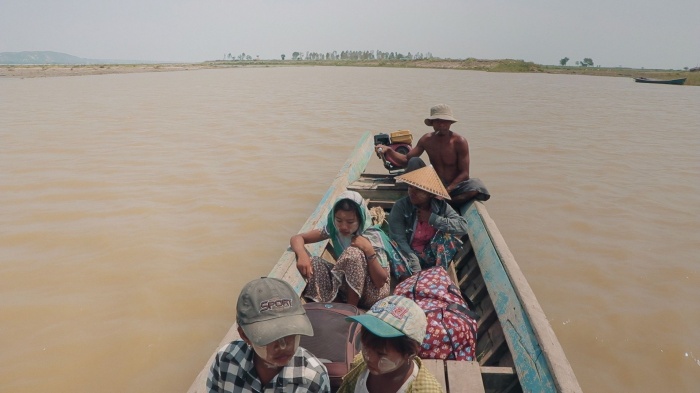
A still from the film Father's House
We gave the Special Mention to the Danish film Father's House by Eva Mulvad, Andreas Koefoed and Adam Nielsen, about a religious sect of the same name. It is a highly accomplished and inventive film, using dramatic reenactments so effectively that at times you simply forget you're watching a documentary. But these reenactments are directed by former members of the sect who managed to escape. The story unfolds gradually, revealing one method after another that the sect used to control its members: how it rewarded them, kept them in fear and humiliated them. These are universal methods that can be used to manipulate people not only within a sect, but across entire countries. Most astonishingly, the sect is still active, and its leaders are alive and well, continuing to recruit new members. They have, however, relocated from Denmark to the Czech Republic.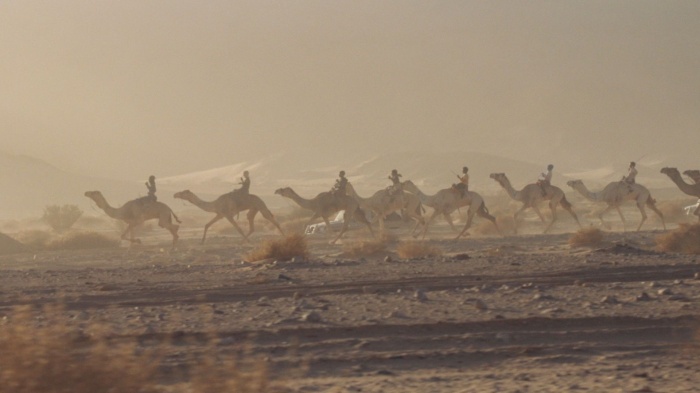
A still from the film Child of Sinai
The Best Cinematography Award went to Child of Sinai by French director Loup Bureau. The film follows nine-year-old Bedouin boys from Egypt's Sinai Desert whose poor families send them away to train as camel jockeys. Only boys are chosen for this role because the lighter the jockey, the faster the camel can run. The entire skill is needed for races held once a year in the desert. It is an extraordinary, epic spectacle involving enormous risks. The camels race across rocky terrain, while jeeps carrying spectators drive between them, followed by the jockeys, who fire shots to scare the camels into running faster. All of this unfolds amid clouds of dust and a desert of breathtaking beauty. Of all the films we watched, this was undoubtedly the most visually striking in terms of cinematography.
Ukrainian Cinema at the Festival
I'm pleased with how Ukraine has been represented in Tallinn this year. What's more, many Ukrainians are volunteering at the festival, helping with its organisation and getting the opportunity to watch films.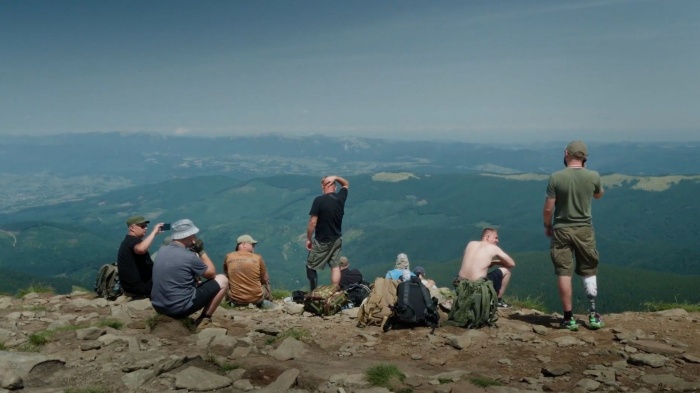
A still from the film Living On
The first film about Ukraine I saw here was Living On by Lithuanian director Nerijus Milerius. It follows wounded veterans. The director stayed close to them, documenting their experiences as they underwent surgery, recovered and learned to live in their new bodies. It is an extremely difficult experience to witness, but an essential one if we are to understand, even partially, how much courage these people need. And, without a doubt, films like this deserve to be heard as loudly as possible at international festivals and platforms, so that audiences abroad understand the price Ukraine is paying to hold back Russia's onslaught and see the individual people behind this struggle.
I also attended a screening of To Die To Live by Yuliya Hontaruk. Afterwards, the audience gave the film a standing ovation that lasted several minutes. Yuliya had come with the film's protagonists — volunteer veterans — and the post-screening discussion was truly special. The guests were welcomed with great warmth, and you could feel an extraordinary sense of support and affection for these stories.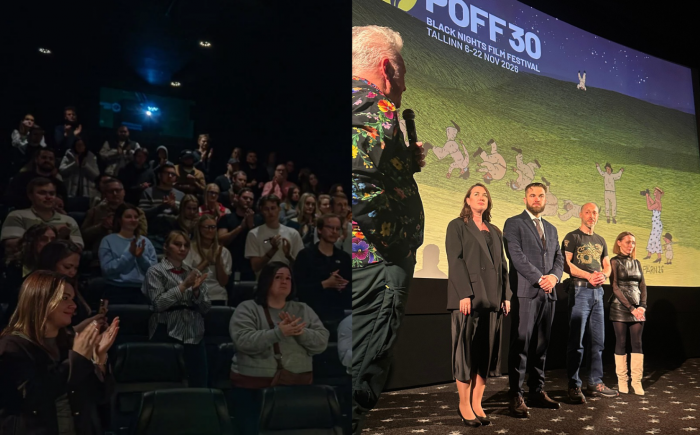
Screening of To Die To Live. Photos: Uldis Sekulis’s Facebook page and Roman Bondarchuk
I also watched Before Dawn, a short fiction film by Yuliya Haleta, which was part of the PÖFF Shorts New Talents competition. It is a very accomplished Ukrainian film, built around a strong concept and both cleverly conceived and executed. It, too, received a tremendous round of applause after the screening.
Meeting the Ukrainian Diaspora
I met some very interesting people in Tallinn who work at the Ukrainian Cultural Centre. I was particularly impressed by the artist Anatoliy Liutiuk, a Ukrainian-Estonian artist [Editor's note: the protagonist of the documentary film Tales of a Toy Horse by Uliana Osovska and Denys Strashnyy]. He founded the Ukrainian Cultural Centre and a parish of the Ukrainian Greek Catholic Church. The place is essentially Anatoliy's own kingdom. Anatoliy has built a nativity scene where he tells instructive stories for children and adults — an enormous moving metal installation in the garden, featuring angels, hell, moral tales drawn from everyday life, saints and animals. It is fascinating to see, even as an adult.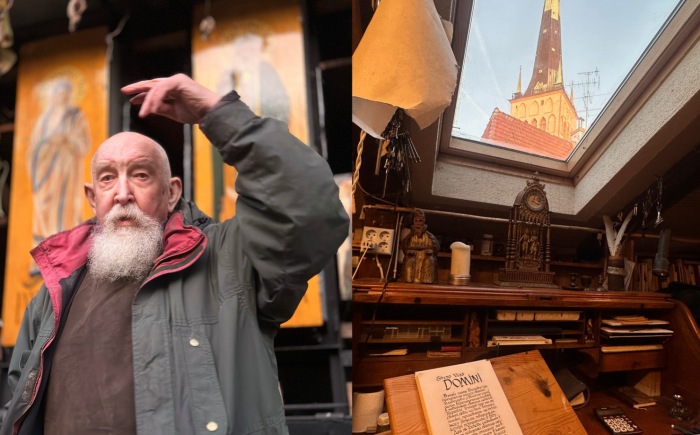
Anatoliy Lyutyuk and his space. Photo: Roman Bondarchuk
Anatoliy also runs a paper-making workshop, owns printing presses and publishes books. He works with the children of Ukrainian refugees, using play to explain how life works and how to cope with everything happening back home. Together, they are creating a book in which children are invited to draw their homes as they imagine them after returning. The houses they come up with are extraordinary: robot houses, underwater houses, houses with ears to hear the Russians approaching and react accordingly. Anatoliy also has an exercise in which the children reflect on what they would take with them from Estonia once the war is over. This, too, offers a fascinating insight into what they have gained in this country and how they are growing here.
In other words, the Ukrainian Cultural Centre is a kind of ark: a place where the stove is always burning, activities are held, books and postcards are printed, and children learn about art and life while healing together.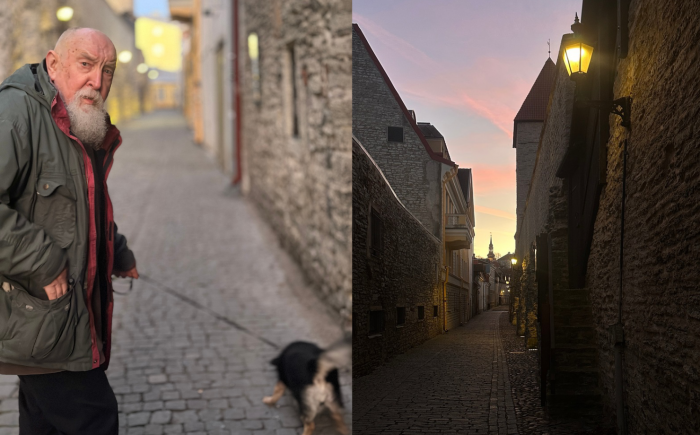
Strolling through the streets of Tallinn with Anatoliy. Photo: Roman Bondarchuk
How Should We Respond to Russian Films at International Festivals?
This year, the Black Nights programme included Three Comrades, directed by a Russian filmmaker who emigrated to France. The film tells the supposed story of friendship between her Russian son and two Ukrainian teenage boys who fled to France to escape the war. I was outraged both by the film itself and by the festival's decision to select it. I believe that until Russia pays reparations to Ukraine, Russians should not be given a platform to speak, create or promote their art internationally — let alone raise the issue of reconciliation between Ukrainians and Russians.
We discussed the film with members of the Ukrainian diaspora in Tallinn, including refugees who had also seen it. They told us that last year, a film made by Russians, or at least sympathetic towards them, had also been screened there, prompting the diaspora to organise a public protest. But these actions only drew more attention to the film, and viewers queued up to see it. So this year, everyone agreed: the best thing to do was simply not to publicise the film. And indeed, even its evening screening — the world premiere — failed to fill the auditorium. Overall, the film is very poorly made, so I'm confident we won't be hearing much more about it.
A Brief Look at the Films in the Competition
Overall, I'd say the programme was quite diverse.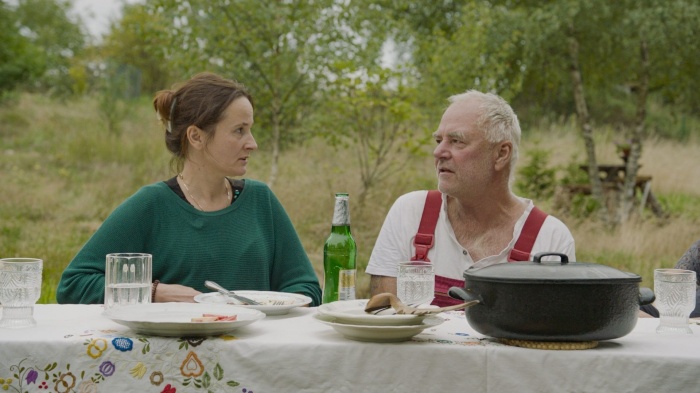
A still from the film Love Exposed
There was a Czech film, Love Exposed by Filip Remunda, a personal story about a woman who works as a film editor and tries to edit a film about her relationship with her father, who left the family when she was still a little girl. The editing process itself is woven into the fabric of the film, making it an intimate family story about reconciliation.
The Finnish film Fruitcakes: Dawn of Drag by Vesa Kuosmanen tells the story of the pioneers of the drag queen movement, who effectively risked their freedom because LGBT communities were criminalised at the time. Ultimately, the film explores how a younger generation is trying to reconstruct that era: they once again rent the club in Helsinki where drag shows were held back then, while also recounting the history of Finland and tracing the journey from the criminalisation of drag shows to the present day.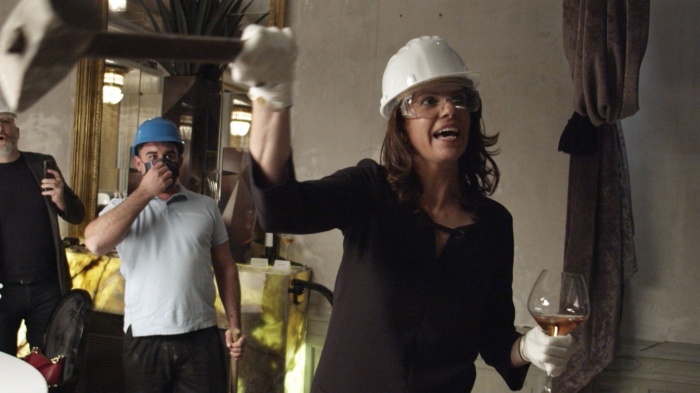
A still from the film Taste of Democracy
The Hungarian film Taste of Democracy by Péter Akar and Ambrus Fatér is about a two-Michelin-star restaurant whose owner's daughter decides to transform it into something more contemporary. The film follows the transition from a renowned, established restaurant to an experimental restaurant-theatre where chefs take part in all the decision-making. But I had the feeling that the owners themselves could have commissioned exactly this kind of film. In other words, when it comes to the question of what democracy actually tastes like, the film offers no answer.
The Azerbaijani film Birthday Candles by Murad Allahverdi follows blind veterans who lost their sight in the war with Armenia. However, the film provides very little context about the conflict itself. Instead, it focuses on one of the protagonists, who hopes to regain his sight using new technologies developed by Elon Musk that involve implanting electronic devices.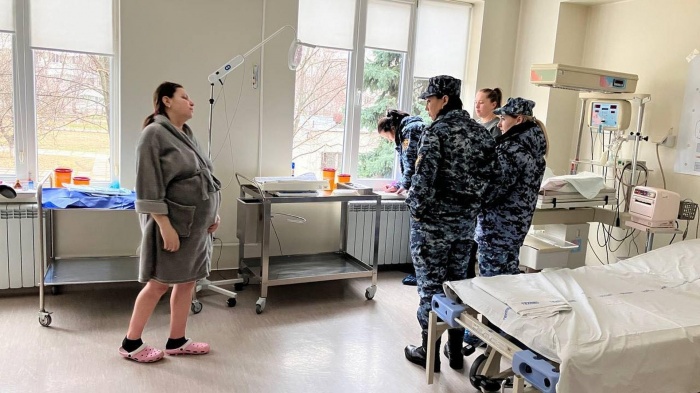
A still from the film Sentenced at Birth
The Moldovan film Sentenced at Birth by Daniela Miron and Diana Vlas is about mothers who ended up in prison with their children. It follows the women after they have served their sentences and been released, as they try, not always successfully, to rebuild normal lives. Moldova, essentially, does very little to support young mothers and children living in poverty.
The Romanian film Lost and Found: Thirty Years, Not Together by Laurențiu Garofeanu tells the story of a woman from North America who knows she was adopted and is trying to find her biological mother. She eventually locates her in Romania and travels there to meet her Romanian family. She arrives in a rather remote, unfamiliar village, where twelve people sleep in a single room. Gradually, she discovers that in the 1990s and early 2000s, selling children for adoption was a widespread practice in Romania. She also learns that she has a sister and devotes herself entirely to finding her, trying to discover where her sister was sent and which country she lives in now.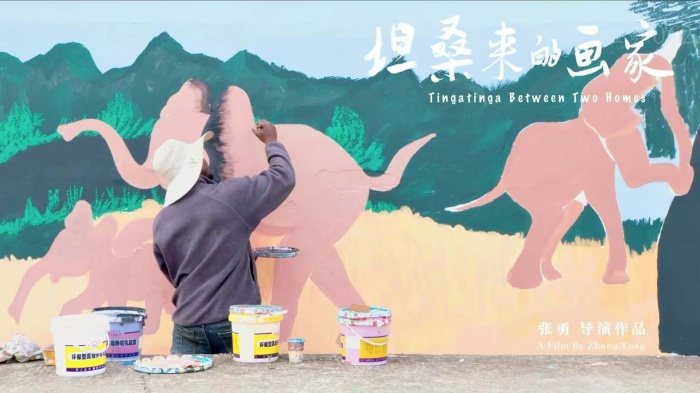
A still from the film Tingatinga Between Two Homes
Finally, there was Tingatinga Between Two Homes by Yun Zhang, about a Tanzanian artist who paints in the traditional Tingatinga naive art style. The film revolves around the artist's dilemma: whether to stay in his native Tanzania or go to China to earn a living. In this way, the themes of artistic and personal choice become intertwined.
Main photo: Roman Bondarchuk as a member of the International Documentary Jury at the opening ceremony of the Black Nights Film Festival.