The war launched by Russia has forced us to look at ourselves and our country differently. We have begun to free ourselves from an imposed external perspective and look more closely at the stories of our families, cities and the places to which we are connected, to reflect on how they have shaped us into who we are, and to redefine and embrace them in all their complexity.
Why is decolonisation about more than monuments and place names, and is rejecting imperial and Soviet narratives enough to see what is ours? How does engaging with local memory and history restore agency to communities, and how can this work be approached when it concerns temporarily occupied territories or combat zones? What is changing in Ukraine’s decolonial discourse today, and how is it becoming a living process of creating society?
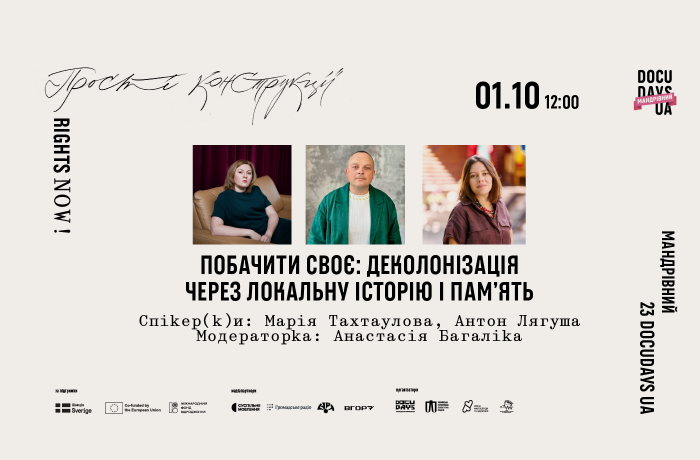
We will discuss this on 1 October at 12:00 p.m. during an online discussion in the RIGHTS NOW! human rights programme, which will open the 23rd Travelling Docudays UA.
Speakers:
Mariia Takhtaulova, historian, PhD, co-ordinator of the Kharkiv Toponymics Group, and Head of Department at the Ukrainian Institute of National Memory;
Anton Liagusha, Academic Director of the Master’s Programme in Memory Studies and Public History at the Kyiv School of Economics.
The discussion will be moderated by Anastasiia Bahalika, Director of the Human Rights Department at Docudays NGO and a journalist.
Join the live stream on the Travelling Docudays UA and RIGHTS NOW! Facebook pages and ask the speakers questions in the comments.
The 23rd Travelling Docudays UA is held with the financial support of the European Union, the Embassy of Sweden in Ukraine and the International Renaissance Foundation. The opinions, conclusions or recommendations expressed do not necessarily reflect the views of the European Union, the governments or charitable organisations of these countries. Responsibility for the content of this publication lies solely with its authors.