This fall, the Docudays UA team embarked on a trip to see how documentary films (sometimes the same ones) are watched and discussed in different corners of Ukraine. Docudays UA website editor Kseniia Opria attended screenings in Zaporizhzhia and Dnipro, Oleksandra Berezovska visited Uzhhorod, Traveling Docudays UA and Human Rights Department communications manager Valeriya Sheremet went to Poltava and Ternopil, and DOCU/CLUB Network coordinator Lina Babych saw the festival opening in Lviv. Check out the puzzle of travel notes and photos we’ve assembled.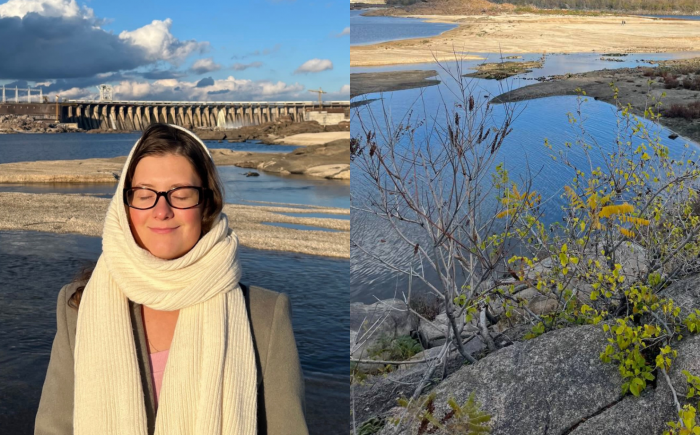
Zaporizhzhia, Kseniia Opria at screenings of Rogier Kappers’ Glass — My Unfulfilled Life and Nathan Fegan’s Inside, The Valley Sings
“One of the viewers shared before the screening: ‘I’ve already watched this film three times, and my friend has too, but we came again.’ These words became the motto of our journey, highlighting how strongly people want to watch films and be physically present, side-by-side, rather than online. Especially in regions where electricity is only available three hours a day, and cultural events are rare. This is not just a thirst for cinema — it’s a mix of scarcity and passion. A year ago, I moved to Zaporizhzhia and felt this firsthand — such events and meetings seemed ordinary in the capital, but here, I wait for them for months, and they are worth a treasure beyond measure.
All together, we watched the autobiographical film about dreams and perseverance, Glass — My Unfulfilled Life, by the charismatic Dutch filmmaker Rogier Kappers, and spent over an hour after the screening sharing stories about ourselves and our friends — some discovered their singing talent at 80, others, living in a Russified industrial city, began giving inspired lectures on Ukrainian poetry.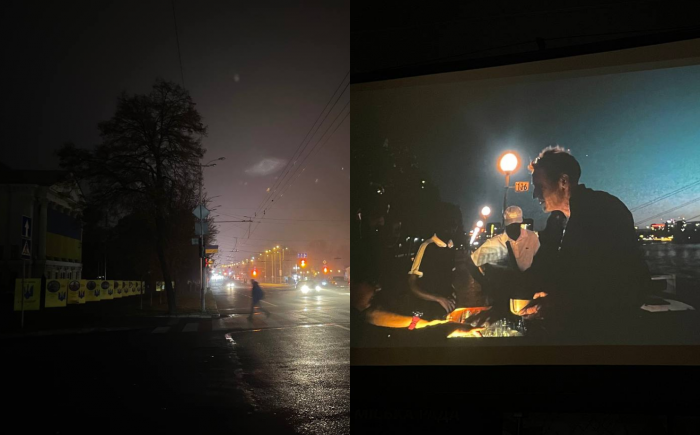
Evening in Zaporizhzhia and the screening of Glass — My Unfulfilled Life. Photo: Kseniia Opria
The next day, three times as many people gathered. We watched a heavy film portraying the experience of people in solitary confinement in the United States. Inside, The Valley Sings was a deeply touching moment, where older viewers, military personnel and their relatives, and young activists exchanged thoughts and stories about a topic often considered taboo — prisons, punishment for crimes, and treatment of prisoners. The film also reminded us of the captivity of civilians and soldiers not across the ocean, but very close, in our present reality. To support those who returned from Russian captivity, Docudays UA together with the Principle of Hope Charitable Foundation organised a fundraising initiative for rehabilitation and recovery.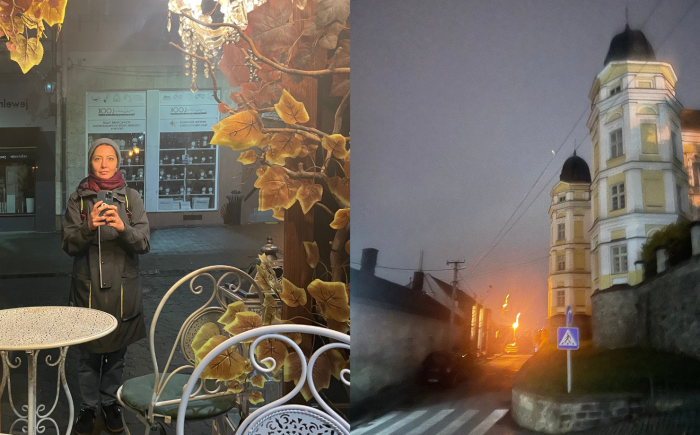
Uzhhorod, Oleksandra Berezovska at screenings of Kevin Macdonald & Ruhi Hamid’s Last Song from Kabul and Rogier Kappers’ Glass — My Unfulfilled Life
Uzhhorod is perhaps the only city in Ukraine where the war is felt differently. There is no curfew here, but air raid alerts, of course, still happen. There are also many who dared to leave their homes when another shell exploded near their building or fragments of a rocket got stuck in their yard. People went to places where they could breathe. The Zakarpattia regional centre is noticeably changing in its urban landscape due to the number of people seeking, even if temporary, shelter here.
My first stop during the Traveling festival was the Transcarpathian Academy of Arts — an atmospheric place where creativity fills every square meter, nurturing the courage to see things differently and not be afraid to declare it.
The screening room fills with students. I immediately notice that some have come of their own accord, while others are here at the request of their teachers. But after the first minutes of Kevin Macdonald and Ruhi Hamid’s Last Song from Kabul, those who planned to leave as soon as the lights dimmed decided to stay.
Then I hear sobs and heavy breaths… The story of a girls’ music group fleeing the dictatorial regime in Kabul to Portugal, to pursue their passion and live freely, strikes a chord. In the audience are people who have escaped Russian aggression from their hometowns of Kharkiv, Kherson, Irpin, Mykolaiv, and Mariupol.
When coordinator Mariya asks how the students interpret the concept of a “rare resource” (the chosen theme of the 22nd festival), the first answer comes: “It’s time.” For each of those present, it is the time lost to war — but time they want to reclaim, using every opportunity to keep living. Under any circumstances.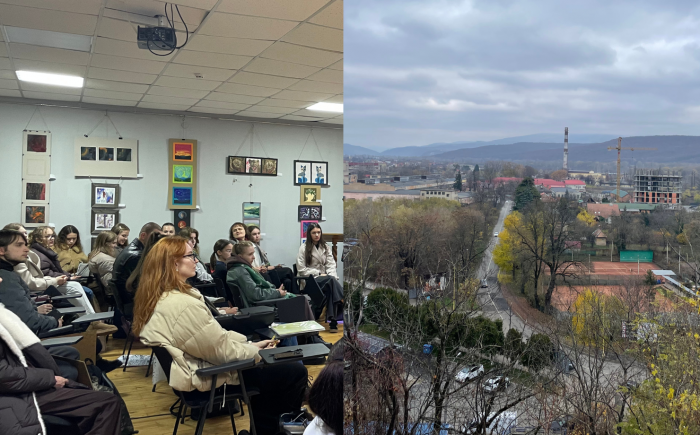
Traveling festival viewers in Uzhhorod, along with city landscapes. Photo: Oleksandra Berezovska
The second stop in Uzhhorod was a local veteran hub, with a completely different atmosphere. Any attention is appreciated by the veterans here, but the space has its own language, mood, and norms. The coordinators tried to engage the military community with the film Glass — My Unfulfilled Life by Dutch director Rogier Kappers. By the middle of the screening, only two captivated viewers remained in the room. They watched and later spoke about their own… unfulfilled lives, the war that changed everything, lost friends, and hopes. Yet they also reflected on the opportunities that remain as long as you are alive.
What certainly delighted the Uzhhorod veterans was discovering the EarCatch app, which allows viewers with visual impairments to watch films with audio description. Everyone tried experimenting with the app and was impressed.
So, mission accomplished, with results and feedback, even though many challenges still remain…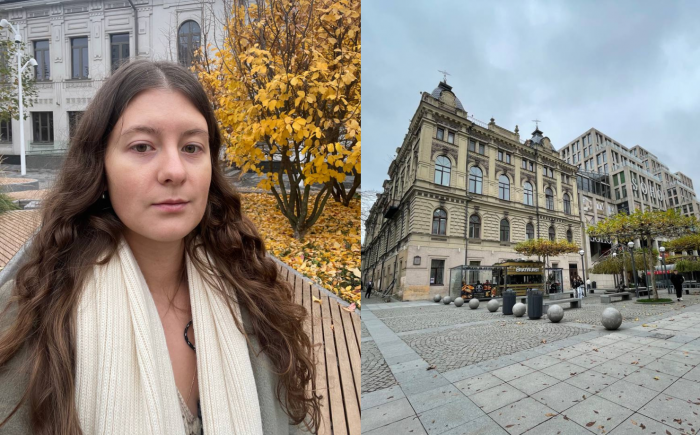
Dnipro, Kseniya Opria at the screening of Daria Penkova’s Where's My Body Armor?
From Zaporizhzhia, I caught the morning train to Dnipro to see the city and attend a Traveling festival event. A blackout-struck metropolis, often under missile attacks, yet alive and developing thanks to tireless and inventive people. Before the screening began, I managed to ride the tram through the central streets, walk around, admire century-old buildings, marvel at the modernist synagogue, get lost for a few hours in the exhibitions of the Center for Contemporary Art, and charge my phone at McDonald’s. In the cozy Ukrainian Diaspora Library, a community of displaced persons had gathered, and the regional festival coordinator in Dnipro, Hryhoriy Kurachytskyi, introduced me to the library staff and shared his story:
“As head of the NGO ‘Pryazovska Human Rights Group’, I joined Docudays UA in 2015. My first screening was in a women’s prison. At that time, I was filming an amateur film, the war was just beginning, and Mariupol had not yet been occupied. I called my work About People’s Rights Under the Guns, filming trains and all my screenings. I submitted it to the festival — colleagues didn’t include it in the program but gave me lots of advice on filmmaking. Since then, for 10 years, I’ve been organising the Traveling festival in Mariupol, and since 2022, here in Dnipro. We continue working. Docudays UA is our inspiration and form of communication.”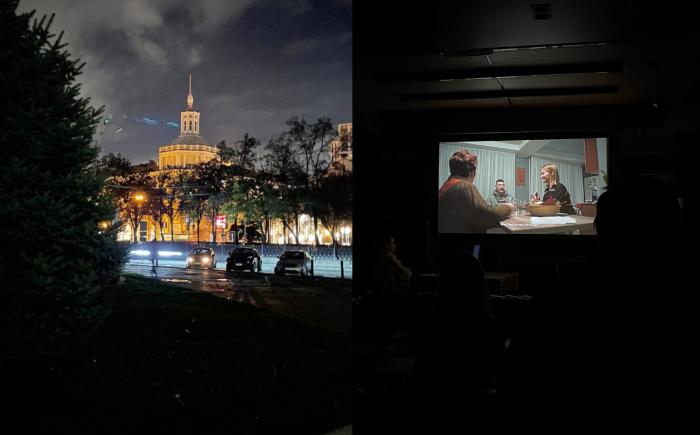
Blackout in Dnipro and screening of Where’s My Body Armor? Photo: Kseniya Opria
At this screening, I mostly listened rather than spoke. Watching Daria Penkova’s short film Where’s My Body Armor? together, we had the chance to talk with the director online. Discussions covered the film’s creation, the military community, and the life of the heroes post-filming — yet the red thread was personal memories of their native region:
“When I saw the Kramatorsk train station in the film, my heart sank. I know it doesn’t look the same; so many have died there. Remembering the Donetsk region, it gets sad again. But, you know, Mariupol isn’t buildings — it’s people. When we gather together, our city comes alive,” commented Viktoriya Lysohor, director of the Korolenko Central Library in Mariupol, where the festival’s screenings were held pre-invasion.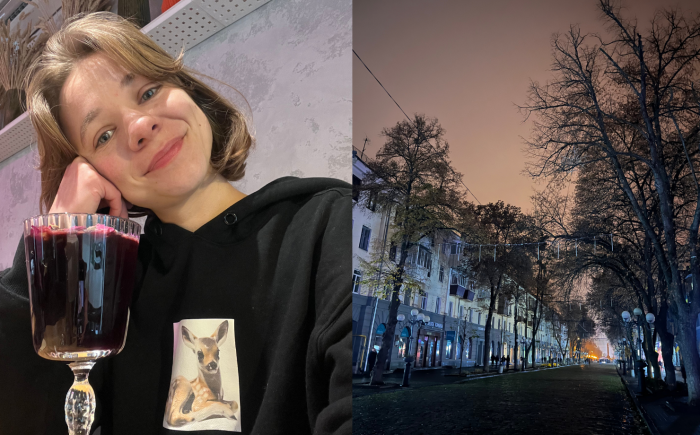
Poltava, Valeriya Sheremet at screenings of Antonio Lukich’s How I Spent My Summer Holidays and Kevin Macdonald & Ruhi Hamid’s Last Song from Kabul
This time, the Traveling festival in Poltava was the most inclusive ever. It began years ago with a viewer who lost her sight as an adult and could only visualise films she remembered from childhood:
“Thanks to audio description, I truly saw a film for the first time in thirty years.” Her words inspired the regional coordinator Olena Burim not to be afraid to work with diverse audiences and to experiment — and I wanted to attend at least one of the events. I’ll tell you about the one that touched me the most.
It was a screening of two documentaries for people with hearing impairments: one we watched only with descriptive subtitles, and the other, at the suggestion of UTOG, additionally with live sign language interpretation. For most of them, it was their native mode of communication.
I tried to focus more on what I saw, and then compared my personal observations with the thoughts of the audience, who were also experts in the field. And yes, if Antonio Lukich’s short film How I Spent My Summer Holidays was fully accessible in its format, during the screening of Last Song from Kabul by Kevin Macdonald and Ruhi Hamid, no one, myself included, could take their eyes off the interpreter: she was conveying the mood created by the music, its tone and rhythm, reproducing the playing of various instruments when the melody was offscreen — all of which complemented the subtitles and helped the audience fully immerse themselves. So we gained invaluable experience!
The discussion was rich and heartfelt; both stories sent shivers down our spines. We reflected on how our children have changed because of the war and on childhood in Ukraine as such, shared feelings of pride and a sense of responsibility for their future, spoke about the pain of loss, the cost of freedom, and the desire above all to be oneself. And also about the sense of community and mutual support that pervaded the screening — something that is so important today.
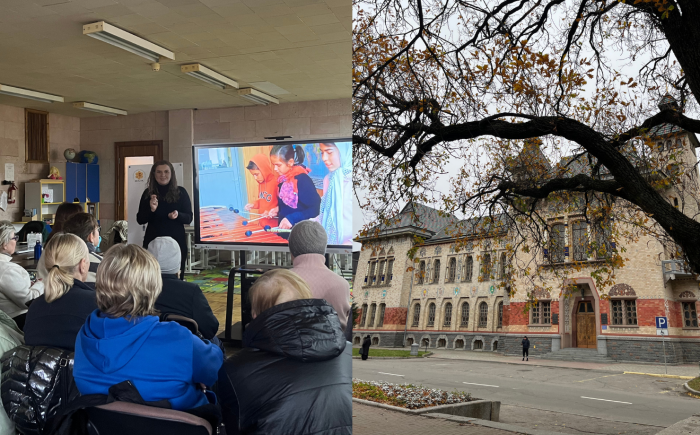
Screenings with sign language interpretation and facade of Poltava Local History Museum. Photo: Valeriya Sheremet
“Often, our people don’t even realise that many things, like cinema, can be accessible to them. They are held back by childhood stereotypes, habits, doubts. Events like these break those stereotypes and allow them to step beyond their usual boundaries,” a viewer of the Traveling Festival noted.
And not only for people from vulnerable groups, but for our entire society.
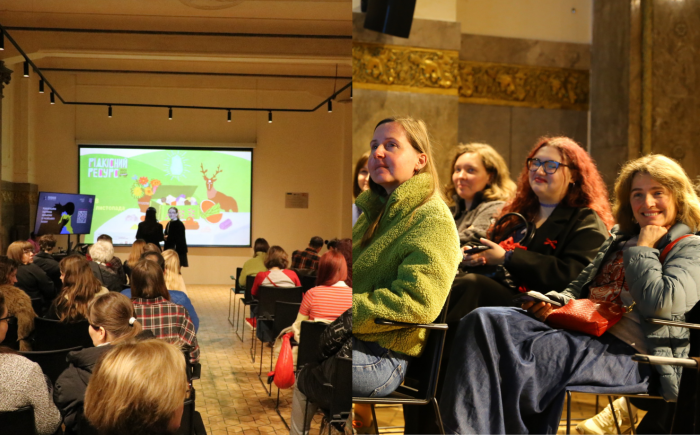
Lviv, Lina Babych at the 22nd Traveling opening with Gar O’Rourke’s Sanatorium
The first event of the 22nd Traveling Docudays UA in Lviv took place at the Lviv Cultural Hub — an exceptionally cozy and beautiful space that immediately creates an atmosphere of trust and engaging time spent.
About fifty viewers attended the screening, from students to older adults. We watched a film about the Kuyalnyk sanatorium in Odesa through the eyes of an Irish director, and it left a strong impression: many admitted they had not expected documentary cinema to be so captivating, emotional, and visually expressive.
Although slightly fewer people stayed for the discussion afterward, the conversation was incredibly lively and meaningful. Participants didn’t want to leave for a long time, asking the director Gar O’Rourke and Ukrainian fixer Serhiy Solodko, who joined online, numerous questions. Viewers were curious why a Ukrainian sanatorium became the subject of the film, how the team worked during the war, how the protagonists were chosen, and what the secret of documentary cinema is that holds attention from beginning to end. It was a warm, sincere, and truly special evening that inspires continued work.
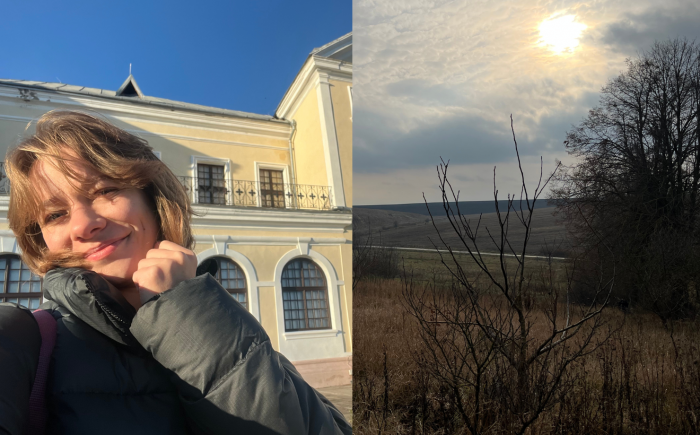
Epilogue. Ternopil region, Valeriya Sheremet in the Docudays UA park with a memorial tree for our incredible colleague
“This tree, guess whose? No? Then you didn’t watch the video closely. It belongs to Mrs. Alla Mykolaivna Tiutiunnyk.”
This is how my acquaintance with the Docudays UA park began. Not from films or stories, but in reality. Here it is — right before your eyes and under your feet. The park grows in Dubivtsi, Ternopil region, the small homeland of the Traveling festival coordinator, film producer, and civic activist Volodymyr Khanas, among gentle hills and endless fields, just behind his family estate. Every autumn during the festival, a communal cleanup is held here to care for the trees before winter and plant new ones. Some are still very young, almost lost in the grass, while others have been bearing fruit for several years. But each has a story to tell.
“Step carefully, here’s last year’s hazelnut from a festival colleague from the region, Oleksandr Stepanenko,” Mr. Volodymyr introduces as we pass by, “Nuts from Inha Dudnik, coordinator from Kropyvnytskyi, probably since 2017.”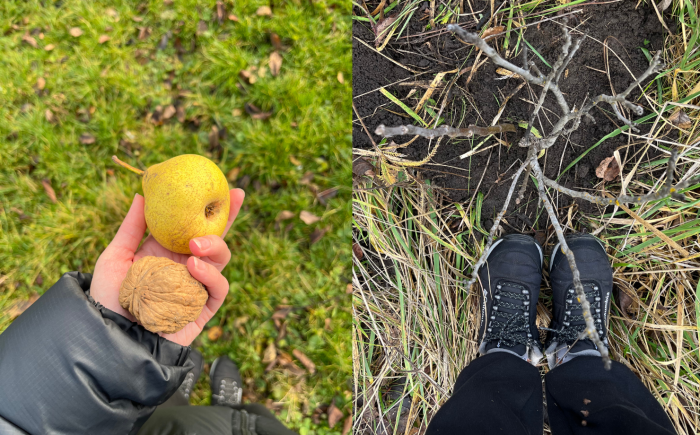
Fruits, nuts, and seedlings of the Docudays UA park in Dubivtsi. Photo: Valeriya Sheremet
Here are trees planted in memory of the coordinator from Kryvyi Rih, ecologist and human rights defender Mykola Korobko; film editor and serviceman Viktor Onysko; reserved spots for memorial trees for Taras and Olia Melster — also military Docudays participants; and trees planted by one of the local co-organisers, defender Vasyl Kapustynskyi. On this day, we added a memorial tree for another wonderful person who became an integral part of Docudays — long-time Traveling Network and Docudays UA film club coordinator Tetiana Kulyk, whose life was suddenly cut short on July 29, 2025, and to whom we dedicated this festival.
“A tree is a symbol of life, of all that Tania had in abundance — love, warmth, inner strength. She always asked how our park was growing, whether the new saplings had taken root. We even dreamed that one day we’d hold an offsite seminar for regional coordinators and organise a big communal cleanup… Today we plant a tree in her memory. From a Christian perspective, she and Vitia and everyone else met in heaven, and from a Druid perspective — they are already sprouting.”
Now this walnut will grow and remind us of the light that Tanya so generously shared with everyone, of her laughter, jokes, advice, her inexhaustible energy and care.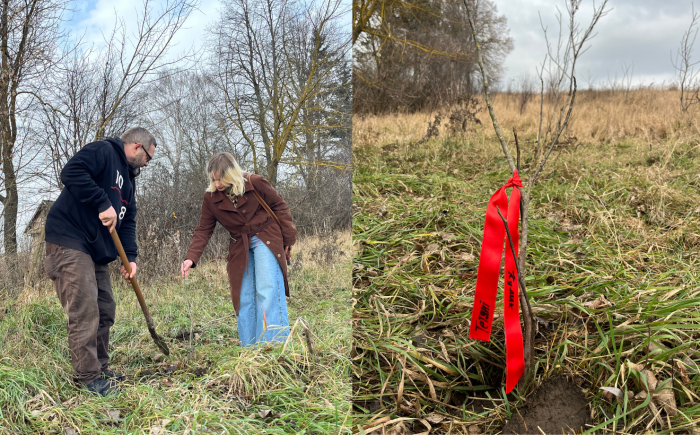
The memory tree of Tetiana Kulyk. Photo: Valeriya Sheremet
The 22nd Traveling Docudays UA was held with financial support from the European Union, the Embassy of Sweden in Ukraine, and International Media Support. The opinions, conclusions, or recommendations do not necessarily reflect the views of the European Union, governments, or charitable organisations of these countries. Responsibility for the content of the publication lies solely with its authors.