For millions of Ukrainians, Russian occupation has changed from an unpredictable exceptional situation into an exhausting reality that has lasted for more than a decade in some areas. It brings an extreme everyday experience of survival under systematic control, psychological pressure and coercion, amid the threat of persecution and violence — and with an uncertain future.
What we can do today as a society is maintain our connection with them and a sense of togetherness despite isolation and distance, and try not to lose one another. This is what our Being Present information campaign is about.
Let us explain what we mean by these words and how we embodied the idea in a visual concept.
We launched the campaign in June during the 23rd Docudays UA International Human Rights Documentary Film Festival in Kyiv and are continuing to develop it during the Travelling Festival, and later in the Docudays UA film clubs. It is a conversation on two levels at once: the personal level through documentary film, which allows us to feel the experience and brings the issue closer; and the systemic level, drawing attention to the broader context, government policy, and legal and social frameworks.
The title itself encompasses these dimensions, because “presence” is both a state and an action. For people forced to remain under occupation, “being present” means being an integral part of the Ukrainian space, our thoughts, agenda, plans and decisions, now and after their return. For Ukraine, it means being present in the lives and circumstances of its people on the other side of the front line, hearing their voices and fighting for each and every one of them: evacuating them, bringing them back, helping them, protecting their rights at home and seeking justice internationally. It also means being present as witnesses, often invisible ones, of Russian crimes; and as participants in the resistance. It means reminding the whole world that Crimea, Donetsk, Luhansk, Oleshky, Henichesk, Berdiansk, and Mariupol are Ukraine: mentally, culturally and politically.
To move away from abstraction and generalisations and see people — what matters most behind the territories — we made the stories of Ukrainian women who survived occupation the cornerstone of the campaign’s entire visual concept and brought it vividly to life in an animated video. It is built around fragments of testimonies selected from the vast collection of interviews recorded by the War Archive team, mainly in the south of Ukraine, but also in the east and the de-occupied part of the Kyiv Region. All the voices are women’s, so the video creates a collective image of a seemingly ordinary woman with extraordinary courage and resilience.
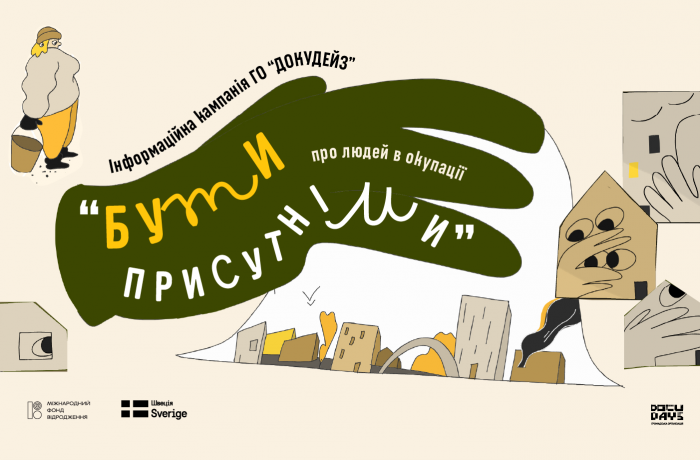
“Despite the atmosphere of fear described by the women interviewed, their stories were simply astonishing in their courage, ingenuity and capacity to come together and help one another. There were many moments of warmth, humour and absurdity that I tried to convey in the video. I deliberately decided not to depict the occupiers and to show their presence through giant boots, enormous hands covering the city like a dome, or eyes trying to ‘scan’ homes with their gaze. It seemed to me that this would convey the atmosphere of occupation more effectively, because it is something that permeates the air and the ground, as though it were present everywhere. By focusing on the details of these stories, I wanted to create a sense of presence for viewers, so that people under occupation would not be forgotten,” says animator and director Olha Makarchuk, describing the visual concept.
We also transferred the video’s key images to the campaign’s graphic elements, so that a sense of presence and empathy would accompany every piece about the lives and rights of Ukrainians in the temporarily occupied territories, or those who managed to leave. The poster and the entire visual design were created by designer Dasha Podoltseva.
On the Facebook and Instagram pages of RIGHTS NOW!, the Docudays UA human rights programme, we will publish interviews, informational and analytical materials on the subject of occupation together with partner civil society organisations and media outlets, and share news about the campaign and nationwide events. The schedule of screenings and discussions taking place this autumn as part of the 23rd Travelling Docudays UA in cities and villages across 19 regions of Ukraine can be found on the Festival’s website and social media pages.
The campaign is implemented with the financial support of the International Renaissance Foundation and the Embassy of Sweden in Ukraine. The opinions, conclusions or recommendations expressed do not necessarily reflect the views of the governments, charitable organisations or companies of these countries. Responsibility for the content of this publication lies solely with its authors.