The free democratic world that Ukraine has long aspired to is now facing serious challenges: the rules no longer seem unshakable, and values increasingly require protection. How are today’s crises changing the balance of power? And what can Ukraine and its experience of fighting for freedom offer to the world?
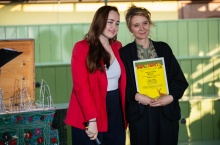
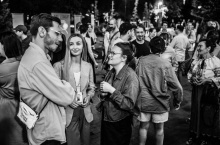
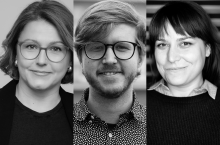
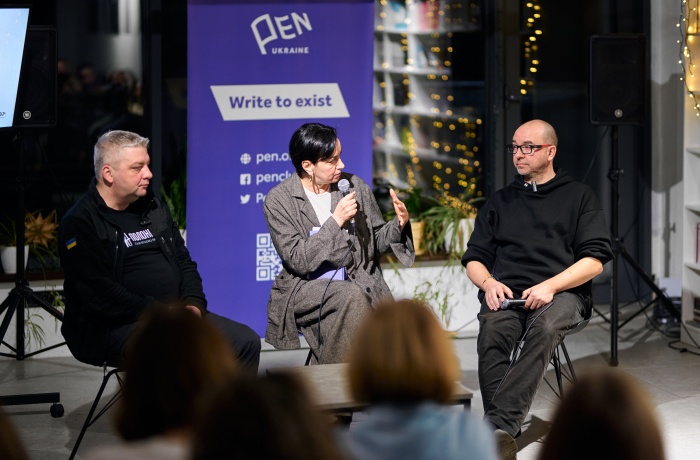
We have saved on DOCUSPACE a recording of the discussion Rare Resources of Democracy: How to Defend the Free World? featuring Volodymyr Yermolenko, philosopher, writer, and publicist, President of Ukrainian PEN; and Maksym Butkevych, journalist, human rights defender, public figure, and veteran with experience of captivity. The event was held in early March in cooperation with Ukrainian PEN and moderated by journalist, documentary filmmaker, and TV presenter Myroslava Barchuk. We are also publishing a summary of the key points.
Watch the full open-access recording of the conversation in the DOCUSPACE online cinema via the link (in Ukrainian language).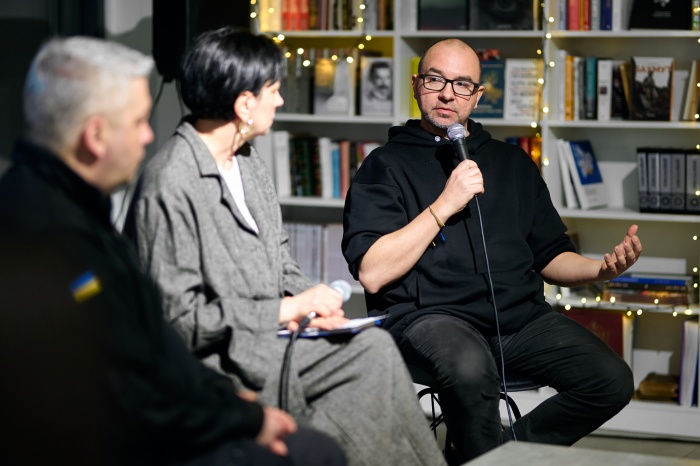
Volodymyr Yermolenko: For Ukrainians, it is crucial to understand that a fundamental revolution is now taking place: there is no longer a world we can align with as a point of gravity. Instead, this so-called free world is increasingly gravitating towards us. Those very forces, the great powers that were meant to stabilise the world, are becoming sources of its destabilisation. In this situation, the key is to preserve the point of gravity within ourselves and to become it ourselves.
Myroslava Barchuk: The night before, I had a dream that Donald Trump had registered for our event, but with the nuance that he wanted to sit on the main panel. And I thought, what an accurate metaphor for our conversation: how can we talk about values and democracy when, from the “main panel of the world”, we hear: “You have no cards”? How can we defend them when everything is decided so cynically, when we no longer know who carries these values, who belongs to the free world, and who is our enemy?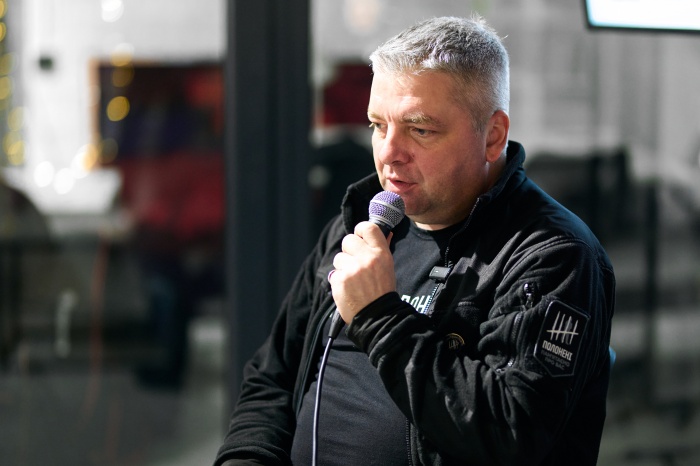
Maksym Butkevych: Our war is not being fought for territory or power, but for values, and we are showing that they truly matter, that they must not only be proclaimed, but also defended. It is important to recognise and sustain the sense that we share these values with so many peoples — above all in Europe, but far from exclusively here — and therefore, by defending them, we are in fact defending the values of people in many countries around the world. However, the point of departure lies with us. I see that more and more people abroad are beginning to understand this — and a different kind of solidarity is emerging: not with a victim, but with an ally; a sense that we are in the same boat, that this is our shared history.
Volodymyr Yermolenko: The most widespread emotion among our friends in the Western, European world is confusion, fear, and a sense of helplessness. And Ukraine’s great mission is to remind them that the free world is strong. We should not be afraid of this word. Strength does not mean violence, it means influence, authority, and the ability to act.
Over recent decades, the world has come to equate goodness with victimhood — when you do not defend yourself, when you are thrown into prison, when you are bombed. But goodness that is capable of defending itself evokes doubt. And this is a syndrome we must overcome, first and foremost through our own example — by beginning to reconceptualise what the “free world” actually is.
Volodymyr Yermolenko: The only effective way to resist tyrannies is through alliances of smaller countries, a federation that combines the internal strength of a republic with the external strength of a large political community. The European Union was partly built on this very logic, as an alternative between an empire and a small nation-state that can be easily crushed. And this idea can and should continue to evolve, perhaps in new configurations and alliances. It is a complex process, but it is our only chance to persevere.
Maksym Butkevych: War is almost always the worst time for democracy. It inevitably brings restrictions on a whole range of rights and freedoms that are considered fundamental, yet are not inviolable. At the same time, over the past four years Ukraine has somehow managed to restrain many of these limitations. We have not seen the kind of radical steps that, for instance, I expected while I was in captivity, and I was pleasantly surprised to see that problems are discussed openly and that this leads to consequences. It is crucial to preserve this, otherwise we risk losing the very foundations of our resistance — we will turn into a “small Russia” opposing a “big” one. And what would be the point of that?
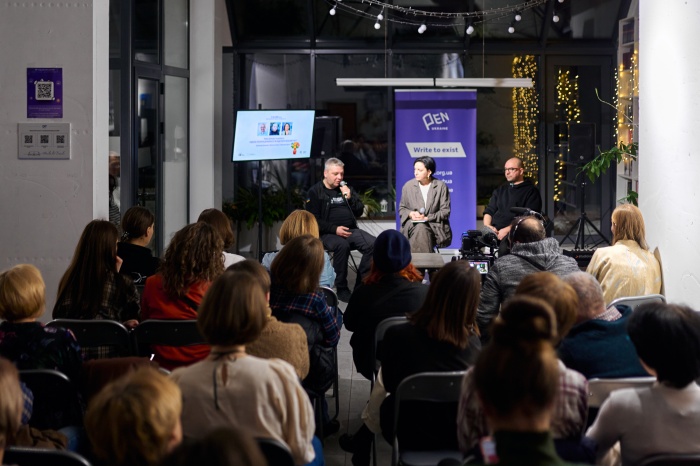
Volodymyr Yermolenko: One of the key feelings among Ukrainians today is a sense of fragility. We understand that life is fragile, that our country is fragile, and that both must be protected by any means. That freedom is a rare thing and must be fought for. By contrast, Western Europe has been shaped by the idea of surplus — an abundance of goods, freedom, social protection, democracy. And the realisation of their fragility is painful for many: a sense of countdown emerges, that tomorrow will be worse. This feeling is deeply destructive and, it seems, occurs more often among our colleagues than among us — even despite the war and real losses. In essence, Russia is trying to impose this feeling by destroying infrastructure and energy systems, plunging people into the emotion of constant loss. But if we give in to this emotion, we will collapse. That is why it is so important for us to stand our ground against this emotion.
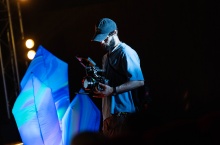
Photo credit: Stas Kartashov
The event was held with the financial support of the European Union and the Embassy of Sweden in Ukraine.