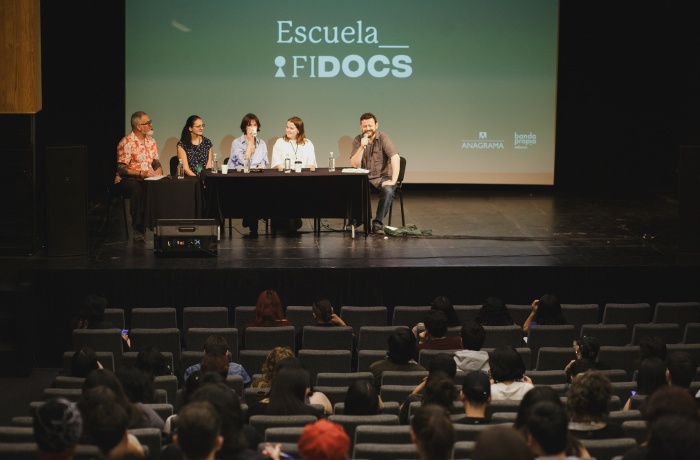
How did the Ukrainian delegation’s participation in Chile unfold? Read a piece by Yulia Kovalenko, Director of the Programming Department, about how a country on another continent, fourteen thousand kilometers from Ukraine, engages with documentary cinema about human rights and with the inseparable link between history and the present.
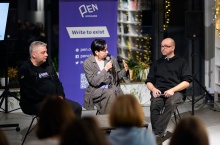
“We are currently in the middle of presidential elections; the atmosphere is full of uncertainty and fears of negative developments. That is why we would like to focus the panel discussion on the resilience of cultural spaces such as Docudays UA,” told me Constanza, the coordinator of the educational section Escuela at the Chilean festival FIDOCS, in her invitation to the event. The search for resilience increasingly seems to be a universal task in different corners of the world — even when thousands of kilometers of land and ocean separate us, we are very likely to find common ground in our experiences of living through upheaval in our respective countries.
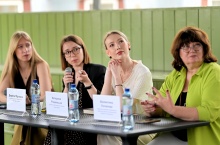
In November of last year, 2025, a Ukrainian focus took place in Santiago, the capital of Chile, at the 29th International Documentary Film Festival FIDOCS. This programme emerged as a continuation of the partnership between our festivals, which began back in early 2025. In June, our cooperation — supported by the International Renaissance Foundation — culminated in screenings of a selection of Chilean documentary films at the 22nd Docudays UA and a public discussion about the experiences of Chilean and Ukrainian documentary professionals in cultural diplomacy. A recording of that discussion can now be freely viewed on the docuspace platform.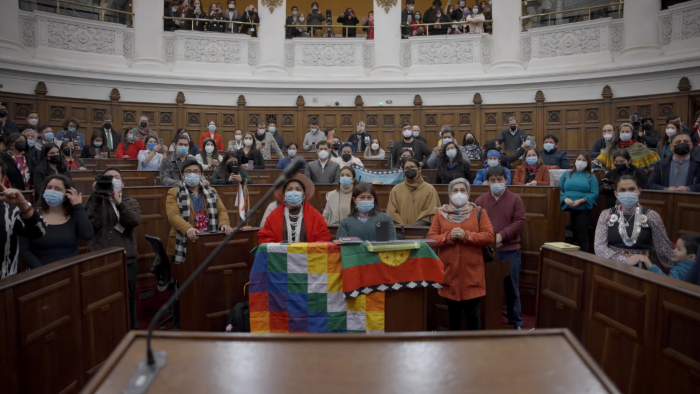
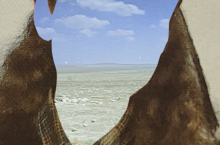
A still from the film Oasis
Although geographically distant from us, Chile has a traumatic experience of dictatorship just one generation behind it — an experience the country is still trying to process, including through cinema, and through that process to shape a vision of its future and of the state Chileans want to become. In some cases, quite literally so: since 2019, following mass street protests, the country finally decided to abandon the constitution that had been in force since the Pinochet era and thus plunged into a long and exhausting process of drafting a new foundational document. Since then, Chileans have gone to referendums several times with proposed new constitutions, and each time those proposals have failed. This topic was addressed in the film Oasis by the directing duo Tamara Uribe and Felipe Morgado, included in our non-competition programme Rare Resource. The film captures not so much political infighting as the deep societal debates that arose during work on the constitutional drafts. What kind of society do we want to live in? What unites us? How can the interests of all vulnerable groups be taken into account? How should we deal with a traumatic and uncomfortable past? Chile has much to share with us in the context of building and defending democracy.
All the more interesting, then, was the process of preparing the Ukrainian focus in Santiago together with our Chilean colleagues. The programme, titled Window Docudays UA, included three Ukrainian films that had participated in Docudays UA in different years: Militantropos by Liza Smith, Alina Gorlova, and Simon Mozghovyi, which opened the Ukrainian focus with a story about the fundamental changes our society is undergoing in the context of a full-scale war; Fragments of Ice by Mariya Stoyanova, which spoke to Chilean audiences in the most familiar and widespread language of their own national cinema — family archives; and 20 Days in Mariupol’s successor in spirit, 2000 Meters to Andriivka by Mstyslav Chernov, which concluded the Ukrainian screenings in Santiago at the very moment when our country was experiencing yet another massive missile attack.
Each screening was accompanied by an introduction delivered by our Docudays UA delegation — programmer Olia Sydorushkina, fundraiser Nastia Humeniuk, and myself. In our remarks, we tried to provide a broader Ukrainian context: to talk about how our country gained independence in 1991 after centuries of colonisation; how our society rose up against authoritarianism in two revolutions in less than ten years; how Russia’s war against Ukraine began in 2014; and, of course, how it continues today. To be honest, before the start of the Ukrainian focus I had concerns that too many details about the reality in which we live in Ukraine today, presented alongside such demanding films, might alienate audiences. Yet one of the very first things we heard from the FIDOCS programmers upon arriving in Santiago was a request to share even more about our realities: “There will be a lot of young people and students among our audience — it would be great if you could tell them more about what is happening in Ukraine right now, about the war and about how you are coping with all of this.” Well, that is the best possible request a Ukrainian delegation can hear at an international festival in a country on another continent, fourteen thousand kilometers from home.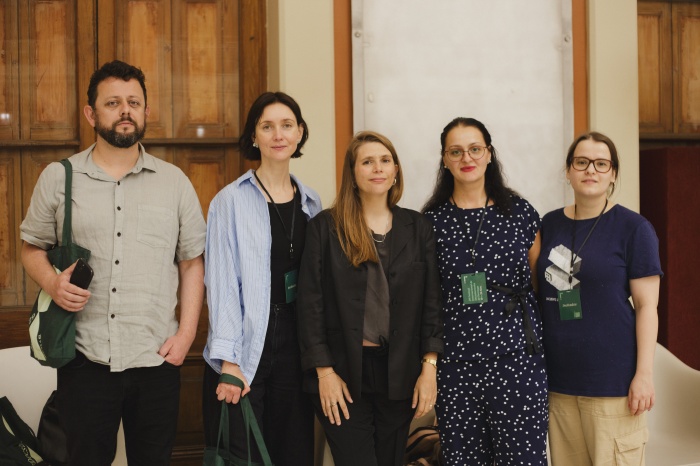
The delegation of the NGO Docudays together with representatives of FIDOCS. Photo courtesy of the FIDOCS film festival
The festival audience indeed consists to a large extent of students. FIDOCS actively collaborates with educational institutions and student media, and some of the festival venues are halls at a local university. The festival’s industry section also focuses on providing more opportunities for the professional growth of emerging documentary filmmakers. At the same time, discussion of films clearly occupies an important place in the culture of film viewing — Chileans eagerly engage in debate and take their time reflecting on the films they see and on the language of cinema more broadly. I was fortunate to attend a screening of Nine Different Nuances of the Same Colour by Carlos Vásquez Méndez, from the national competition, which was introduced by a film curator and researcher. She devoted her nearly half-hour introduction — which could easily be called a small, wonderful lecture — to reflecting on the director’s experiments with the film camera. In this culture of unhurried conversation about cinema and its language, one senses a certain — positively meant — intellectual luxury and richness. Chilean cinema has given the world many outstanding directors — Patricio Guzmán, Raúl Ruiz, Pablo Larraín, Maite Alberdi, among others — clearly influencing the country’s internal audience discourse as well. Cinema here finds an attentive viewer.
After one of the screenings in the Ukrainian programme, we went out for a bite to eat with the interpreter who had voiced our introductions to the films from English into Spanish. Jota had lived in the United States for some time but eventually returned to Santiago, where he now works as a translator and plays rock music. “There was a time when I was convinced that I would never, under any circumstances, be able to take up a weapon,” Jota shared with me on the way to the café. “The very idea that I might have to kill someone seemed unacceptable to me in any situation. Then I observed a lot of things in the world, and my perspective changed. For example, your films — Militantropos helps me better understand the state of a person who has no other choice but to take up arms and defend themselves. It’s not so much about ideologies as about a simple choice: defend yourself and live, or surrender and die.”
Over the course of the festival week, we would have many more conversations with different Chileans about ideologies. It is obvious that the ideological climate within each country is shaped to a large extent by its historical experience and geographical conditions. During that week, I got the impression that among the younger generation in Chile’s creative sector there is a noticeable sympathy for the left — clearly conditioned by the relatively recent traumatic experience of a right-wing dictatorship in the country. At the same time, the left wing encompasses a rather broad spectrum of ideological systems, from liberal values to socialism or communism, which is sometimes perceived simply as a substitute for or synonym of liberalism and democracy. The festival took place against the backdrop of the presidential elections, right after the first round, which determined the two main contenders for the presidency: the ultra-right candidate from Chile’s Republican Party and admirer of Trump’s politics, José Antonio Kast, and Jeannette Jara of the Communist Party of Chile. The conservative figure of Kast — whose brother served as a minister during the dictatorship of Augusto Pinochet and whose father was a member of the Nazi Party — provoked serious concern among all the Chileans I spoke with at the festival because of his political programme; young people see him as a threat to freedoms and human rights.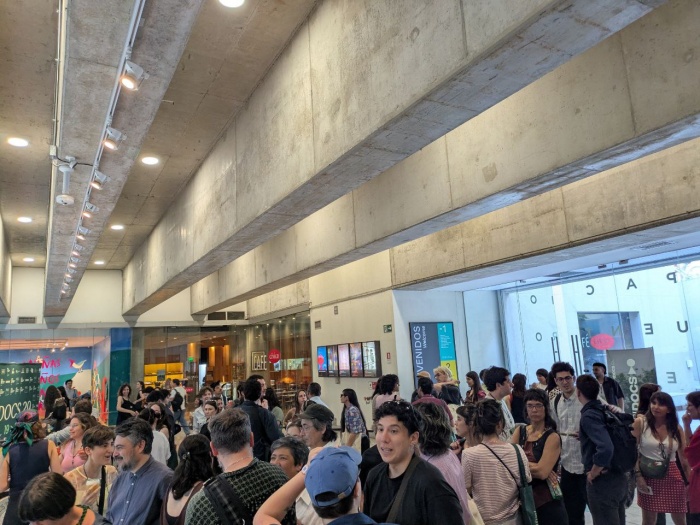
Atmosphere of the FIDOCS Festival. Photo: Olga Sydorushkina
However, in this context, it is also interesting that the only alternative to Kast’s ultra-right programme in these elections — the Communist Party — is perceived by young people rather as liberal-democratic. “The right is building its campaign to discredit Jeannette Jara by accusing her of being a communist — but she’s not a communist! She stands for liberal and democratic values,” one interlocutor told me. Of course, anything is possible in our turbulent times — especially in a sphere as unstable as politics, and even more so when the choice is limited. Still, these discussions inspired us, together with Taiwanese artist Su Hui-Yu, who was presenting his work at FIDOCS, to also share with our Chilean interlocutors our common thoughts on how the absence of a critical perspective on communist programmes romanticises this ideology and elevates it to a level almost detached from what communist systems actually become in practice.
“Just look at China,” Su says. “Do you see individual freedoms or limits on state power among its values? Or ask the Uyghurs how equality works in China. Every country that has taken a course toward communism has ended up as a dictatorship.” In general, Taiwan remains one of Ukraine’s strongest advocates in the Asian region and undoubtedly shares, to a significant extent, a Ukrainian perspective — but that is a topic for a separate conversation, one that we at Docudays UA already began in 2024 with a programme of national focus exchanges with the TIDF festival in Taipei. Personally, I very much look forward to the day when Ukraine officially recognises an independent Taiwan — a small country with a brave heart.
A few weeks after FIDOCS took place in Chile, the second round of the elections was held, and the country’s president became José Antonio Kast, described by the media as the most conservative candidate since Pinochet. He defeated his opponent by more than 16 %, receiving 58.2 % of the vote. Kast will officially assume office in March. All that remains is to keep our fingers crossed for the Chileans and wish them resilience and perseverance in staying on the path of defending democracy and liberal values — something they have managed to do for the past 36 years. In fact, the FIDOCS festival itself stands as a wonderful example of this resilience. Founded by Patricio Guzmán in 1997, FIDOCS is the only film festival in the country that has never interrupted its activities in any year. Perhaps the secret of this resilience lies, among other things, in the fact that a significant part of its team consists of people who took their first steps in cinema precisely at FIDOCS events and screenings, as they themselves admit. I believe this is a wonderful example of how a festival becomes not just a programme of films, but a place where communities are formed and values are shared.
Main photo: the Ukrainian delegation of the NGO Docudays in Chile. Photo courtesy of the FIDOCS film festival