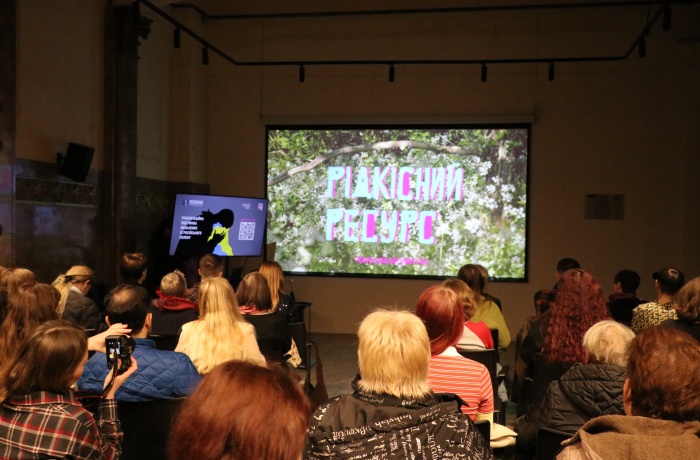
In 2025, the 22nd Travelling Docudays UA International Human Rights Documentary Film Festival took place in nearly 100 settlements across 20 regions of Ukraine. Among them were frontline hromadas in the Kherson, Zaporizhzhia, Dnipro, Sumy, and Kharkiv Regions.
The festival was held during the full-scale war. And this determined not only the themes of the programmes, but also the very need for such events — for conversations, meetings, and collective film viewing in places where people often lack safety, electricity, and space for dialogue.
The theme of the 22nd Travelling edition was Rare Resource. It associatively refers to the agreement between Ukraine and the United States on rare earth metals, but for us it is, first and foremost, about people and their inner strength. About the ability to endure, to unite, to take part in the life of communities and the state, and to influence their decisions.
The Festival focused on human dignity, on the human right to a voice and participation in public life. Through documentary cinema and public discussions, we addressed topics that become especially acute in times of war: the upholding of human rights, respect for human dignity, the return of our fellow citizens from captivity, the rehabilitation of military personnel, the difficult experiences which children live through, the preservation of memory and the establishment of justice, participatory democracy, and European values.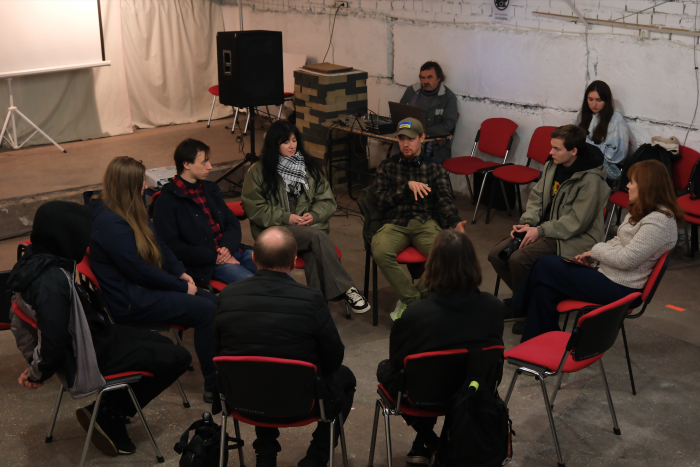
Travelling Docudays UA in Kharkiv. Photo: Hanna Yaremenko
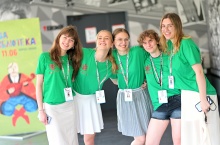
A total of 26 regional partners, 132 volunteers, 118 experts, and nearly 245 partner organisations and venues contributed to the preparation and implementation of the festival. Together, they organised 624festival events. These included 19 press conferences, 462 screenings, 17 cultural and educational events, and 126 human rights events: panel discussions, trainings, seminars, lectures, masterclasses, and exhibitions.
Overall, the Travelling Festival was attended by 66,715 viewers. Of these, 12,483 people took part in screenings and discussions in person. As part of the communication campaign, we produced more than 800 publications, with total views across media and partner platforms exceeding 2 million.
The programme of the 22nd Travelling Docudays UA brought together 10 documentary films from Ukraine, Ireland, France, the Netherlands, the United Kingdom, Croatia, Italy, Slovenia, Qatar, Portugal, and Spain.
The films discussed freedom and dignity, historical memory, the right to one’s body, reintegration after war, sexual autonomy, personal choice, and responsibility.
Maryna Zorina, the regional coordinator from the Kirovohrad Region, noted that it was precisely the diversity of the programme that helped engage audiences of different ages, while the subject of participatory democracy became one of the key focuses of the discussions:
“We talked a lot about how citizens can influence government decisions, how to build transparent mechanisms for participation, and how to turn one-off initiatives into a sustainable culture of co-creation.”
In Ternopil and Chortkiv, special attention was given to the 50th anniversary of the Helsinki Act and the legacy of the human rights movement. Participants reflected on the current war as a consequence of systemic human rights violations. Oleksandr Stepanenko, the regional coordinator in Ternopil, emphasised:
“Human rights violations in one country sooner or later lead to threats to international security. We can see this today in the example of Russia.”
At the same time, he stressed the importance of the European cultural code:
“Respect for human dignity and diversity is what can unite us within the country and in future Europe.”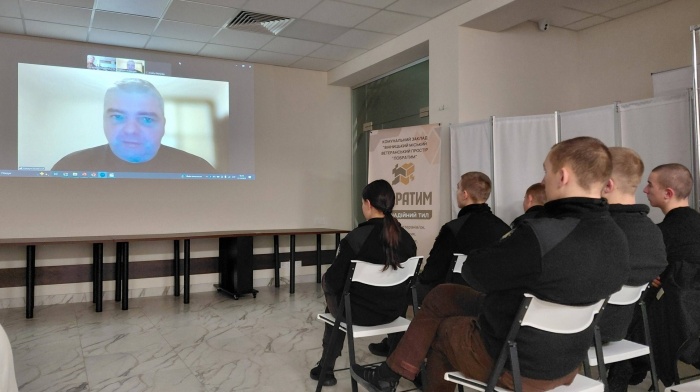
Travelling Docudays UA in Vinnytsia region, screening with the participation of Maksym Butkevych
One of the key emphases of the human rights programme was the topic of rehabilitation and reintegration of people released from Russian captivity. To draw attention to this topic, the festival, together with the Principle of Hope charitable foundation, launched a charitable initiative: a fundraising campaign to support military personnel and civilians returning from captivity. The founder of the foundation, Maksym Butkevych, who is a well-known human rights defender, a veteran with experience of captivity, and the first Ukrainian to receive the Václav Havel Human Rights Prize, became the ambassador of this year’s Travelling Festival.
In frontline and rear cities alike, the festival initiated meetings between civilians and military service members. Veterans, military personnel, and their families from across Ukraine joined screenings and discussions focused on the rehabilitation of military service members. In Kharkiv, Vinnytsia, Kherson, Dnipro, Rivne, Ivano-Frankivsk, and Ternopil, people with lived experience of captivity and return took part in the conversations on this subject, shifting the discussions from an abstract level to the realm of lived stories.
Separate events were held in veteran hubs, rehabilitation centres, and hospitals — in Rivne, Kharkiv, Khmelnytskyi, Vinnytsia, Uzhhorod, and Lviv.
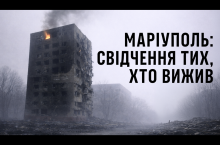
As part of the festival, special screenings were also held of the film Witnesses. Captivity Kills, created by the Ukraine War Archive team and edited from interviews with the defenders of Mariupol and their relatives. In the final week of the festival alone, the film was viewed online 8,908 times.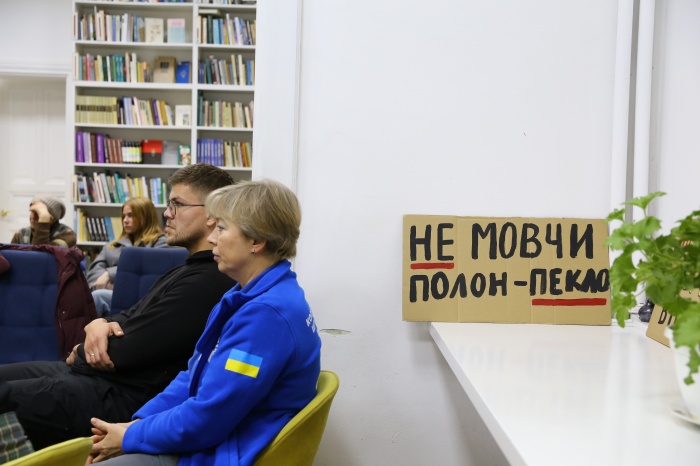
A screening of the Travelling Docudays UA in Lviv. Photo: Yaroslav Tabinskyi
The 22nd Travelling Docudays UA consistently developed its inclusivity. Screenings with audio description, extended subtitles, and accessible venues enabled people with visual and hearing impairments, people with mental disabilities, as well as veterans with acquired injuries to take part in our events.
In Uzhhorod, the festival ambassador was Nadiia Dioloh, a person with a disability and Head of the Accessibility Department at Mriya v Diyi. In Poltava, inclusive screenings became part of the overall festival process rather than a separate activity.
Regional coordinators emphasised that in the conditions of the war, inclusion ceases to be a matter of choice and becomes a necessity.
The 22nd Travelling Festival actively engaged with young people, secondary school and university students alike. Screenings were held in schools, lyceums, higher education institutions, and youth centres. For many young viewers, the films How I Spent My Summer Holidays?, Where’s My Body Armor?, and Last Song from Kabul became their first in-depth encounter with the subjects of human rights, discrimination, and making sense of war.
In Chuhuiv, a screening of How I Spent My Summer Holidays? was followed by a discussion titled Childhood Under Sirens: How to Help Children Cope with the Stress of War, with the participation of a child psychologist.
Nataliia Pishchulina, a representative of the Chernihiv Region and NGO Ukrainian Antiquity, emphasised:
“It is extremely important to hold such events in small settlements, especially those far from the regional centre, even though they do not deliver the desired targeting. There, however, they have a greater impact and significance. For example, in the de-occupied Ripky, there is a youth space and centre, but events for young people are rare. Accordingly, taking part in the Travelling Festival is an opportunity to ‘open the doors of the centre’ to the audience and to discuss relevant topics.”
As a continuation of the nationwide information campaign Sexual Violence on the Internet: How to Protect Children, initiated in 2024 by NGO Docudays in partnership with NGO Magnolia, the Travelling Festival featured screenings of the film on sextortion My Sextortion Diary by Spanish director Patricia Franquesa.
Following the screenings in the regions, expert thematic discussions were held with the participation of representatives of the education sector, the cyber police, psychologists, and representatives of human rights and youth organisations. In her comment for Hromadske Radio, Svitlana Silchenko, a psychologist and the Travelling Festival’s regional coordinator in the Vinnytsia Region, emphasised the importance of the campaign and the need for educators to pay closer attention to their pupils and students:
“Our campaign is not only for teenagers and children, it is also for adults and for those professionals who work with children: teachers, social workers, psychologists. It is for people who may notice that something is happening to their pupils, students, or a friend’s daughter, and who understand that this is the moment to pause and pay attention, and perhaps it is precisely your involvement that can save a life, stop a process which can cause fatal consequences.”
In Poltava, Uzhhorod, Lviv, and other cities, discussions were joined by filmmakers, as well as the protagonists of the films — both in person and online. Their presence significantly deepened the conversations.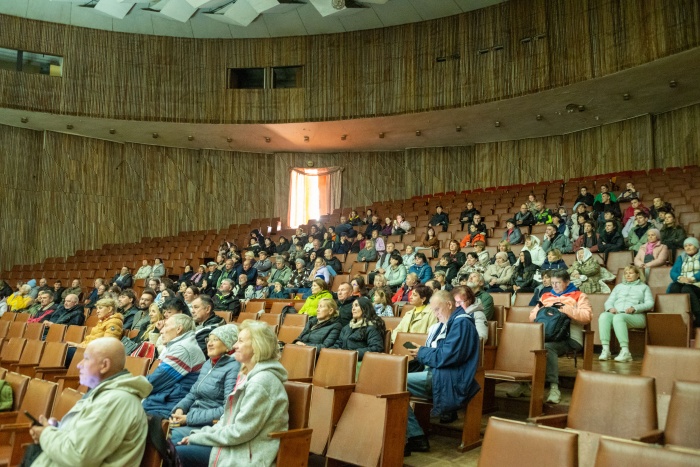
A screening of the Travelling Docudays UA in Kyalnyk. Photo: Natalia Mykhailenko
A landmark event was the premiere of the film Sanatorium in Kuyalnyk, at the very location where the film was shot. For director Gar O’Rourke, this screening was special. He thanked the sanatorium staff for their trust and for the opportunity to work with very personal stories.
The Travelling Festival engaged with vulnerable groups: people living in dormitories for internally displaced persons, in remote communities, geriatric care homes, social centres, resilience centres, probation centres, and penitentiary institutions. In particular, in penitentiary institutions in the Kharkiv, Sumy, Cherkasy, and Poltava Regions, more than 70 screenings were held for over 1,400 inmates. Audiences watched and discussed the films Inside, the Valley Sings, about the experience of solitary confinement, My Sweet Child, and How I Spent My Summer Holidays?.
This year’s Travelling Docudays UA was held in the loving memory of Tetiana Kulyk. A person with a big heart, an extraordinary talent for management, a rare ability to sense the world with great subtlety, and a calling to change it for the better. That was our Tania, Coordinator of the Network Development Department at NGO Docudays, who devoted herself entirely to the annual Travelling Festival and to the everyday work of the Docudays UA Film Club Network. Her life was suddenly cut short on 29 July 2025.
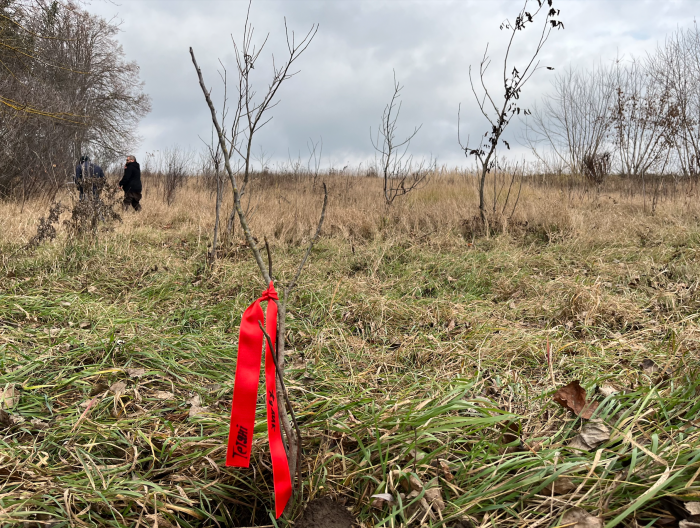
The memory tree of Tetiana Kulyk in the Docudays UA park, Ternopil region. Photo: Valeriya Sheremet
The 22nd Travelling Docudays UA took place in large cities and small communities, in frontline and vulnerable regions. Everywhere, people watched documentary films and spoke about difficult things. About war and loss. About loneliness and dignity. About human rights, about the heroic deeds of the Armed Forces of Ukraine, volunteers, and medics, and about the work of each and every person in bringing Victory closer.
The Travelling Festival made these conversations possible in places where festivals and public discussions rarely happen. And this was its main value, because the right to a voice and to dialogue must not depend on where one lives.
Main photo: Travelling Docudays UA in Lviv. Yaroslav Tabinskyi
Festival organisers: Non-governmental Organisation “Docudays,” Ukrainian Helsinki Human Rights Union, Charity Organisation “Charity and Health Fund,” and NGO “Center for Modern Information Technology and Visual Arts.”
Media partners: Suspilne, Hromadske Radio, hromadske.ua, GURT, Vgoru.
The 22nd Travelling Docudays UA is held with the financial support of the European Union, the Embassy of Sweden in Ukraine, and International Media Support. The opinions, conclusions or recommendations do not necessarily correspond to the views of the European Union, the governments or charities of these countries. Responsibility for the content of the publication lies solely on its authors.