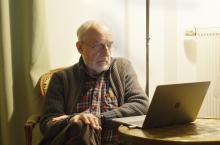
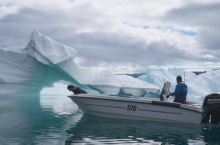
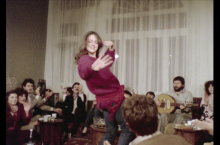
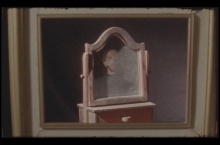
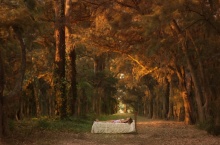
A street in downtown Warsaw, Poland. Arjun Talwar immigrated here a decade ago from India but still struggles to fit in. Wolf Street – or Ulica Wilcza – hasn’t made it easy for him. In an attempt to accelerate his integration, the director begins filming his neighbors, testing his relationships with them while seeking ways to overcome his own alienation. With the help of his friend Mo, another immigrant-turned-filmmaker, Arjun uncovers the mysteries of the street, revealing a web of charming characters: a postman who, along with letters, delivers remedies for loneliness; an exile from Damascus building a replica of his hometown; and a wandering brass band, among many others. The director discovers that they are like himself—people who live between the past and the present, between an imagined homeland and a real one. The street, like an invisible thread, connects them all, offering solace against the melancholy of everyday life.
Within Wolf Street’s kilometer-long confines, an image of modern Europe emerges, exposing a kaleidoscope of contradictions and anxieties. The film throws stereotypes to the wind as it tries to navigate the fictitious boundaries between neighbours. Poland, often perceived as homogenous, unwelcoming, and right-wing, is faced with a mirror held up by a foreigner filmmaker who creates a witty and personal portrait of his adopted country.
Letters From Wolf Street will have its World Premiere at the upcoming edition of Berlinale - Berlin International Film Festival, in the Panorama section.
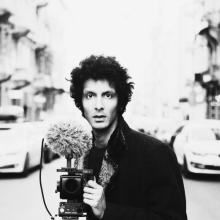
Arjun Talwar grew up in Delhi. He studied Mathematics before being admitted to the Cinematography Department of the Polish Film School in Łódź. His short films have been screened at various international festivals, such as Visions du Réel, Big Sky, FID Marseille, and Tampere. Arjun’s first documentary feature, A Donkey Called Geronimo, premiered at DOK Leipzig and was later released in cinemas.
Letters From Wolf Street (2025 ), A Donkey Called Geronimo (2018 ), Deportation (2018), Where I Can't Be Found (2014), Habitat (2014)