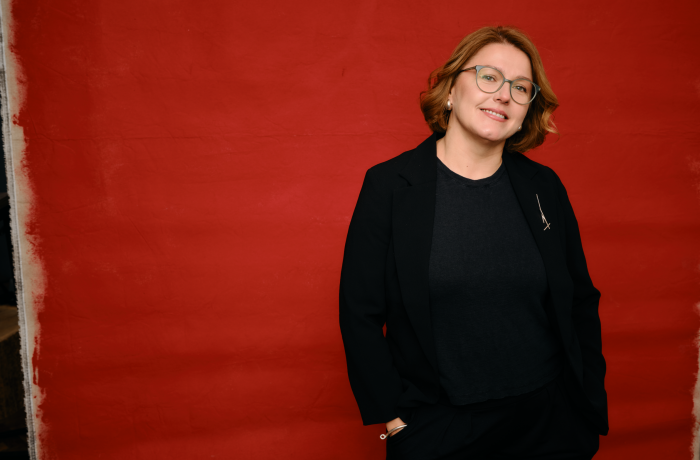
On the eve of the 23rd Docudays UA, our editor Kseniia Opria spoke with Kateryna Botanova about viewing documentary cinema through the eyes of a cultural researcher, the festival as a critical tool, decolonial discourse, and curatorial decisions. The subject of this conversation will join this year’s international jury, which will determine the winner in the DOCU/WORLD category.
My first question to you, as someone who works with visual art, is how you watch documentary cinema, what connects you to documentary filmmaking, and what interests you in this field?
My field is cultural studies, cultural anthropology, visual art, and literature. That is where I feel like a professional. Cinema is a sphere of my informed love.
The most interesting things for me happen in the gaps. Documentary filmmaking usually builds its narrative on facts, documents, and testimonies, on voices and stories connected to reality, and in this, in my opinion, lies its greatest value. At the same time, visual art comes into play in the gaps between facts and testimonies, in what is left unsaid, or perhaps invisible and unnoticed.
In the Ukrainian context, I have written a great deal about how, since the beginning of the full-scale invasion, art has turned into a formula for expressing testimonies about this great war, its experiences, victims, and feelings. Now these two fields, documentary filmmaking and visual art, are beginning to diverge again, and this is also an important phenomenon. Yet they still remain ways of looking at the same reality of war. As the artist Alevtyna Kakhidze once said to me: “I am too lazy to talk about anything else, because the war surrounds me, I live in it every day, my family lives in it, all my people and my dogs live in it, so I simply cannot think about or work on anything else.”
An interesting example of a work where testimony and the gaps of the unspoken, the forgotten, and the repressed intersect is Oleksiy Radynski’s film Where Russia Ends. It is often described as a documentary, but I would rather disagree with that. This is a case where the narrative is built on documents and historical facts, but the most important things actually happen in between them.
I would like to ask about your connection to the festival world. How are you developing your interdisciplinary project Culturescapes in Switzerland?
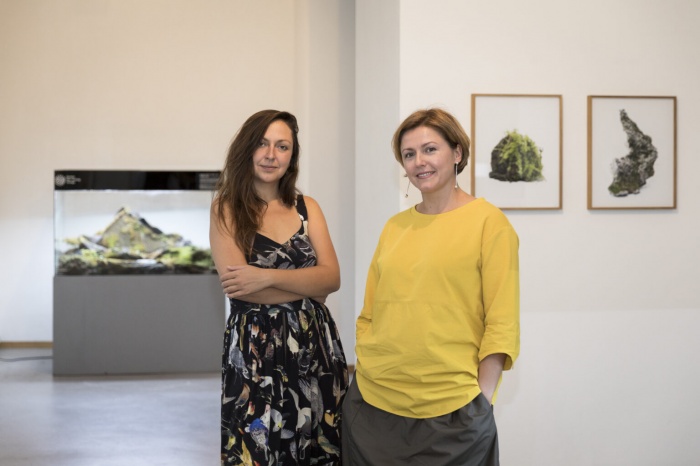
Vernissage Diana Lelonek. Center for Living Things at Buero, Basel. Curator Kateryna Botanova. Culturescapes Poland-2019. Photo: Dirk Wetzel
Since 2017, I have been working with the Culturescapes festival as a curator shaping its architecture. The main line we have been following since then is rethinking the festival outside the traditional notion of “festivity” — celebrating life, music, or theatre, that is, performative entertainment. After all, there is also the festival as a critical tool, which brings knowledge that is not always comfortable, very often unfamiliar and unclear, which requires certain work to engage with.
For me, this perspective has always been very important. In Switzerland, it is not easy to implement, because it is generally a bourgeois, closed-off audience that prefers comfort.
At Culturescapes, we work with distant contexts: South America, Africa, and soon the Arctic. We raise questions related to indigenous peoples and cultures, coloniality, domination, and the production of knowledge — culture as a way of life versus culture as entertainment.
Could you tell me about Culturescapes as a physical space? How does it function, and how is its programme structured?
In a sense, it is a unique festival because it does not have its own venue or festival centre, and therefore has to engage a wide network of partners each time. In fact, the core of the festival is located in Basel. Basel in Switzerland is a cultural capital with a broad network of cultural institutions. It is also a border city between Switzerland, Germany, and France, where there is a great deal of cross-border cooperation, including within the context of our festival. Our events are also hosted by French and German partners: theatres, cinemas, art centres, museums, literature houses, jazz clubs. We jointly make decisions about the programme, which very often relies on our suggestions: new ideas, names, plays, or films.
A similar principle is used in the Travelling Docudays UA, where after the festival in Kyiv, its film programme and concept travel to cities across Ukraine thanks to regional coordinators.
It seems to me that this is a great and important recipe for sustainability, when something we create does not exist only once. I really like these travelling formats, when you understand that your work continues to live on and engage with different audiences.
How do you build a dialogue about Ukraine in Switzerland? How does the local community reflect on us and our war?
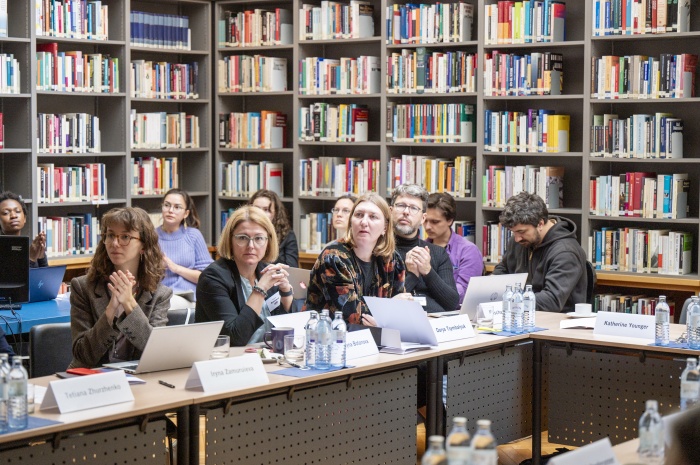
IWM Vienna. Ukraine's Altered Landscapes. Photo provided by Kateryna Botanova
I write for international media and take part in events related to Ukraine, ranging from university lectures to broader public talks or panel discussions. Each time, it is clear that the audience is different and the type of conversation is unique.
Specifically in Switzerland, building a dialogue about Ukraine is very difficult, because part of the Swiss identity is their neutrality. It is easier for them to cooperate with Belarusians and support them, as it is a safer situation, whereas Ukrainians, with their struggle, heroism, and active stance, slightly fall outside the category of the entirely “comfortable” victim.
On the other hand, I observe that on the anniversary of the full-scale invasion there were large demonstrations and discussion events in Basel, Zurich, and Bern. There are active Ukrainian communities, but they mostly remain within a closed circle. From time to time, articles appear in the media. So the topic of the war and Russian-Ukrainian relations is present.
As we observe the international film community and festivals, we start to think that the world is tired of our war, that it wants to invite Russians more often to talk and cooperate, to award them film prizes. Do you agree with this? And how can we re-enter this conversation through culture in order to keep the focus about the war in Ukraine?
On the one hand, it is true: the world is growing tired of the Ukrainian war, because it is very difficult to keep attention focused on one difficult situation for years. It seems to me that Trumpism in itself produces such a quantity of conflicting and striking messages that they are capable of simply taking over any information space. On the other hand, it seems to me that Europe increasingly understands that this war is drawing closer to it in one form or another, or at least that it will not end quickly and that our reality will no longer return to what it was before. That is why I observe a consistency of political decisions from our European partners.
I also see a positive dynamic in visual art and literature. There used to be a great many Russian voices here, but now there are radically fewer of them and, at the same time, Ukrainian voices are sounding loudly.
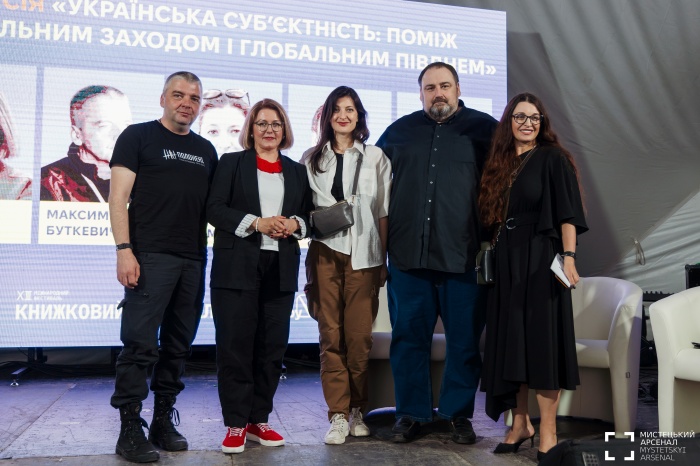
Book Arsenal 2025. Discussion with Frontier Institute members. Photo: Anna Putylina
What should be done about the Russian presence? It seems to me that the period when we were actively cancelling their cultural product ended long ago, and that is as it should be. We can see that this strategy was counterproductive. Now it is more important to draw attention to the fact that the number of places is always limited, and by choosing someone, you are not choosing someone else. Here, for example, I always bring in the decolonial discourse and ask the question: If hegemonic powers are present in the cultural space, then how are we to learn about what is happening in the cultural world of West Africa or South-East Asia? It is physically impossible to fit everything into a single festival or exhibition programme, this is always a conscious curatorial or directorial choice.
So now we are not speaking specifically about Russians, but rather emphasising conscious choice and the need to include more and more voices. After all, how many resources does Ukraine have to produce its own voices? Questions of funding, people, strength, energy, time. High-quality, great cinema, works of art, books, translations — all of this is enormous work. If Ukraine does not receive support, these voices will simply disappear.
We often ask the same question to colleagues from different fields: where do you find the energy to continue your work?
I do not know how to do anything else, only how to work in culture. For me, it is simply very important.
I moved to Switzerland 9 years ago. A new world opened up to me, and new work, which, of course, took up a great deal of time. This reduced the number of my professional contacts with Ukraine. And at a certain point, long before the full-scale invasion, it became clear that I was missing it. That this calm rationality and balance by which the Western art world lives is good for catching your breath and calming down for a while. But I lacked involvement in the production of meanings.
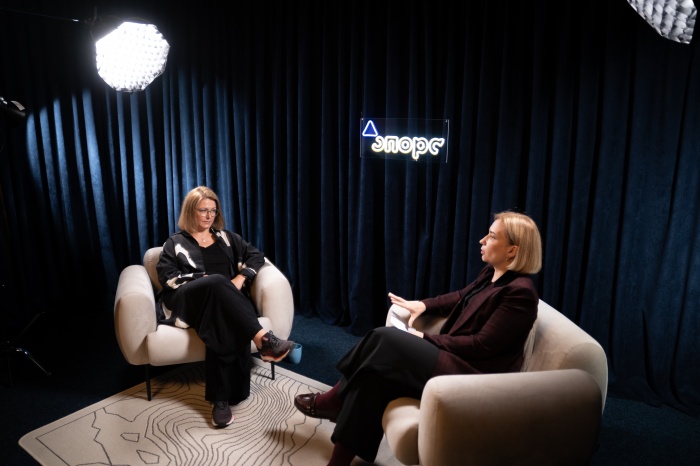
Interview with Kateryna Botanova for Opora. Photo: Yevhen Yeshchenko
And what I see in Ukrainian culture is the articulation of problems, an attempt to make sense of this constantly changing reality. This existed even before 2014, but became especially evident after the Maidan, with the beginning of the war, and now after the full-scale invasion — these are changes happening in a very short time and space, and they need to be transformed into meanings. Not to miss them, forget them, or turn away, but to acknowledge and endure them. Because otherwise, without meaning, a person will simply go mad, and the world will begin to fall apart.
Finally, I would like to ask about your exhibition with Roman Bondarchuk and Daria Averchenko, Kherson. The Steppe Holds, which was based on materials from the Ukraine War Archive, including testimonies of Kherson residents about life after the full-scale invasion. How was it created? What sparked it, and what meaning did you invest in it?
All the impulses came from Daria and Roman. They approached Olesia Ostrovska-Liuta, the director of the Mystetskyi Arsenal, bringing with them a body of archives, memories, knowledge, films — everything that surrounds them — and said: “Let’s talk about Kherson.” The Arsenal spent a long time searching and thinking who could be entrusted with this project, because it is neither an art exhibition by artists, nor a documentary exhibition by photographers, nor even an exhibition about films — it is a kind of hybrid. It is a story about Kherson and the Kherson Region, as well as about the Ukrainian South. I joined it in the role of curator.
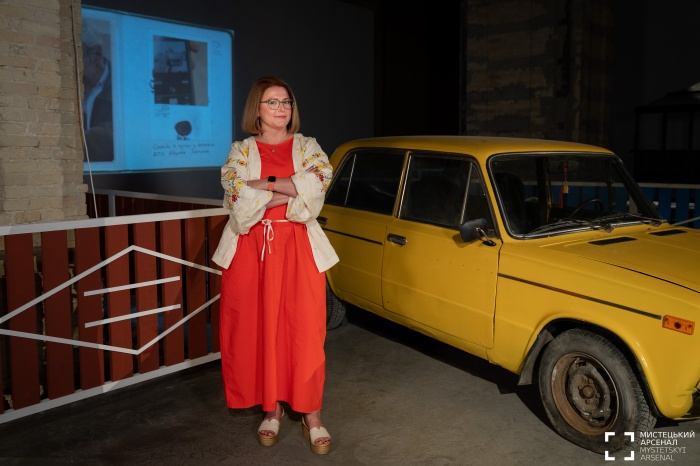
Kherson. The Steppe Holds. Photo: Andrii Tsykota
It is a narrative about something that had long been unjustly marginalised in culture and began to return to us through the war. During war, the awareness of value comes through loss. And in this sense, the Kherson Region is, unfortunately, such a story. For many people, for whom this region had simply been part of Ukraine, the Azov Sea, a summer beach, suddenly everything acquired a completely different meaning. And this is what we tried to convey: what existed, and what is important to preserve. Even if it physically no longer exists and perhaps will no longer exist, it is still part of us. I was sincerely struck by how many people who came to the exhibition said that they were not from the Kherson Region and had perhaps never been there, yet they absolutely identified with it: “I see myself in this yellow Zhyguli car, landscapes, stories of village life, songs.”
It is also very important that we speak about the diversity of Ukraine, its richness of identities — this is our value and our strength. It is a personal story, but at the same time a very large one. One of my favourite curatorial projects.
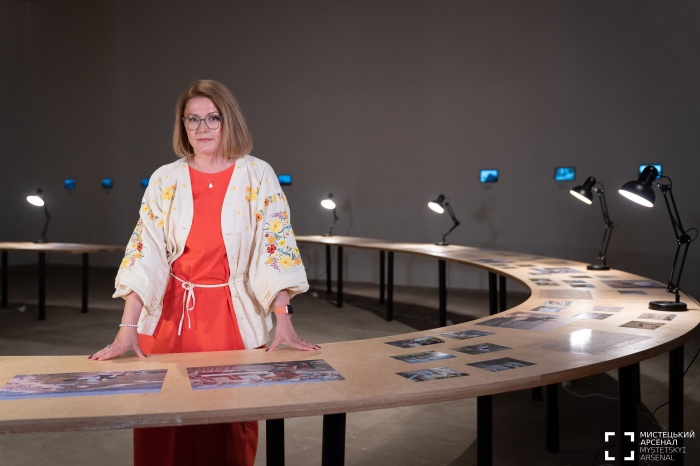
Kherson. The Steppe Holds. Photo: Andrii Tsykota
Perhaps you have a favourite corner from there that speaks to you the most?
Absolutely, it is the Resurrection Pit. We had many discussions and doubts about it. In Roman’s film Volcano, it is an image of transformation, loss, humiliation, and then absolute reinvention of oneself, after which the main character, Lukas, emerges and understands that he no longer wants to escape from reality.
At first, we did not understand what to do with it, because it is impossible to recreate a pit in a gallery space. Nor could we place an object that would retraumatise people. And then we came up with the Resurrection Pit (and I defended it through all our collective doubts), and I am very proud of how we made it.
People were afraid to enter it, but if they dared, they later said they had experienced catharsis. Especially because it comes at the end of the exhibition, like one of the final objects you enter, requiring a certain courage to step into this enclosed dark space. But if you do enter, you see the sky above you, sunflowers, stars. It is about how the darkest and deepest pits of our experience can turn out to be transformative. And that if you lift your eyes, there may be a very beautiful sky above us, guiding us forward.
On June 11, during the 23rd Docudays UA, a public lecture featuring Kateryna Botanova will be held. Follow the festival news on our website so you don’t miss any details of the event.
Main photo: Grygory Vepryk for Frontier Institute
The 23rd Docudays UA is held with the financial support of the European Union and the Embassy of Sweden in Ukraine. The opinions, conclusions, or recommendations do not necessarily reflect the views of the European Union or the governments of these countries. Responsibility for the content of the publication lies exclusively with the authors and editors of the publication.