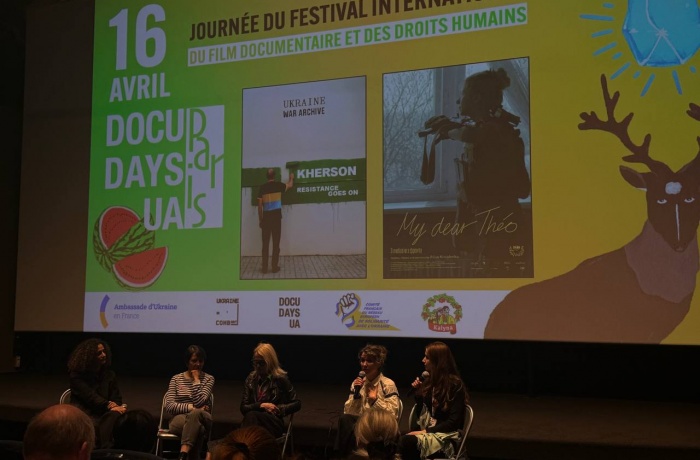
On April 16, the Cinéma des Cinéastes hosted a Docudays UA evening organized by Ukraine CombArt—an independent cultural initiative promoting Ukrainian art in France—in collaboration with the French committee of the European Network of Solidarity with Ukraine and the Kalyna community.
Paris audiences were introduced to two Ukrainian films offering distinct perspectives on the experience of war. Kherson: Resistance Goes On by Tetiana Symon portrays the stories of volunteers who save lives under constant shelling. My Dear Théo by Alisa Kovalenko is an intimate lyrical diary of a filmmaker, mother, and soldier. Letters addressed to her future adult son Théo are interwoven with notes from frontline life: routine, endless waiting, quiet reflections in trenches and dugouts, observations of ants in the soil and the beauty of landscapes, and tender moments of closeness and camaraderie—set against the backdrop of shelling and loss.
The evening took place in the iconic auteur cinema space Cinéma des Cinéastes, founded in 1973 at the initiative of the Société des Réalisateurs de Films. Traditionally, the venue serves as a platform for filmmakers’ voices, audience discussions, and events that shape the European cinematic landscape. This made the Docudays UA screening particularly meaningful, situating Ukrainian stories within the broader cultural space of Europe.
The screenings were followed by discussions with the filmmakers. Tetiana Symon presented the War Archive, a platform by Docudays that collects, structures, and preserves evidence of crimes committed during Russia’s war against Ukraine.
Through the stories of volunteers—the protagonists of Kherson: Resistance Goes On—French viewers were able to grasp what people in Kherson experienced during the occupation and after the destruction of the Kakhovka dam. “It was important for me to show not only fear, but also the dignity of those who remain,” said Tetiana Symon.
The screening of My Dear Théo was followed by a prolonged silence after the final credits. During the discussion, audience members admitted they had not expected to see war portrayed this way—in pauses, in everyday details, in the simple joy of having internet access.
“This film was not conceived as a film from the beginning. But when the comrades we see on screen began to die or go missing one by one, I realized I had to preserve their memory. They must not disappear,” emphasized Alisa Kovalenko.
Viewers shared a wide range of reflections—from deeply personal to global questions: Will Kovalenko’s son one day understand her decision to join the army? How can this war be stopped? And why do Ukrainians defend both their territories and their values with equal determination?
At the same time, the Paris screening offered European audiences a different lens on war—not only as a space of combat, but as an experience shaped by values, human connections, and everyday choices. These films speak about people who, regardless of their profession or past lives, are now defending the future—often at the cost of their owntheir lives.
Author: Oleksandra Berezovska