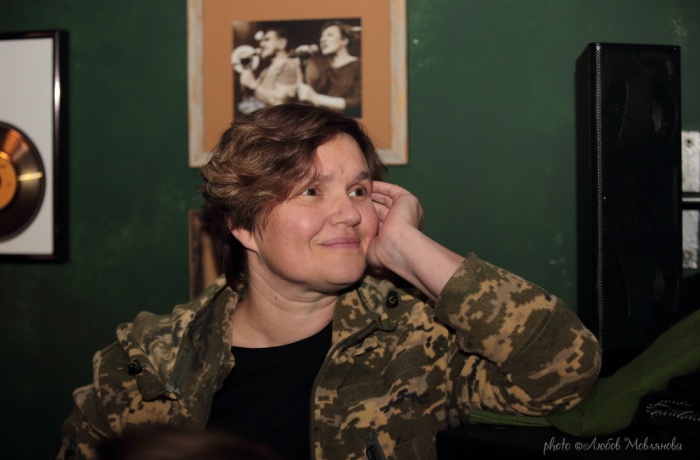
This year, the jury of the RIGHTS NOW! Special Mention is made of people working across different dimensions of contemporary reality — from strategic reflection on societal transformations to direct experience of war, humanitarian work, and the study of information influence. Among them is Lesia Lytvynova, known to many as a volunteer. However, Lesia herself firmly rejects that label when speaking about her foundation. She always emphasizes, “This is my job, and I get paid for it.” Then she adds with a laugh, “Though it’s difficult to call it a salary.”
After 2014, with the outbreak of the Russian-Ukrainian war, she left her career as a director and founded the SVOI Foundation, which helps people with severe illnesses. It also helps those who have lost their homes and entire cities because of Russia. At the start of the full-scale invasion, she joined the Armed Forces of Ukraine and is now a veteran. Journalist and writer Nataliia Bushkovska spoke with Lesia about war, civilian life, identity, and documentary cinema.
This year, Docudays UA together with the Hurkit Foundation and the SVOI Foundation are raising funds for evacuation vehicles and medical treatment for wounded military personnel. You can support the fundraiser via the link.
In one of your interviews, you denied being a volunteer. If someone asked you, “Who are you?” what would you say?
At one meeting, I was introduced like this: “And this is Lesia — a specialist in all sorts of sh*t.” That’s the most accurate self-identification, but unfortunately, you can’t really use it anywhere.
I’m convinced that we are all multidimensional beings, existing across many layers. Occasionally, the identity of “mother” comes to the forefront — and everything else becomes irrelevant. At times, I turn into a completely classic mother hen, trying to shield my chicks and losing whatever is left of my common sense in the process.
Occasionally, I’m a “veteran,” especially when I meet people outside my bubble. At other times, a charity foundation worker. And sometimes, a volunteer in the traditional sense, when I take on tasks outside the foundation. My self-identification changes every time. The only one that hasn’t changed since Maidan is this: I am Ukrainian.
I’m a real ethnic mix: my mother was born in Novorossiysk [a city in Russia], into a family with Jewish and Russian roots, both of which experienced political repression. On my father’s side — Kuban Cossacks [Kuban — a region in Russia, Cossacks — predominantly East Slavic, historical autonomous military class], and even there, Ukrainians are less than half. A colleague once told me, “You’re an ethnic chimera.” I never cared much about my nationality — I felt equally comfortable with everyone, in all languages and religions.
But during Maidan, after the first deaths, after realizing how deeply everything that was happening was tied to identity — something in me changed forever: “I am Ukrainian” took root in me in a profoundly bloody way. It’s the one thing that cannot be taken out of me.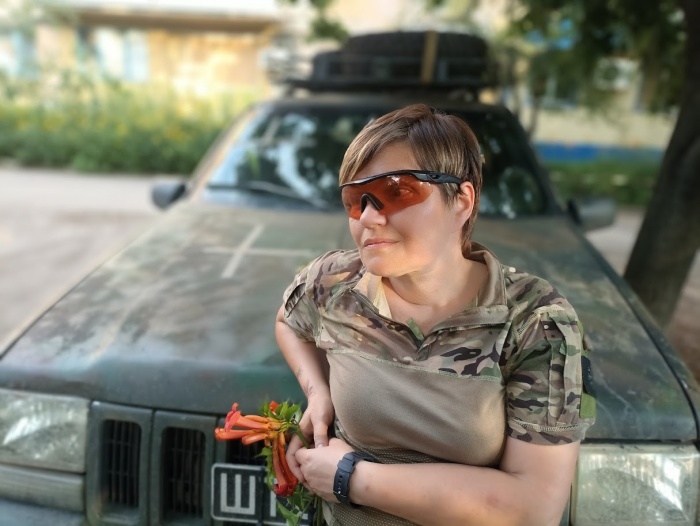
Veterans sometimes say that returning to civilian life is one of the hardest experiences — even harder than going into combat. You went through the front line, injury, and demobilization. Do you agree?
“There” really is easier. I can confirm that.
Why?
It’s very basic. In war, the division into opposites is clearer. There’s your own, and there’s the enemy. I may disagree with my own, but ultimately, they are mine and I am theirs. I rely on them, and they rely on me. On the other side is the enemy, and I don’t question that at all. Anyone who physically came to wage war against Ukraine loses absolutely any right to be seen by me as a person who had a childhood, helped an old woman cross the street, or saved a kitten. They are an unconditional enemy — and that’s simple.
In war, you feel control and local responsibility more strongly. In a specific task, everything depends on you: on how you behave, how prepared you are, whether you chose your gear well, whether you checked every detail, coordinated with adjacent units, or threw an extra tourniquet or additional equipment into your backpack. That’s your zone of control.
Random strikes, shots, and all that absurd randomness exist both there and here, but in the rear, you can’t control it. You’re a passive observer, and at first it drove me insane.
I don’t think I’ve returned to civilian life. A full return to peaceful everyday life is impossible — it would mean denying the fact that the war continues. My 18-year-old son is picking a profession with the military in mind and is studying tactical medicine. My husband is still in the army. What civilian life can I even talk about?
I understand why society keeps bringing up the end of the war — it’s a defense mechanism. If you can’t defend yourself by preparing for the army and staying operational, you defend yourself with the thought that in due time it will end. I don’t feel that the war will end within a timeframe I can grasp. So I have to stay in shape, keep preparing, and keep learning.
There’s a lot of talk now about civilians’ rights in the public sphere — and much less about the rights of those who fight. But a soldier is the same civilian who was mobilized yesterday.
How does it feel from the inside: did your rights become less important the moment you took up arms?
I am entitled to fight for myself, my children, and my country.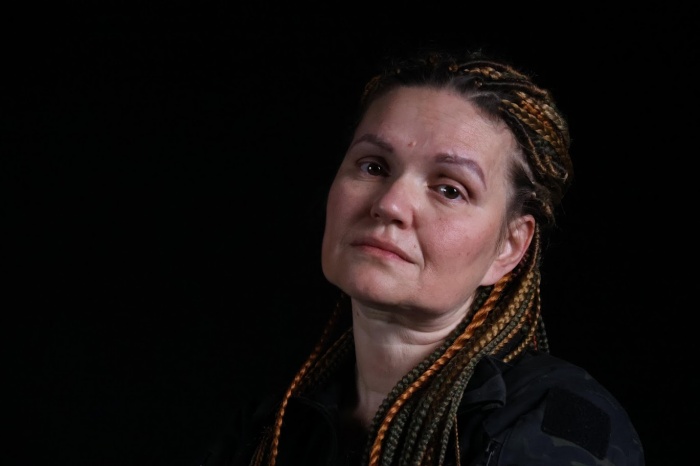
So you see it as a right, not just a duty?
It’s both a right and a duty. You see, I was part of that wave when many people went voluntarily. It’s hard for me to speak for other units or people who ended up in the army under different circumstances. But those I had the honor to fight with hid their diagnoses, deceived medical commissions, concealed their age, and did everything they could to exercise their right to take up arms. These are people I respect.
Stepping outside that bubble always feels like entering another world. I cannot respect those who say they weren’t born for something. That they are “a person in the status of a person.” It’s like someone goes to the toilet and says, “Come wipe me, I wasn’t born for unpleasant things like that.”
You can now watch documentary films about war not only as a director but also as a soldier and a veteran. In your opinion, how can documentary cinema influence us?
There should be many films of different kinds: for children, for intellectuals, for potential soldiers, for the elderly, and for those who hesitate. Each audience needs its own kind of film. And the more high-quality—emphasis on high-quality—content there is, the better.
For example, I got absolute pleasure from the film Palianytsia. It shows the war through two street artists — how they go through transformation, how they change. It’s such a beautiful observational film. And I saw how important it is for an entirely different audience that I don’t directly interact with.
I was also deeply impressed by the film 2000 Meters to Andriivka. At first, I was afraid to go — I thought it would trigger flashbacks. Instead, I felt safe, almost at home. I understood and felt close to all the characters. I sincerely hope such honest cinema has also affected viewers who are not military.
Photos provided by Lesia Lytvynova.
The 23rd Docudays UA is held with the financial support of the European Union, the Embassy of Sweden in Ukraine, and the State Film Agency of Ukraine. The views, conclusions, or recommendations expressed do not necessarily reflect those of the European Union or the governments of these countries. The authors alone are responsible for the content of this publication.