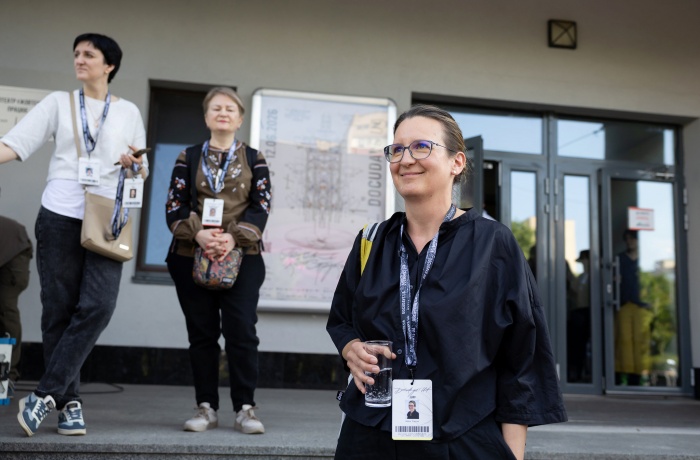
Anna Lazar is a curator, art historian, writer, Ukrainian and Polish philologist and translator, the Director of the Ujazdowski Castle Centre for Contemporary Art in Warsaw and, this year, a jury member of the DOCU/UKRAINE and DOCU/SHORT competitions at the 23rd Docudays UA. Since the beginning of the full-scale invasion, she has also been extensively involved in volunteering in and for Ukraine.
Docudays UA Press Coordinator and artist Maria Matiashova spoke with Anna about culture as a space for experimentation, the dangers of propaganda, the responsibility of art in times of war, and why Ukrainian culture today is one of the key drivers of Europe’s transformation.
Interest in Ukraine
While still studying at a lyceum in Wołomin, I often skipped classes and travelled to Warsaw. One day, at the Księgarz bookshop club, I came across the anthology of contemporary Ukrainian prose Rybo-Wino-Kur (edited by Oleksandra Hnatiuk). It featured texts from the 1990s, a cross-section of that period’s literature. They made a very strong impression on me.
I began reading more Ukrainian literature. When the time came to choose my field of study, I struggled to decide for quite a while. I applied to several programmes, but eventually enrolled in Ukrainian Philology combined with Polish Philology. It seemed important to me to be able to work within both cultural spaces. Although from the very beginning, it was contemporary Ukrainian culture that interested me most.
Over time, this interest only deepened through subsequent professional choices: diplomatic work in Ukraine, translation, and a growing engagement with Ukrainian art. At a certain point, I realised that I viewed Ukraine as an exceptionally important and close participant in the European community.
After all, I did live in Ukraine for seven years — until 2022.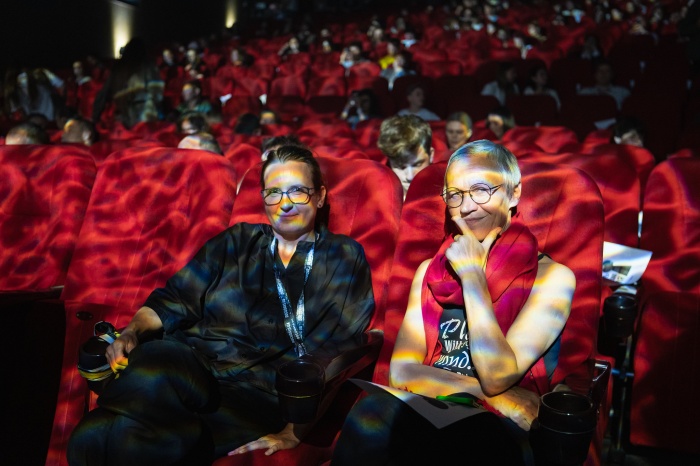
Anna Lazar during the Opening Ceremony of the 23rd Docudays UA. Photo: Andrii Tsykota.
Defining features of Ukrainian culture
In my view, what makes Ukrainian culture unique is that artists and writers are deeply embedded within society and share the same experiences as their society. Culture here is very close to real life, it responds to it directly and immediately.
I am not sure this works in quite the same way in other European contexts. There, culture is often linked to a certain economic privilege: you can devote yourself to art once your basic needs have already been secured. In Ukraine, by contrast, people often create out of an inner necessity — and from the experiences they are living through. It seems to me that this is one of the key and defining characteristics of Ukrainian culture.
Balance between experiment and responsibility
Culture is not something that can resolve a crisis or provide answers to every question. It allows us to look at ourselves from a distance, from a perspective that is not yet obvious. I believe that cultural institutions are spaces for experimentation, where unexpected decisions can be made and unique models can be created. Through cultural practices, society shapes its vision of the future and the present, constructing a narrative about its own identity.
Culture is also a framework for dialogue and polylogue, a space that allows us to experiment with ideas, ways of thinking, and sometimes even with action itself. But this space is not limitless, it always entails responsibility and choice. Not everything can or should emerge within it. Genuine culture must open outward, whereas manipulative propaganda does not have to. This is especially important in the context of information warfare, when certain narratives are easily recognisable as constructs designed to advance positions that are not our own. It is a difficult but fundamentally important balance.
For the institution where I currently work, the Ujazdowski Castle Centre for Contemporary Art in Warsaw, concepts such as courage, responsibility, and a willingness to experiment are essential, but so too are transgression and a readiness to make mistakes.
Experience and anticipation of Docudays UA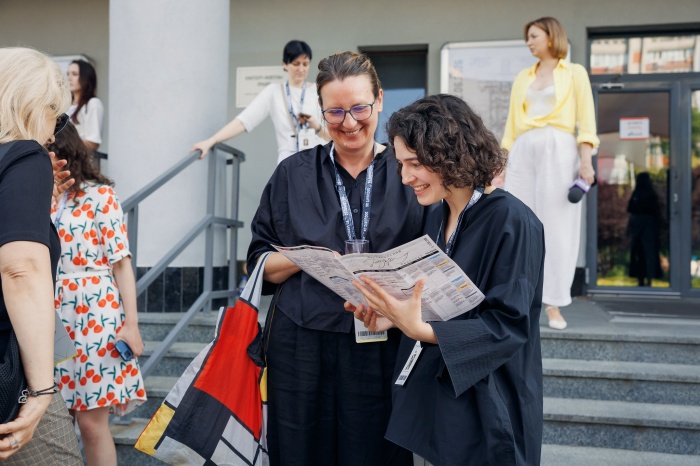
Anna Lazar and Maria Matiashova. Photo: Sergii Khandusenko
It is an honour for me to be invited to serve on the jury of such a festival. I believe my art historical perspective may be valuable. I do not have any specific expectations of Ukrainian documentary cinema. When I know in advance what I want art to prove to me, I lose interest in it. What matters to me is approaching it with a ‘fresh mind’, a willingness to follow a sense of authenticity, to recognise vulnerability, and at the same time to value fidelity to a civic position. Some films try to captivate through a familiar, often sentimental aesthetic of a disaster film. What interests me is something else. And when I find it, I will say so.
European context
It is important for me to see the agency of Ukrainians, including those who have non-binary understandings of themselves, as a principle that continually reappears. This is not something new; it is a long-standing characteristic of this land. Everyone likes to talk about the Cossacks, but it is worth considering who they really were and what the Wild Fields actually represented. They were people who did not want to be serfs and fled coercion. They said ‘no’ to violence and emancipated themselves through their own choices. And behind such choices there is always responsibility, a willingness to take risks, and an understanding that freedom must be fought for.
In my view, Ukraine’s struggle for independence and democracy — values we call European — is providing an important breath of fresh air for Europe itself, which today is being forced to rethink itself. It is terrible that this process is being paid for with Ukrainian blood. Yet I hope that Europe will make a much greater contribution to the Russian-Ukrainian war. In Poland, many people understand that Ukraine is defending not only itself but also Poland and all of Europe. By investing in support for Ukraine, we are investing in our own security.
At the same time, Russia’s aggression against Ukraine is an expression of a broader political construct that resonates in different parts of the world. It is important to understand whether Europe — with all its shortcomings — is capable of standing up to other geopolitical models and defending the values it claims to uphold: democracy and human rights. I believe in those values, and I believe that both institutions and individuals should invest in these principles.
Main photo: Anna Lazar at the 23rd Docudays UA. Yevhenii Zavhorodnii
The 23rd Docudays UA is held with financial support from the European Union, the Embassy of Sweden in Ukraine, and the State Film Agency of Ukraine. The views, conclusions, or recommendations expressed do not necessarily reflect those of the European Union or the governments of these countries. Responsibility for the content lies solely with the authors.