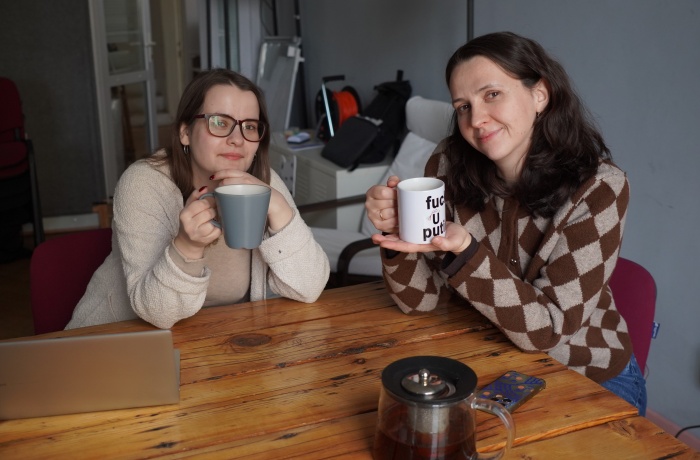
On the final pages of the Docudays UA guide, you can usually find the festival team. Next up is the fundraising department. It’s small, but it ensures the viability of all the festival’s projects. Editor Kseniia Opria and communications specialist Valeriia Sheremet spoke with their colleagues about their profession, their journey to Docudays UA, and the challenges of working during wartime.
Yuliia Kartashova, Fundraising Director at the Docudays NGO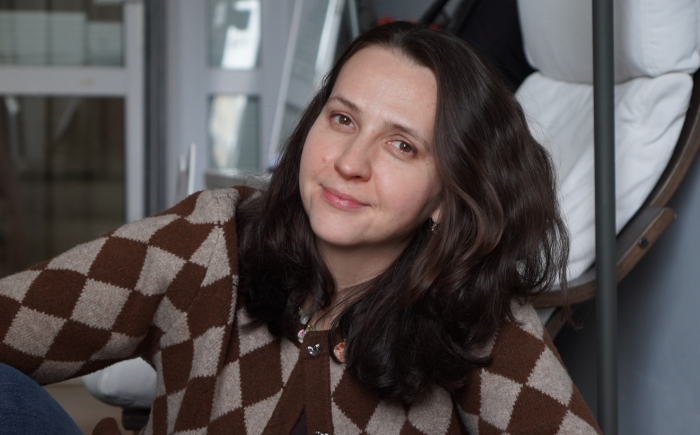
Tell us about your profession.
Once, my husband asked an AI something like, “Draw my wife, she’s a fundraiser, she raises money for a festival,” and it generated an image of a girl sitting at a table in the middle of a meadow; on the table was an empty jar labeled “festival fundraiser.” I found it hilarious because it has nothing to do with my job. Maybe that image would resonate in countries where crowdfunding and a culture of support are well developed — here, it’s only beginning to take shape, and right now it mostly works for the army.
How would you explain in your own words what fundraising is?
Fundraising is a comprehensive effort to attract funding for the implementation of ideas. It starts with a concept: when you clearly understand it, can envision the outcome, and calculate the budget, then it makes sense to think about funding sources. Most often, fundraising is associated precisely with this stage, but at Docudays it’s broader and closely tied to the implementation of the projects themselves: we monitor plans, deadlines, indicators, and work across several areas simultaneously — Docudays UA, the Traveling Festival, the Ukraine War Archive, the DOCU/CLUB Network, and cultural diplomacy.
How did you become part of the team?
You could say I was headhunted by Docudays. It was the end of 2016: I was giving lectures on fundraising, which I had learned at my previous job, and Viktoriia Leshchenko (editor’s note: at the time, Head of the Program Department) messaged me on Facebook with an offer to join the team. It was a difficult period in my life: I felt exhausted and was preparing to become a mother, so the only reason I came to the interview was the festival itself. I liked cinema, I liked Docudays UA, and I immediately felt that shared sense of values. I was honest about my doubts, saying maybe they should find someone else. To which Alla Mykolaivna Tiutiunnyk replied, “Yuliia, people have children here and come to the office with their babies — you don’t have to give up your career!”
What in this work remains invisible but is critical?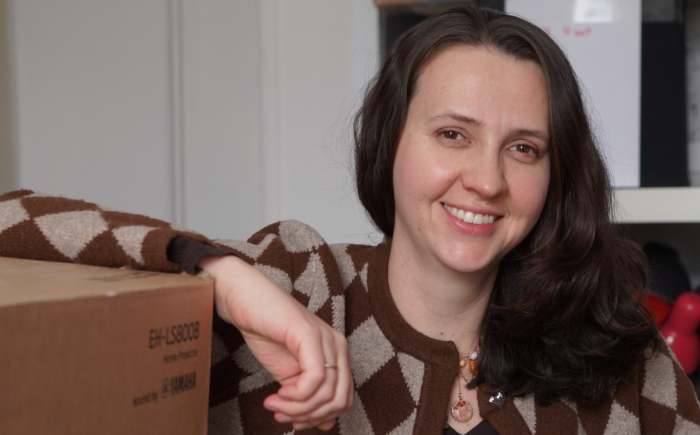
I think this work is generally quite invisible. Our main task is to secure funding on time or, when we see an opportunity, to offer it to the team. If this process is invisible, it means everything is working properly. The most important and least visible part is internal communication: between creative and project teams, communications specialists, financiers, and lawyers. You often have to act as a bridge between the bureaucratic world of agreements and reality, explaining complex wording in simple terms.
What is the most difficult thing for cultural projects in fundraising during wartime?
In fact, grant projects — both international and state-funded — are the only thing supporting us, of varying scale, for individuals and organizations. While the state and public support are focused as much as possible on the Defense Forces and saving lives, we are grateful that partners still have the capacity to fund social and cultural projects. We truly do a lot to develop Ukrainian culture and strengthen Ukraine’s voice in the world.
What helps you through difficult moments in your work?
My family keeps me grounded — I’m very lucky that everyone is close by. And also this sense of long-term planning, which gives direction and confidence that a good life is possible. We still plan our projects with a positive outlook and dream of implementing them in peacetime, after Ukraine’s victory.
Anastasiia Humeniuk, Fundraising Manager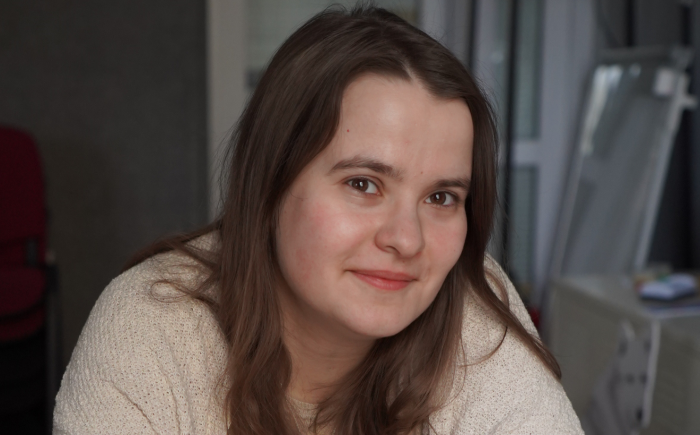
How did you become part of the Docudays NGO?
In April 2023, there was an open call for my current position. I was looking for a job, and I had known about Docudays since 2018, when I volunteered there. After that, I attended the festival almost every year and kept trying to join the team. In 2019, I actually succeeded: I worked with the Filmchief festival management system. Over the years, I gained experience in other organizations and companies. And eventually, I joined the festival team.
What helps you stay strong in difficult times?
A really great community sustains me. I genuinely love everyone. I work in a wonderful department, and I have an incredible supervisor. I’ve learned a lot from her and continue to learn. We both live in Kyiv, going through blackouts and shelling, and we often text each other, “How are you?”
My colleagues are amazing people working in different parts of Ukraine; they’re professional, inspired, and supportive. And when you’re surrounded by such people while developing complex applications and communicating with potential donors and partners, it makes the work much more enjoyable — even in the difficult conditions of war. I see the value of my work and grow as a person.
Where can people find you at the festival? Where are you physically and emotionally?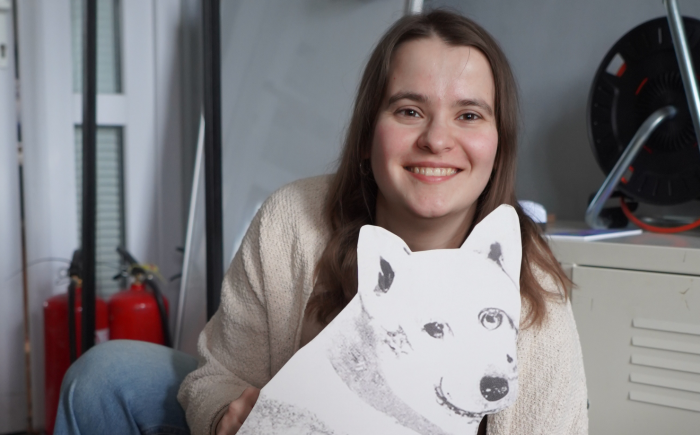
Physically, I’m usually at the Zhovten cinema, our main venue. I like seeing in real life what has been achieved after all the planning. It energizes me to see what was once just words on paper become reality. Emotionally, I’m also within the Docudays UA community — our team, as well as stakeholders, partners, volunteers, and audiences. When you come to the festival, you always see familiar faces. You may not know their names, but you understand they’re part of our community. Even some animals are regular guests.
Despite the intense days and workload, what typically stays with you after the festival ends?
A feeling that we did it. I always have it: wow, we did it! On a practical note, our merch stays with me forever: T-shirts, tote bags, and stickers. I really like our approach to merchandise — it’s always diverse and of high quality.
Which films or events from this year’s Docudays UA program are you most looking forward to as a viewer?
I always attend films from the national competition. This year, I want to see Silent Flood by Dmytro Sukholytkyy-Sobchuk on the big screen — it won Best Cinematography at IDFA in Amsterdam. For me, it’s critical to watch and support Ukrainian cinema. And, of course, to share our culture.
Photos: Nika Popova
The 23rd Docudays UA is held with financial support from the European Union, the Embassy of Sweden in Ukraine, and the State Film Agency of Ukraine. The views, conclusions, or recommendations expressed do not necessarily reflect those of the European Union or the governments of these countries. Responsibility for the content lies solely with the authors.