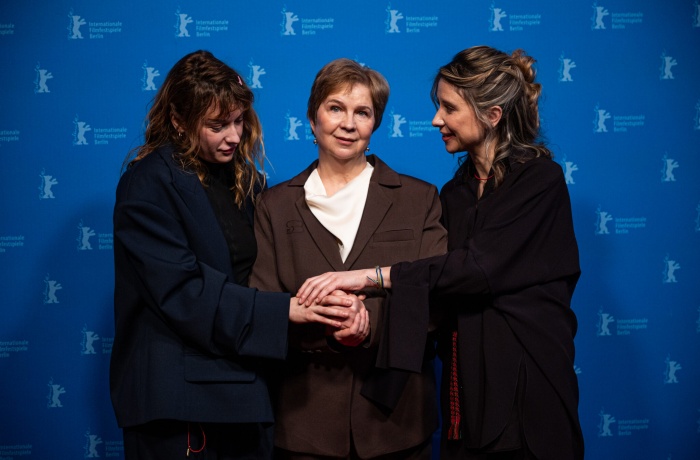
Read the final conversation from the series of interviews with the authors of Ukrainian feature films. Alisa Kovalenko and Marysia Nikitiuk, directors of the film Traces, which is taking part in the DOCU/UKRAINE competition.
Alisa, you have both the experience of conflict‑related sexual violence (CRSV) and of living through its trauma. You were among the first to speak openly about this issue. How did this shared ground with the protagonists shape your work? At what point did you decide their stories should be told through film, and how difficult was it to begin the project?
Alisa Kovalenko: It is a long story that began with my captivity and the sexual violence I endured there, which I did not speak about for almost two years. It was difficult to share this with my loved ones, friends, and family. Thanks to the Theatre of Displaced People, I first told my story to one of its founders, Eduard Zhenot, and that led to an attempt to reflect on trauma through documentary theatre. It was extremely hard; at the time I could not even understand whether it was hurting me more or working as therapy. Perhaps only years later did I realise how important it was that I broke an inner wall and shared this experience.
Following the documentary performance Captivity, the Ukrainian Helsinki Human Rights Union reached out and asked me to provide testimony. I wanted to know how many other women had suffered sexual violence and torture in captivity, and I was told I was the first to speak openly about such experiences in the context of war. Very few were ready to testify or to speak publicly about CRSV — the official term for conflict‑related sexual violence.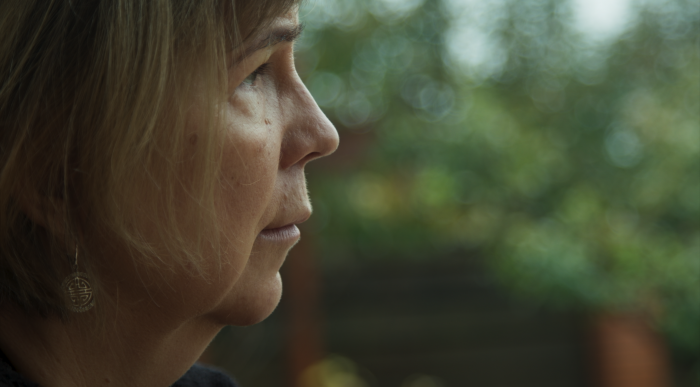
A still from the film Traces. Iryna Dovhan, the protagonist of the film.
Some time later, I was approached by Iryna Dovhan, the central protagonist of the film Traces. She had endured captivity, horrific torture, and sexual violence in Donbas. Iryna invited me to the first gathering of women who had suffered sexual violence and torture. There were fifteen of us, and it was a very unusual meeting — we could hardly understand what we might do together, women of different ages and backgrounds. The meeting was held with the support of Dr Denis Mukwege’s foundation. He is a Congolese doctor who helped thousands of women affected by sexual violence during the Second Congo War and was awarded the Nobel Peace Prize. He founded a foundation that supported women in Ukraine to come together and begin their advocacy work — they wanted to build a network of mutual help and support. During those two days of meetings, we tried to identify our areas of activity, and from the very beginning one of them was memory preservation and documentation. The idea of a documentary film naturally emerged as a tool for documenting, preserving memory, and advocacy. It so happened that I am both a survivor and a documentary filmmaker, yet for a long time I was afraid to take on this subject — the question kept resurfacing, and I would say I was not ready. This continued until the full‑scale war began, when we witnessed the horrific extent of war crimes, including crimes of sexual violence.
In 2023, our organisation SEMA Ukraine — formed solely of women survivors who support one another and engage in advocacy — held a board meeting. We received a proposal from the Denis Mukwege Foundation, our biggest partner, offering a small grant for documenting crimes against humanity. Personally, it gave me the push I needed. Our board voted on whether or not to make a documentary film, but it was clear to everyone that now was the time and that it was crucial to amplify the voices of survivors, to highlight the struggle for justice, and to speak out about the crimes of sexual violence committed by Russia. I feared it might retraumatise me, dragging me back into the past and my own wounds, but I realised it was worth stepping beyond that. And so we began work on the film.
My decision to begin work on this film came first and foremost from the heart — as a survivor, an activist, and a member of the community of women for whom it mattered deeply. We agreed that this would be a project born from the heart of the community, not simply my directorial work, but our collective project built on mutual support and trust. That is how it all began. Iryna had already started recording women’s testimonies, documenting a wide range of war crimes. I joined after the liberation of the Kherson region: she found the women, and together we documented their testimonies. For me, that was the beginning of of our work on the film.
Tell us about the experience of co‑directing the film. What moments felt most effortless, and which challenges were the hardest to overcome?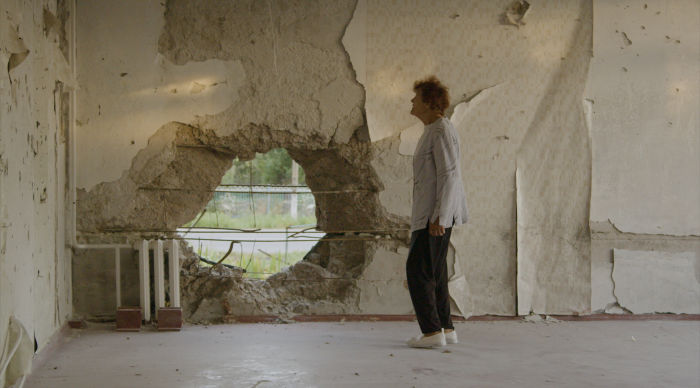
A still from the film Traces. Liudmyla Mefodiivna, the protagonist of the film.
Alisa: The first stage was very difficult, because it meant working with incredibly harrowing experiences, with pain. When you are immersed in that pain, listening to testimonies for hours on end, one after another, it is extremely hard. Honestly, I lost some inner faith that I could make this film — I began to have nightmares with elements of the testimonies of torture and abuse of other women. I realised how important it was to have a creative partner by my side, and I reached out to Marysia. That is how our collaboration began — a path from my human rights work to creative cooperation.
At the beginning, we thought it might take a hybrid form, since everything started with testimonies and there was not yet a defined visual language. Marysia had experience in documentary theatre as well as extensive work in fiction cinema, and I felt it could be interesting to combine these in an experimental format. But when I began filming, it was more about capturing the atmosphere of survivors’ lives — I never recorded interviews where someone simply spoke to the camera. I started searching for this language in the everyday lives of the women protagonists, and that is when Marysia and I realised we should follow a documentary path and leave behind hybrid experiments.
Marysia Nikitiuk: Co‑directing is quite challenging, especially in our circumstances. The subject itself carries a deeply traumatic weight. It is Alisa’s story, and for me it resonated as a citizen — the potential to confront the aggressor was immediately clear. This is the very soft power we often speak about, and it was obvious that my efforts belonged here. Since I am not a bearer of the trauma, I had the choice of whether to work with this theme. Immersing myself was difficult, even painful. I see myself more as a supporting director. We began with the idea of experimenting with a hybrid form. I am a great admirer of Adina Pintilie’s Touch Me Not, which I consider a fascinating and high‑quality example of diffusion between fiction and documentary cinema. As Alisa gathered more and more material, it became increasingly clear that reality in this context was sharp and did not need to be diffused with anything else. We made the right decision to abandon experimental searches, stylistic forms, and aesthetic embellishments. We turned instead to the idea of classic documentary, so that the subject itself, the story itself, could resonate both as advocacy and as an artistic act, even on such a harrowing theme. From there, we shaped the structure together, edited, and worked side by side. It was a necessary experience of collaboration, and I believe we achieved a strong result.
In dealing with such a painful subject and the personal testimonies of the women, how did you and the crew help one another to keep going?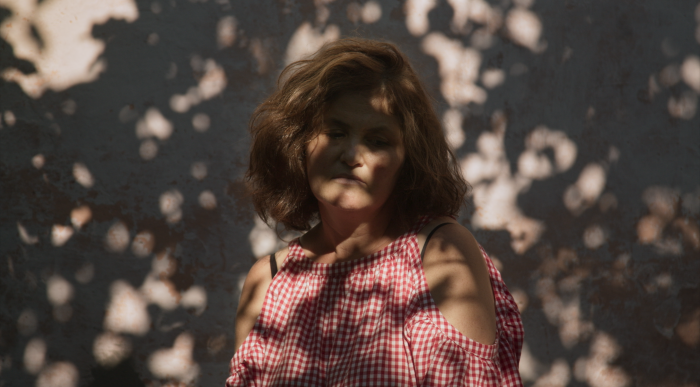
A still from the film Traces. Olha, the protagonist of the film.
Alisa: When you are no longer alone in this, when you can reflect on the traumatic experience together with the team, it does not destroy you as much. The worst thing is isolation within trauma. When we live through something together, it becomes a little easier to bear. There are even forms of torture, such as solitary confinement, which are extremely hard to endure in captivity — deliberately designed to break people, because isolation makes them feel far more oppressed.
Marysia: For me, the film was about sisterhood and the power of mutual support. In a way, it grew as a gesture of support for Alisa. It is like offering a shoulder — you cannot carry another’s pain entirely, but you can create a connection where pockets of warmth, understanding, and solidarity appear. This became a source of strength that helped us move forward.
Alisa: We also felt great support from Iryna, the main protagonist, for whom this was deeply significant. She had been a driver of the process since 2019. It matters enormously when the protagonists and the whole team share a common energy, motivation, and awareness that they are creating something important together. This creates a strong sense of mutual support, which plays a vital role when working with such traumatic themes.
How have international audiences responded to Traces? What journey do you see ahead for the film, and what impact do you feel it may — or already does — have both in Ukraine and internationally?
Alisa: From the very beginning, when we decided to make the film, we embedded an impact campaign into its concept. In a way, the film became a continuation of the advocacy work of SEMA Ukraine. It was an inseparable element: we knew we would run an impact campaign and try to use the film as a tool, a shield, a sword, a loudspeaker — in every way possible. During the Berlinale we announced the launch of our impact campaign. At the national level, we will continue breaking the wall of silence and stigma, working within communities, screening the film in de‑occupied territories, and engaging with law enforcement structures to promote and implement a survivor‑oriented approach in investigating CRSV crimes. We now have a joint project with the association of women lawyers JurFem. They developed a project to design and implement a special course on CRSV for law faculties at universities, and they proposed including the film in the curriculum. This means that future prosecutors investigating war crimes, including CRSV, will approach survivors with greater empathy thanks to this course and the experience of watching the film.
A still from the film Traces
Actually, together we shaped the notion of active empathy. It is not only about compassion or sharing pain, but about empathy that transforms into action, inspiring one to join the struggle and stand side by side. It is not about pity or saying, “Oh God, how terrible this is.” We reflected for a long time on how to embed this active empathy into the film. The moment of clarity came at the Berlin premiere: the entire audience stood and applauded. We saw people’s eyes filled with tears — not of pity, but of inspiration. Afterwards, many viewers came to us and said that although the film deals with a very difficult subject, it gives strength, it fills and inspires, and makes them want to join the struggle. It was an incredible feeling: we had achieved something. Not simply “made a film,” but embedded something important, and we felt it in the cinema. This was the case at many other festivals — in March we had a major tour, and everywhere the feedback was similar.
As an organisation, we have long worked to change the narrative — to move away from the image of the silent victim in tears, towards the survivor. In English, survivor is such a powerful word; in our language it is harder to capture, but it means those who endured, those who overcame. This shift is vital, because conflict‑related sexual violence remains the most silenced and stigmatised war crime in the world. History shows how hard it is for survivors to speak, and yet another step is just as important: turning pain into strength, trauma into post‑traumatic growth, dignity’s triumph over evil. It was very important for us to shift the focus — not simply to show trauma, suffering, blood, and crimes, but to highlight, against this horror, the triumph of human dignity, solidarity, and mutual support. We wanted to show that women become subjects in their own right, active advocates for their rights, fighters for justice. In a broader perspective, this is about all of us, because we have broken the narrative of the classical victim. We have resisted for many years, we have proved our agency, and it is important to bring that to light.
Marysia: I witnessed active empathy in action when, after the Berlin premiere, people came up to us and directly asked how they could help and get involved. We immediately directed them to SEMA Ukraine. The film fulfils its artistic function, sharing experience while also shaping a new narrative — essentially a hero’s journey. That is why it resonates so strongly: we see people who have endured and can move forward. This shift from the victim paradigm is deeply inspiring. The film carries a lightness, and I believe it will continue to radiate that impact.