About the Author:
Asia Pavlenko is a cultural studies researcher and critic, working as a Performing Arts Programme Manager at the Ukrainian Institute.
My first venture into documentary theatre was Who Is Heard in the Beilis Case, created at the Jam Factory Art Centre in 2022. Directed by Dmytro Levytskyi, the piece wove together archival materials and personal letters from the fabricated trial of Kyiv Jew Mendel Beilis with actors’ testimonies of the full-scale war. Anastasiia Lisovska remembered the occupation of Borodianka, Piotr Armianovskyi reflected on life in Donetsk, and Oksana Leuta shared a blurred photo taken moments before their car came under Russian fire, causing her concussion. French journalist Frédéric Leclerc-Imhoff, whom she accompanied, was killed. Each story is conveyed with utmost care — sometimes through almost ASMR-like recollections whispered into headphones, at other times through images and whiteboards where slogans are constantly erased and rewritten to be carried across the stage. Over time, the meaning of the document itself changes. Watching the performance a year later, when the actors once again rewrite the slogans, the phrase “Kherson is Ukraine” resonates with warmth — the territory has only recently been liberated.
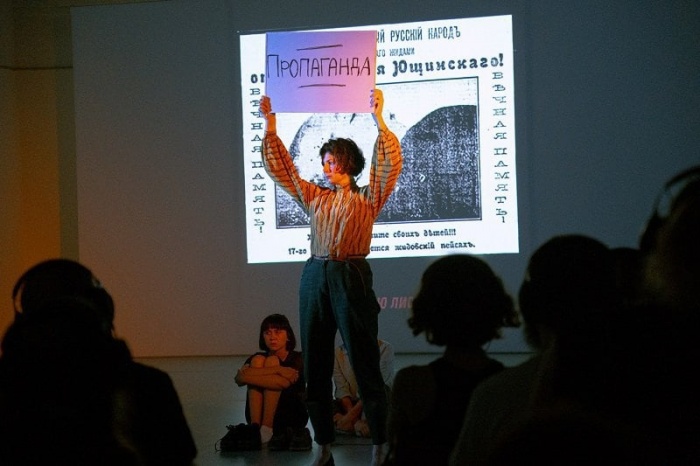
Who is Heard in the Beilis Case performance. Director — Dmytro Levytskyi, playwright — Lesia Berezdetska, performers — Anastasiia Lisovska, Piotr Armianovskyi, Nadiia Kalyniuk, and Oksana Leuta. Jam Factory Art Center, 2022. Photo: Olha Klymuk.
Documentary theatre arises from the need to respond in the here and now. During the Bolshevik Revolution, “living newspapers” emerged — swift stagings of news for illiterate audiences, serving propaganda and mobilisation. After the Second World War, amid tribunals of Nazi perpetrators and a reassessment of values, theatre was seen as a space for testimony. The realm of documentary theatre shifted from transmitting detached facts to becoming compassionate and self-aware. Here, its focus lies on the link between major historical events and the destiny of a single person. To capture the voices of witnesses, plays incorporated hearing transcripts or direct fragments of interviews — a practice referred to in theatre as verbatim. Over time, community members themselves began to contribute to the writing or performance of texts, giving rise to the theatre of witness.
This sets in motion an endless cycle of exchange between directors, who listen to others’ stories, actors, who embody them, and people who contribute their own experiences to the text. Gradually, the boundary becomes thinner: individuals with lived experience (“reality experts”, as Olena Apchel calls them) begin to write the final texts and step onto the stage themselves. They no longer need to be replaced by actors, while those who once performed on behalf of the theatre take on the role of narrators, bringing their own lives out from behind the curtain.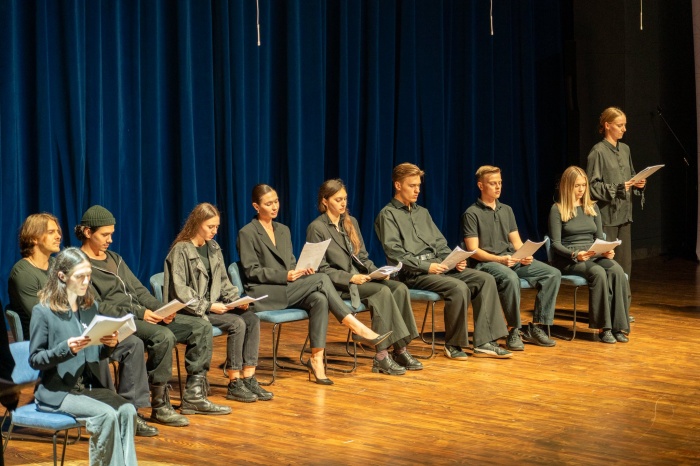
Second Festival of First Plays. VeteransTheatre, 2025. Photo: Territorial Defense Forces | TRO Media.
The strength of documentary theatre is revealed less in isolated projects than in the effort to establish infrastructure. This means lasting networks and institutions that stay connected with communities, run collective workshops to support participants in their first plays, and manage readings, productions, and public festivals as meeting points and showcases. In Ukraine, a notable and successful example is the Veterans’ Theatre, created through the collaboration of TRO Media and the Playwrights’ Theatre. Veterans and their families write their own texts with the guidance of playwrights, while the Veterans’ Theatre helps bring these works to audiences through public readings. If one unravels the lineage of documentary theatre in Ukraine, it soon leads to a chain of Theatre of (fill in the blank). Playwright Maksym Kurochkin became involved in the Veterans' Theatre and the Playwrights Theatre, and earlier in the Theatre of the Displaced. Alongside Natalka Vorozhbyt, German director Georg Genoux, and military psychologist Oleksii Karachynskyi, the team worked with internally displaced people, helping them to transform their experiences into texts and productions. As part of the project, filmmaker Alisa Kovalenko also created a play from her own story, having survived captivity in Donetsk in 2014. Vorozhbyt and Genoux additionally travelled to frontline towns in Donetsk and Luhansk, where they brought local schoolchildren together with Ukrainian soldiers in collaborative work. Every journey led to a performance staged in the same towns. Central to the work was the principle of “not to judge” — embracing all experiences, even those considered socially unacceptable. In Ukraine, documentary theatre becomes a tool for advocating the rights of those whose voices cannot be heard directly. One example is the Ukrainian Institute’s wider project Crimea 5 am, where Natalka Vorozhbyt and Anastasiia Kosodii engaged with the stories of political prisoners, journalists, and their families facing persecution by Russia after the occupation of Crimea.
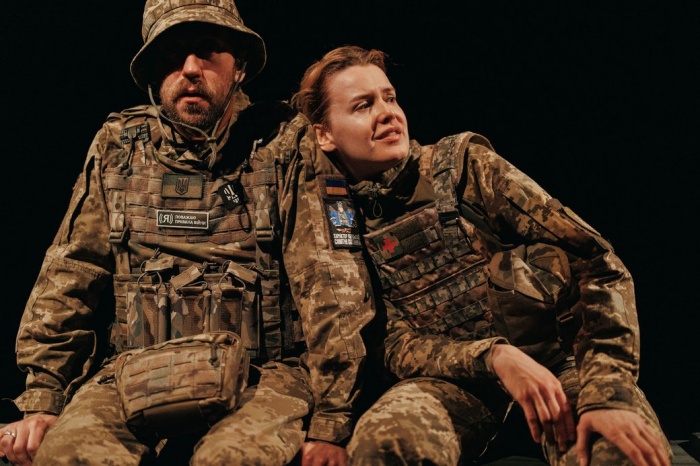
Military Mother. Director — Oleksandr Tkachuk, based on a play by Alina Sarnatska. Veterans Theatre, 2024. Photo: Oleh Palchyk.
It is not only playwrights who use the instruments of documentary theatre — journalists do as well. When statistics and broad facts fail to stir empathy, journalism embraces the immediacy of live performance. Music, visuals, movement, and the physical presence of storytellers forge a deeper bond with audiences, turning each encounter into something singular. In the US and France, journalists have revived the “living newspaper”, reshaping news and reports into performances with dance and theatrical elements. Radio also taps into the heritage of documentary theatre.
This year, the DOCU/SYNTHESIS programme will feature screenings of the project Radio Live, where people from countries affected by war share their personal stories. Unlike performances with pre-written scripts, Radio Liveunfolds through questions posed by the director-facilitator and answers that may differ each time, even in a single detail. The performance remains flexible, responding to recent events in the lives and countries of the performers. Much depends on who is present in the audience and whether participants have managed to arrive, sometimes from under shelling. As a performer Oksana Leuta puts it, “This is radio that wants to become theatre.”
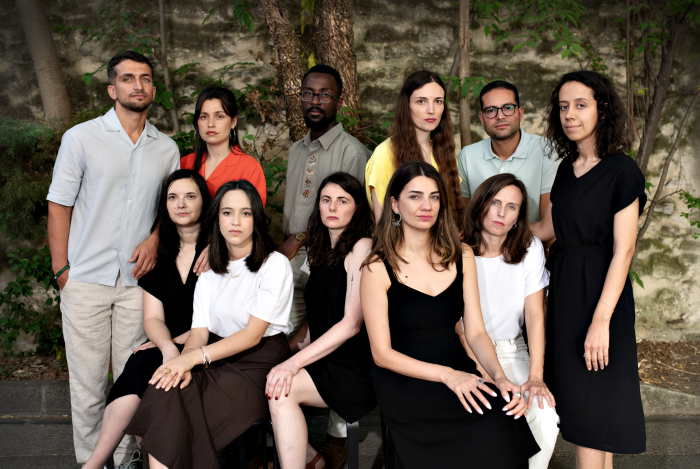
Radio Live project’s team. Photo: Yohanne Lamoulère.
“We're still looking for the right words to describe the performance. Of course, it became a theatre, a performance, and a documentary. But it's something that came from my journalism and radio work more than it came from theatre. With documentary theatre companies I know, it's different and more written, there's a script, even if it comes from testimonies,”
admits the project’s director, French journalist Aurélie Charon.
Radio Live is the result of her practice and numerous journeys to countries that have experienced, or are still experiencing, war. Throughout this time, Aurélie maintained contact with new acquaintances she met during her travels, and with the intention of long-term collaboration, Radio Live was born. Live radio aims to cultivate empathy and curiosity in audiences towards other contexts through the performers’ personal stories and universally recognisable, human images. The team also includes illustrator Gala Vanson and composer Emma Prat. Gala creates visual materials from photographs and videos constantly exchanged between the performers and the director. Meanwhile, Emma collects songs important to the participants, studies the music and languages of their countries, and produces arrangements that she later performs live.
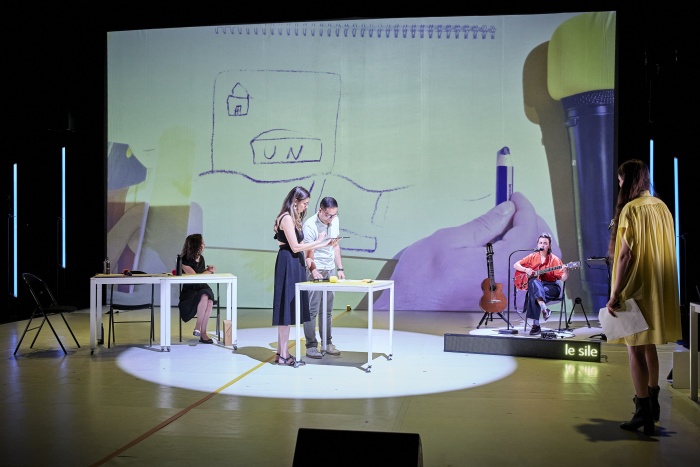
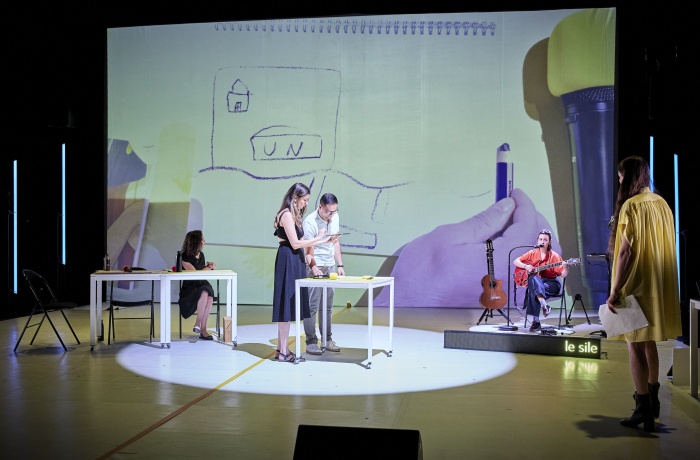
Radio Live show. Amir Hassan’s story. Photo: Christophe Raynaud de Lag.
“Working with journalists, I know that every second counts. You need to be very quick, very informative. In this performance, there are a lot of pauses. Because of these pauses, there is more of the air, and I think there's a place for people to process, to think, and to understand,”
adds Oksana.
In 2023, I saw Oksana Leuta perform in Lviv; now she appears on my screen while Radio Live tours France. The next destination is Kyiv, where at Docudays UA she will go on air with live radio, speaking from and about herself together with other participants of the project.
The documentary performance Radio Live, as part of the DOCU/SYNTHESIS programme, is taking place with the support of the French Institute in Ukraine.
The 23rd Docudays UA is held with the financial support of the European Union, the Embassy of Sweden in Ukraine, and the State Film Agency of Ukraine. The views, conclusions, or recommendations expressed do not necessarily reflect those of the European Union or the governments of these countries. The authors alone are responsible for the content of this publication.