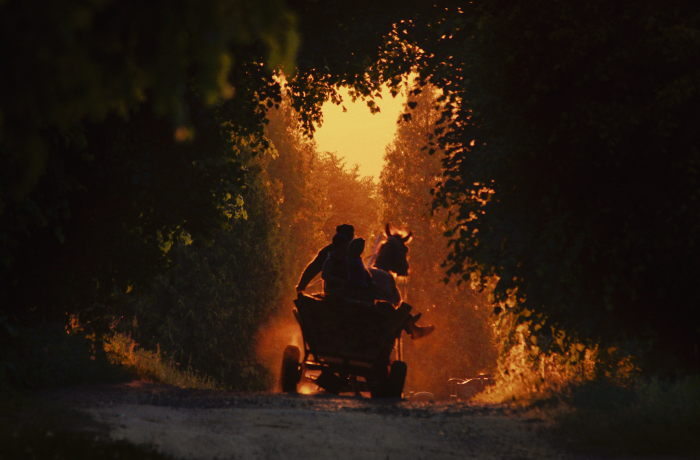
We continue our series of interviews with Ukrainian feature‑length directors — this time we spoke with Dmytro Sukholytkyy‑Sobchuk about his film Silent Flood, which is competing in the DOCU/UKRAINE section.
How did Silent Flood begin for you? I’m curious about where the idea came from. Did it start with a place, with the story of the river? Was it unfolding as our journey through the film does, from a specific location and memories of it, through the Second World War, to the local community and eventually the military? Or did your encounters with the people and places take shape in a less linear way?
It began back in 2004, when I was studying at the Faculty of Philosophy and Theology in Chernivtsi. At the time, I was fascinated by the idea of travelling downriver, and a friend introduced me to a wonderful man — Ihor Kuzmych, a rafting instructor. That summer he said to me: “Gather some people and we’ll go with two or three catamarans.” As it turned out, no one else could make it, so it was just my fellow student Andriy and my colleague Maksym, who worked with me at the Chernivtsi cinema where I was employed as an artist. So the three of us, together with Ihor Kuzmych, set off on that rafting trip.
We set off from Halych.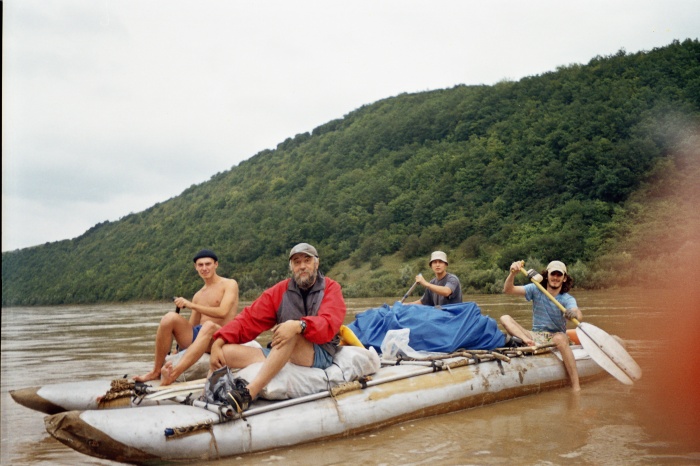
Photo from the first rafting trip, featuring instructor Ihor Kuzmych. Provided by Dmytro Sukholytkyy-Sobchuk.
That year there was a flood — one of the largest natural disasters in the region. It felt as though the rafting trip would never happen; right up until the last moment everything was uncertain. But eventually we set off: we took to the water, which was still very high, as the flood had only just subsided. Everywhere we stopped along the riverbank, people told us stories about the flood — what it had done, how it had affected them. Walking along the shore, we could see the muddy trace a metre and a half above us, marking how the water had gradually receded.
All the while, our guide spoke about the places we passed and the villages along the way. He was a deeply knowledgeable man — sadly, he passed away about fifteen years ago. I was struck by how many markers and points of reference there were. For instance, the fortresses of the Halych‑Volhynian principality, and countless ruined bridges. He told us the stories of each one: “This bridge dates back to the Second World War, and there was another from the First World War, though it can no longer be seen — we only heard about it.”
At one point we reached the place where this community lived [the one Dmytro observes in the film — ed.]. I had a camera — still a film one — and I took three photographs. Ihor told us about this community, known as the , who do not use electricity and reject the conveniences of civilisation: no telephones, nothing of the sort.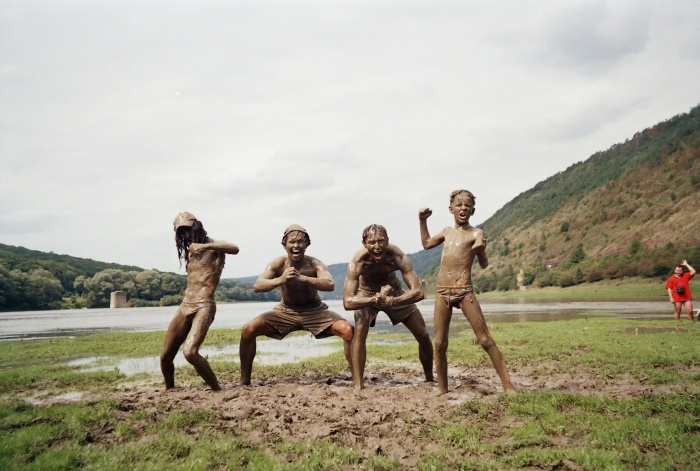
Photos from the rafting trips against the backdrop of destroyed bridges. Provided by Dmytro Sukholytkyy-Sobchuk.
After that, I continued rafting for several more years — I even received instructor status and organised trips myself. Along the way I gathered some information, as the village was very intriguing. At one point during a trip we simply passed by the community, spoke briefly with locals. Later, when I was studying at Karpenko, I decided to go rafting again with friends from the film faculty, but this time I took a camera to try filming something. It was my second year, and I wanted to shoot a documentary sketch. That was my first encounter: some people ran from the camera, others turned away. I walked around the village — we stayed there for two days — and encountered complete refusal. That was already the second attempt — in 2009 or 2010. They refused any filming, but the expedition left me with many photographs and some fragments of information. After that I forgot about them for a long time. In 2021, once the shooting of Pamfir was complete, I wanted to make a documentary that would take me back to places I felt drawn to. They seemed like an abandoned paradise. That was the beginning of the third attempt. I thought then that I had enough energy, resources and experience to enter into dialogue and persuade someone. We agreed to collaborate with Tabor and Liza Smit, and producers Karina Kostyna and Yevhen Rachkovskyi joined us as well.
How did you manage to gain the trust of such a closed community? Did they allow filming straight away? How did they respond to the idea of a film in general, and how did your relationship with them evolve?
Even when people live on the margins of certain processes, those processes still reach them — and in 2021 the key factor was ecological issues. I began visiting the community gradually. It was, I think, October 2021, and I went there twice. I knew I wouldn’t take out the camera straight away, and then it became impossible anyway, because the full‑scale invasion began. In those first weeks we tried to orient ourselves, to decide what to do next: at first there was some volunteer work, and then I realised it was important to record what was happening to us. That was when I started making The Liturgy of Anti‑Tank Obstacles, and we asked ourselves: what was happening there, in that place?
Looking back at my first student encounters, the community either kept away or rejected any interaction. Now things were very different: it mattered to them, and the full‑scale invasion had shaken everyone. Their community has its own hierarchy, with elders, and they were willing to talk. That was the beginning of our relationship.
Journeying down the Dnistro, we passed villages stretched along its banks — each distinct, sometimes even belonging to different administrative regions. Travelling by land would have meant huge detours, so we concentrated on three riverside villages: Mostyshche, Kosmyryn and Stinka. In each, our encounters with local leaders and residents took different shapes: in some families welcomed closer contact, in others the ties remained more distant.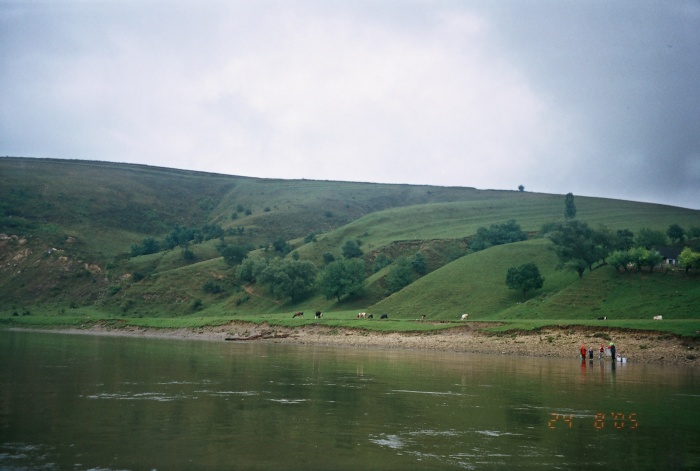
The first photo of the community. Author: Dmytro Sukholytkyy-Sobchuk
The journey stretched over four years. There is a paradox in how an external force can overturn a Bosch‑like image of life — from paradise into hell — even though those places saw no fighting in 2022–2024. The points of reference were always floods or wars. In fact, wars, the Second World War, the ruined bridges — these became their coordinates, the way they mapped the world. In other words, from flood to flood, or from war to war. The younger the generation, the less they recall war and the more they recall floods; the older the generation, the more these points feel like tectonic strata. That became the subject of my observation. The community’s home lies on what was once the frontline of both the First and Second World Wars — something the locals repeated often, and which we confirmed from other sources. The paradox touched me profoundly, and I asked myself: in what ways does it transform them?
In the village of Kosmyryn we found the closest contact: with Mr Roman Bilak, head of the village council, and Ms Uliana, head of the territorial community. They supported us in every way — with contacts, advice, everything. They also helped with members of the community. A few families agreed to let us join them for certain events we could record. Everything else was, so to speak, off limits. Through this contact we saw how the village lived and how humanitarian aid was collected.
Andrii Buchynskyi, one of the members of the wonderful organisation Volunteers of Buchachyna coordinated the collection of provisions for the front and, with his colleagues, organised major volunteer convoys. Thanks to this organisation we managed to accomplish the most difficult part of the film: recording the young men from those villages. It was the greatest challenge, and it was overcome thanks to the Volunteers of Buchachyna.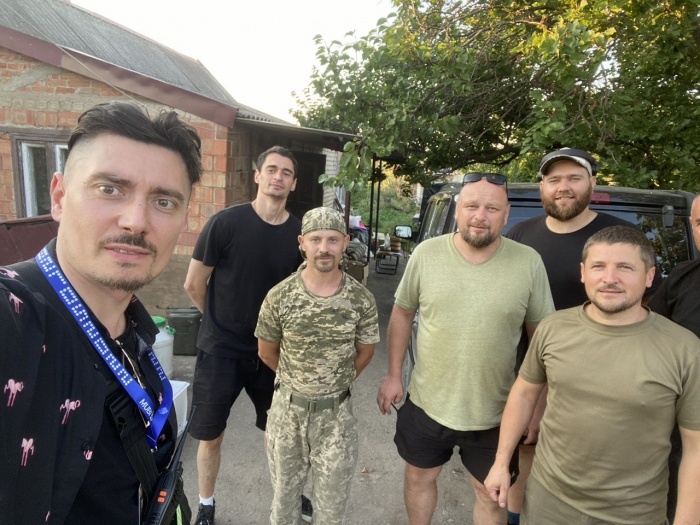
Dmytro Sukholytkyy‑Sobchuk with Volunteers of Buchachyna.
The challenge was this: in villages where members of this religious community live, alongside people of other faiths whose families had relatives on the frontline, we needed to find those relatives. Andrii helped locate the young men from those places who were serving. When humanitarian aid arrived, it was necessary to find them, to arrange matters with their commanders, and then to reach their positions and capture the moment when they received a small message from home, recalling those peaceful, Eden‑like riverbanks. It proved to be an even tougher challenge. All too often, by the time we travelled to our destination, news came that a soldier had been killed, or permission to film was denied. At the outset we might have had thirty contacts, yet by the time we reached the location to film, only three to five remained — and not all of them could be filmed.
The film conveys a particular sense of time’s flow, contrasting with our perception of the present. How did you search for this rhythm and work with the shots? Do you see nature in Silent Flood as an autonomous protagonist?
With a single protagonist the narrative takes a different form: it involves more dramaturgy centred on the character, on how he overcomes obstacles — and in that sense such cinema is close to me. In the case of Silent Flood, it was a continuation and a search for a cinematic language I most enjoy, that of a philosophical essay. We move from seeing certain blocks of information on screen, assembling them together, and then, with this information, we travel the whole path and compose the portrait as a whole. It can be described by the Latin phrase pars pro toto — the part stands for the whole. So when we speak of this small community, we are in fact speaking of society as a whole — of its desire for peaceful existence, of the historical layers present in a place once marked by war. Yet narratively and historically we shift, through the language of cinema, to those places now experiencing the fiercest phase of war, places we as a nation hope will, in time, become small islands of Eden‑like feeling, where people can return to their homes and measure time by such events. It is the moment when we imagine ourselves in places that are now too dangerous to walk, places recently de‑occupied, still in the process of de‑mining.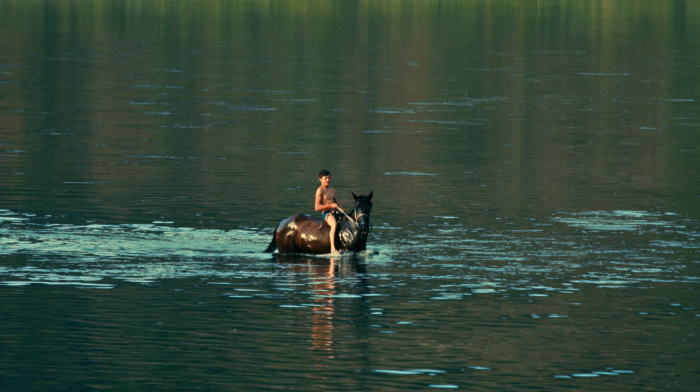
A still from the film Silent Flood.
In your practice, how do you balance documentary with fiction? What do you see as the strengths of each, and in what ways do the approaches overlap in your filmmaking?
Documentary cinema is a kind of inoculation against forgetting what reality is, and against feeling like a guest within it. Fiction cinema, on the other hand, is the possibility of creating something that looks real, but here you control everything you construct, because fiction allows you to build your own ersatz reality, while documentary works directly with reality itself. I feel that documentary cinema has had a profound influence on me, and it is the best thing that could have happened in shaping my fiction films. This alternation — here fiction, there documentary — keeps me ‘fit’, and I manage to do it very organically.
Main photo: a still from the film Silent Flood.