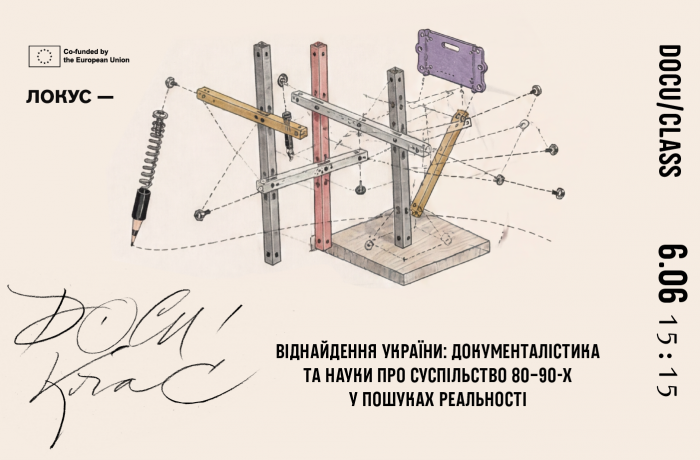
Disclaimer: This event is part of the special programme “Deconstructions,” launched and carried out with the financial support of the European Union within the FILMDECO project, in consortium with two European film festivals — One World (Slovakia) and Verzió (Hungary) — to critically rethink the legacy of colonial policies in Central and Eastern Europe.
The rapid development of documentary cinema in the post-Chornobyl period was an attempt to return to reality and to portray it beyond the framework of official ideological clichés. At the same time, in the second half of the 1980s and throughout the 1990s, Ukrainian sociology as we understand it today was taking shape — transforming into a fully fledged empirical science that studies society beyond the dogmas of totalitarian “historical materialism.” These two processes of empirically studying society unfolded independently of one another, yet were driven by a shared cognitive impulse — the desire to return to reality, to understand it, and to explain it. Sociology and documentary filmmaking pursued this through their own analytical means, but in their orientation toward a common goal, they reflected the pivotal era of the late twentieth century.
Within the framework of our event, we will attempt to examine this unexpected parallelism between documentary filmmaking and sociological science as practices of liberation from totalitarian clichés and of studying social processes in the complex contexts of the late USSR and the formation of independent Ukrainian statehood.
Speakers:
Alona Penzii, Yevhen Holovakha, Yurii Tereshchenko
Moderator:
Volodymyr Shelukhin
Volodymyr Shelukhin is a sociologist, essayist, and lecturer at the educational agency Locus, and an associate professor at the Faculty of Social Sciences at the Kyiv School of Economics. He was a co-founder of the sociological journal SVOYE and has contributed at various times to Ukraiinska Pravda, Den newspaper, Krytyka, among others, and served as editor of the LitAktsent portal (2018–2019). His current primary field is the history of Ukrainian sociology and the connections between early sociology and art and literature.
Alona Penzii is the head of the Film Archive at the Dovzhenko Centre, a film critic, and a curator of film and exhibition projects.
Since 2018, she has been working at the Dovzhenko Centre, researching the history of Ukrainian non-fiction cinema, including animation. She has curated retrospectives of Ukrainian cinema at international and national venues. In 2022–2024, she was a co-curator of film programmes at the Dnipro Center for Contemporary Culture (DCCC). She co-curated the exhibitions “The river roared, howled like a wounded beast” and “In a grand sun-dance amid the cosmic clangor of torment” as part of the Kyiv Biennale in 2023 and 2025. She participated in the Tbilisi Architecture Biennale in 2024. She is a board member of the National Film Critics Award KINOKOLO. As a film critic, she writes for LB.ua, Ukraiinska Pravda, and other media.
Yevhen Holovakha is a Doctor of Philosophy and Director of the Institute of Sociology of the National Academy of Sciences of Ukraine. He has been a member of the Committee on Political Socialization and Political Education of the International Political Science Association, the European Association of Experimental Social Psychology, and the American Association for Research in Personality and Social Psychology. He developed a psycho-sociological interpretation of the mass psychological phenomenon of social ambivalence in Ukrainian society.
Yurii Tereshchenko is an Ukrainian documentary film director of the highest professional category and the author of more than 40 documentary and video films. He is a Professor at the I. K. Karpenko-Karyi National University of Theatre, Cinema and Television. A recipient of awards at numerous international film festivals, he is also an Honoured Artist of Ukraine. Together with Hryhorii Shkliarievskyi, he co-authored the academic textbook Directing: Morphology and Syntax of the Screen Arts (Rezhysura. Morfolohiia ta syntaksys ekrannykh mystetstv).
The event is developed in partnership with the educational agency Locus—. Co-funded by the European Union. The views and opinions expressed are solely those of the authors and do not necessarily reflect those of the European Union or the European Education and Culture Executive Agency. Neither the European Union nor the granting authority can be held responsible for them.