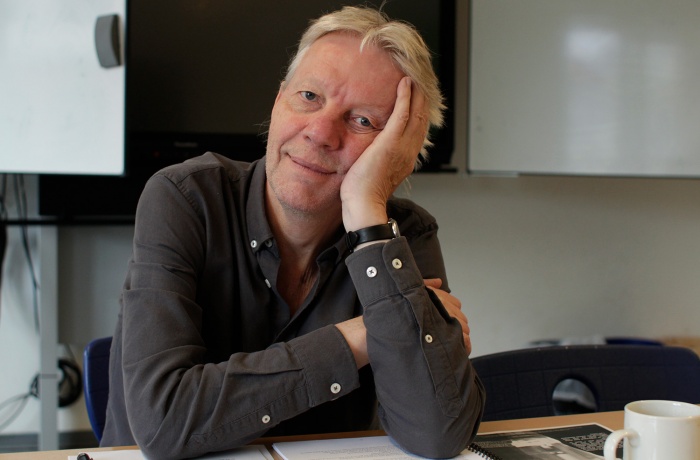
Mikael Opstrup is one of the most influential mentors in the world of documentary filmmaking. With more than 30 years in the industry, he has led the EDN training program, consulted on projects at IDFA, Hot Docs, and Nordisk Panorama, and his book The Uncertainty has become a go-to reference for documentary filmmakers working with real-life protagonists. On the occasion of his masterclass on character-driven documentary cinema for DOCU/PRO platform, film critic Sonya Vseliubska spoke with Mikael about the power of contradictions, the connection between Syrian and Ukrainian documentary practices, and how not to lose faith in the political power of film.
Access to the event with Mikael Opstrup is open to holders of the DOCU/PRO industry accreditation. You can purchase a pass via the link.
At your masterclass, you will talk about character-driven documentary filmmaking. This approach is also central to your book The Uncertainty. Why does it remain particularly interesting to you?
Over the years, I’ve come to realize that this is the direction that interests me most. I think the reason is that, as I write in the book, it is built on contradiction. Documentary filmmakers usually are not in control of key elements of the story, and yet they must construct it. I don’t know of any other art form that deals with such a contradiction. It’s truly fascinating.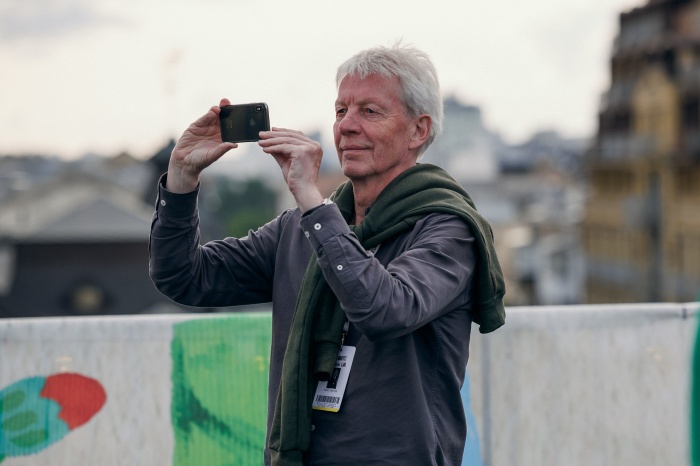
Mikael Opstrup during the 22nd Docudays UA. Photo: Serhiy Khandusenko
And also quite a challenge, especially when it comes to stories about wars and humanitarian crises. For you, is that an added complication or something already inherent in this mode of working?
I don’t think it fundamentally changes anything, because creatively it’s about the same thing: following what you cannot control and turning it into a coherent story. But of course, the more critical the situation is for our protagonists, the more seriously we must treat what I call not violating the “real truth.” It’s a huge responsibility, and an ethical one at that. We should remember: the protagonists have placed absolute trust in us by allowing themselves to be filmed. And they will have to live with our version of their lives for the rest of their days.
In Ukrainian documentary filmmaking, another significant dimension of responsibility emerges. We have to understand that our films are a responsibility not only to the protagonists but also to history. And this is truly difficult, because a film can change something. Maybe in small ways, but it may influence how the war ends. So much is at stake that the director’s work becomes incredibly demanding. Still, the ethical standards in the documentary community is generally very high, and that’s one of the reasons I stay here.
One of the strengths of contemporary Ukrainian documentary cinema is within observational work in which the protagonist is a collective or a phenomenon rather than an individual. How do you view this method, which stands in contrast to character-driven filmmaking?
It’s important to me not to place one genre above another. They are all valuable. Viewers and documentary filmmakers have diverse tastes. I’m certainly interested in observational films, cinéma vérité, direct cinema — whatever we choose to call it. When I watch such films, I often forget that I’m looking at a screen. The sense of presence is a powerful emotional driver in war documentaries. Other people love to be conscious of the media, I just happen to not forget the media is my priority. 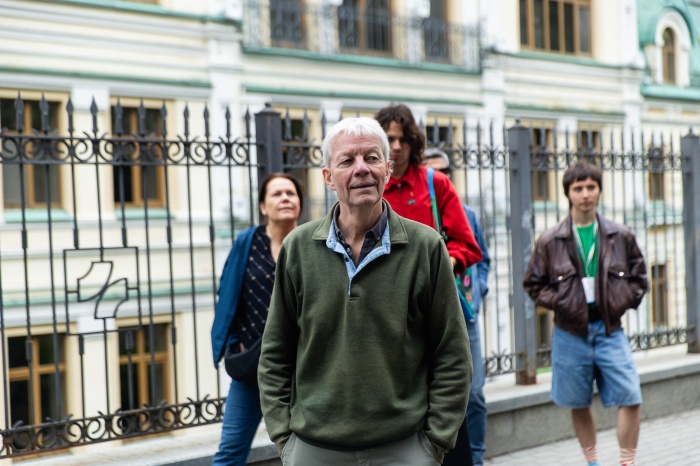
Tour of Kyiv for international guests during the 22nd Docudays UA. Photo: Nastya Telikova
Before working with Ukrainian documentary filmmakers, you were involved in Syrian documentary production. These are two of the most documented wars in recent history, and one can trace a certain evolution between them — in methods, approaches, and perhaps even in technology. How do you see it?
I wouldn’t say I was that deeply involved. There was a Syrian couple: the producer in that duo, Orwa Nyrabia, later headed IDFA for quite some time. I became a co-producer on their first international film, Dolls: A Woman from Damascus, and then they founded a documentary festival in Damascus — it was on stone ground, without an existing scene or tradition. I was invited there for several years, until the 2011 revolution, when everything had to be shut down, and they had to flee the country.
But during those years, I met many Syrian filmmakers. It was a very intriguing experience. At the beginning of the co-production, the producer wisely sent me ten Syrian documentary films, because at the time, I knew nothing about their perspective. They impressed me: I felt I was encountering a different storytelling tradition — completely unlike the one I, as a European, had grown up with. It was a useful insight because we Western tutors often impose our own vision.
As for approaches, I don’t think the difference is that great. Syrian films followed a trajectory similar to what we see in Ukrainian cinema today: first, films from the front line, and then a wave about how war affects so-called “everyday life.” Technologically, there wasn’t a major difference either: compact cameras already existed during the Syrian revolution, and documentary filmmakers could be directors, cinematographers, and sound recordists all at once. The main change is that both visual and sound quality have improved significantly since then.
Today, as wars multiply and escalate, many filmmakers who carry the truth and advocate for human rights increasingly feel pessimistic. The Ukrainian film community acknowledges that it is becoming harder to maintain attention on its tragedy amid these crises, and documentary filmmaking seems to be losing its political weight. What would you say to those struggling with despair, and how can one maintain a balance between aesthetics and shocking imagery in such times?
It’s an interesting and complex issue. Of course, we make films to change the world. And yet, when a film is created purely for the sake of change, a familiar tension arises: the director’s agenda is readable from the very beginning, and the film then merely tries to make the viewer understand it deeper. From an artistic perspective, this is dangerous — I’ve often seen films where I grasp everything in the first ten minutes, and after that, they stop working. So we return again to the contradictions that a director must juggle.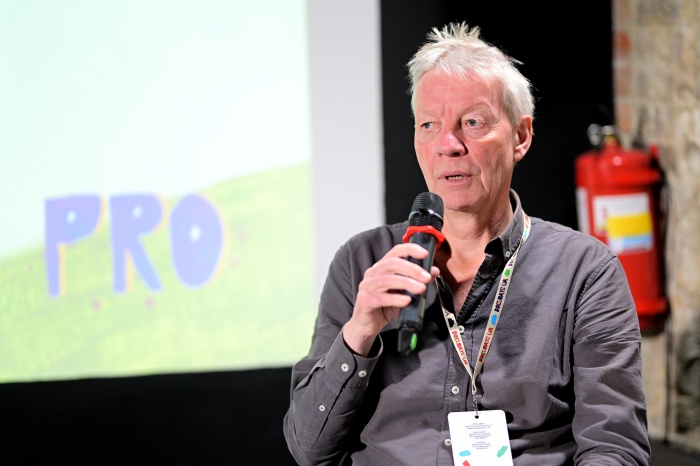
Masterclass by Mikael Opstrup during the 22nd Docudays UA. Photo: Stas Kartashov
We must care about aesthetics because this is a visual art, but at the same time, it is important to show the ugliness of war and death — something that should be unbearable to look at. This is a very difficult contradiction. I come back to this word again, as I think it is key to my interest in documentary filmmaking — the fact that it is built on endless contradictions. The kind of documentary stand is called complementary: two sides of an issue simultaneously complete and exclude each other.