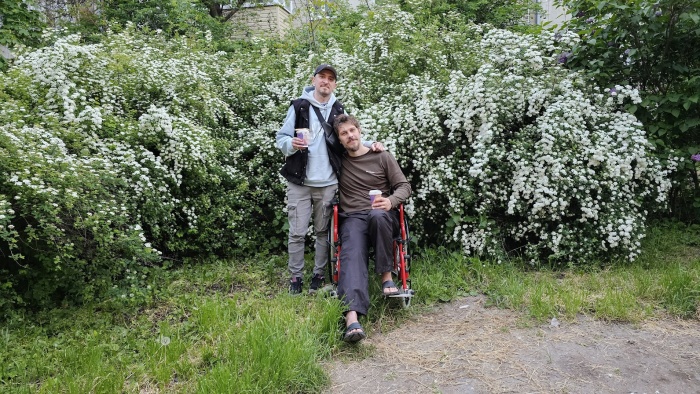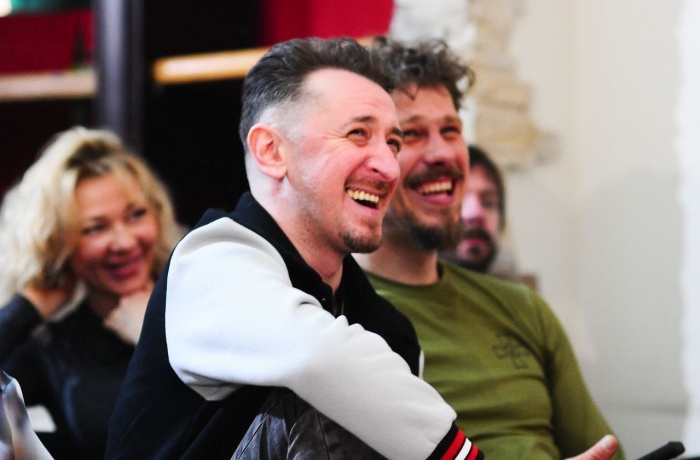
Read the third interview in our series of conversations with creators of Ukrainian feature-length films, featuring Oleksandr Tkachenko, director of Where Everything Disappears, as well as the film’s cinematographer and protagonist, Dmytro Dokunov. The film is participating in the DOCU/UKRAINE competition.
How did you two meet? Whose initiative was it to make the film? When and how did the vision emerge of what it should or could be?
Sashko (Oleksandr Tkachenko): Dok (Dmytro Dokunov) and I are old friends, both in life and creatively. We have been working together as director and cinematographer for 18 years. When the full-scale war began, production stopped, and Dok and our editor Artem volunteered to go fight at the frontline.
There was nothing in the news about the inner dimension of the war. About the drama of the people who had gone to the front. I saw stories of “heroes” in the telemarathon broadcasts, but I did not hear their voices. Hundreds of thousands of ordinary men left their homes and comfortable lives, separated from their families, left behind their ambitions and dreams, faced incredible physical strain and mental challenges, picked up weapons for the first time — and now they were heading into the unknown.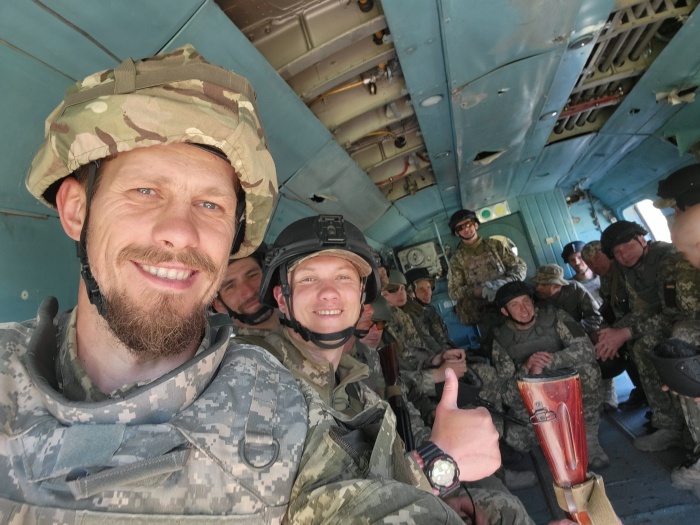
Dmytro Dokunov with his brothers-in-arms. A still from the film Where Everything Disappears
In April, I wrote to Dok and asked whether he was filming anything. Knowing that he was. He uploaded several files to the cloud. They contained real life: people, personalities, emotions.
We decided to make the film. Dok regularly uploaded videos to the cloud or sent hard drives by post from villages closest to the front. I accumulated the material, worked through it, gave feedback, and sent detailed questions for reflection, and Dok recorded voice messages with his answers.
At the same time, I was working on the idea, looking for partners and funding. I understood that my connection with Dok gave us a chance to tell an honest story.
Another close friend of ours joined the team: Ukrainian producer Illia Hladshtein, and later we began working with ARTE.
After the film had been edited, I also joined the military.
How did you construct the first-person narrative? How long did you work on it, and what was the most difficult part of the process? Did Dmytro keep a diary and return to it later, or did he record his reflections during the making of the film?
Sashko: There is no physical diary, neither in the form of a notebook with notes nor notes on a smartphone. The narrative was created from hundreds of voice messages. It was my task to draw feelings out of Dok — feelings which, in war, are mostly frozen — to see how events affected his state of mind. I tried not to pressure him, not to influence him, not to impose my own vision. I mostly listened and asked follow-up questions.
Dok really disliked recording voice-overs — it was difficult for him to read them aloud. It was like scratching at a fresh wound. He would worry, prepare for a long time, do pranayama, yoga exercises; sometimes afterwards it would take him several days to recover from the flood of emotions.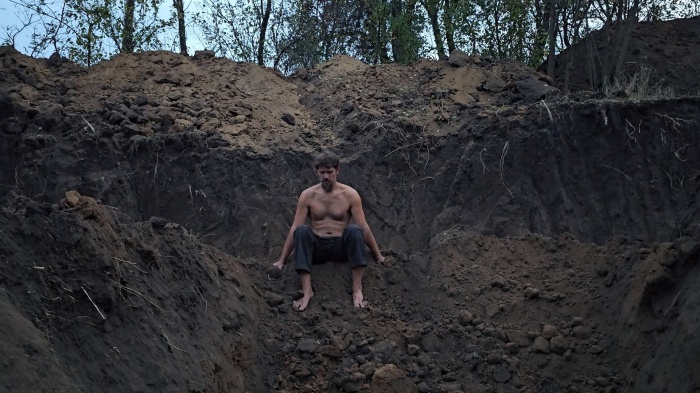
A still from the film Where Everything Disappears
It is a very personal and, it seems, very sincere diary about inner questions and transformations. Dmytro, were there boundaries regarding what you were willing to share and what you were not?
Dok: Yes, there were boundaries. And for me, that was important — not to turn sincerity into exposure for the sake of effect. I wanted to be honest, but I did not want to betray something deeply intimate within myself. There are things that can be expressed in words, and there are things that are still maturing in silence, and it is better not to disturb them. For me, this film is not a confession in the literal sense, but rather an honest presence in the moment. I shared what could genuinely become a bridge to other people: fear, doubt, pain, vulnerability, the search for meaning. But I reserved the right not to explain everything completely, not to name every wound. Because sincerity is not about laying everything bare. Sincerity is when you do not lie. And it was important for me to preserve precisely that truth.
You speak about the ability to see beauty. In the film, despite all the pain, loss, and tension, that light is deeply felt — both in the images and in the words. How do you manage to preserve and nurture it within yourself?