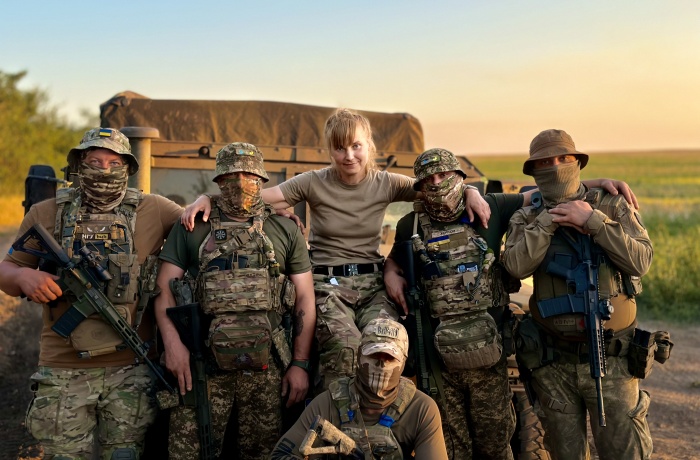
Specially for the 23rd Docudays UA, we have prepared a series of interviews with the creators of Ukrainian feature-length films to uncover the stories behind the documentary films featured in this year’s festival programme and help you get to know them better. Read the first conversation with DOCU/UKRAINE competition participant, filmmaker and servicewoman Helena Maksyom, director of the film Don’t Ask Me If I Killed.
The first footage we see was shot on the eve of the full-scale invasion. When did you start filming this project, and why? Did you immediately plan or feel that this material could/should become a film?
Before the full-scale invasion, I was making a film about institutional care facilities in Ukraine, places where very young and elderly people with disabilities live under one roof, united by their shared dependence on the system. My main protagonist was Ira, a girl on a wheelchair from Nova Kakhovka, an orphan who wrote poetry. After the occupation, she was taken to Russia. I was unable to help her. Then I joined the Armed Forces of Ukraine, and we lost contact. I do not know where she is now or whether she is alive.
I remember very clearly that, long before 24 February 2022, I felt that the Russian army would try to occupy Ukraine. That feeling never left me and made it very difficult to plan anything… I tried to speak about it with colleagues from Europe, with friends in Ukraine… but the words seemed to find no ground to stand on. Many people told me I was exaggerating and that such a thing could never happen. Yet at that time, I think many people felt it too, but pushed the thought away, unwilling to believe it, accept it…
No, I did not plan or feel that the footage shot before the full-scale invasion should become a film… These shots are from my personal diary, like some of the others you see in the film — I film myself, trying to briefly convey my state of mind and what is happening around me.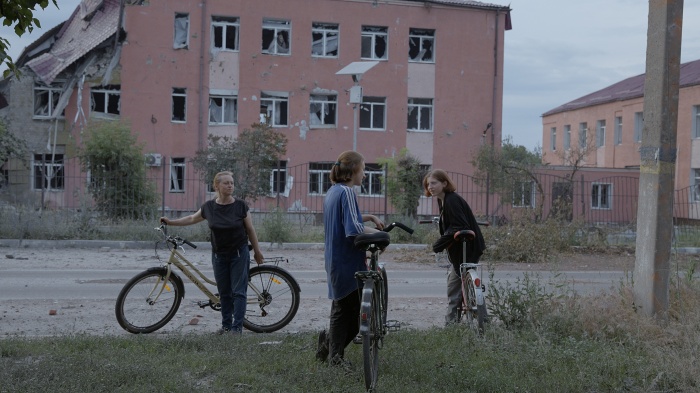
A still from the film Don’t Ask Me If I Killed
When did you make the decision to join the Armed Forces? In the film, you capture the experience of people’s transformation (the expansion of their role) from civilians into military personnel, including your own. How does filming affect the way you live through and perceive this experience? What does the camera allow you to see — in others and in yourself? What principle guided your decision to turn on the camera and film the events around you? When did you feel that this was the moment to document?
At the beginning of the full-scale invasion, I joined a group of volunteers evacuating civilians from dangerous areas. I had a camera with me and sometimes simply recorded what was happening, without thinking that it might one day become a film. A great deal remained outside the frame. Like the time when Serhii, the driver who is now also serving in the Armed Forces of Ukraine, and I came across a Russian checkpoint in the Chernihiv Region and narrowly escaped. Or when a woman from Bucha told us that she had been raped by Russian soldiers, and that she did not know how to live with it afterwards or whether to tell her husband about it.
And then there was Kramatorsk… On 8 April 2022, we arrived at the railway station after a Tochka-U missile had killed 61 people and wounded more than 120. That day became the turning point after which I decided to join the Armed Forces of Ukraine. I completed my training, “celebrated” my birthday on 8 May already as a servicewoman — a combat medic — and on 10 May we left for the Luhansk Region.
I was the only woman in the battalion. The situation was critically difficult: we were vastly outnumbered by the enemy and had almost no resources. At the positions, a camera was not simply inappropriate — it was superfluous. And the desire to film almost disappeared. But there were many losses. And in those moments when it was possible, I began to record things — the boys at the command post, before deployment, fragments of reality that I managed to catch. Sometimes I filmed myself — with the thought that if something happened to me, the camera would remain, and perhaps someone might be able to use this material.
The camera calmed me a little.
I was filming us alive…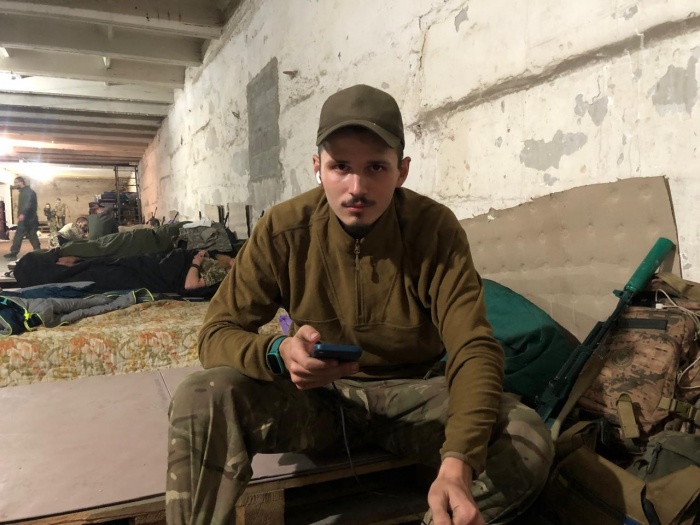
Comrade Artem. Photo provided by Helena Maksyom
How did your brothers-in-arms and command respond to the idea of filming? Was it difficult to coordinate the footage with your unit’s press service? How much can be shown to viewers when the war is still ongoing?
The idea of making a film first came to me after the death of my close friend and brother-in-arms, 20-year-old Artem. I really wanted him to be remembered. My brothers-in-arms, who had by then become like family, accepted the idea. But during that period there was almost no time for “just filming” — in war there is constant work and no days off.
I did not film secret operations. I did not take the camera to combat positions. I filmed only when it was possible and when it did not interfere with service. The commander of the National Guard of Ukraine at the time, Lieutenant General Yurii Lebid, was also fine with the occasional filming, as long as it did not interfere with combat and service duties. So the press service had no objections either.
It is difficult for me to answer what exactly can be shown to viewers. Sometimes I get irritated when journalists talk about things that should remain secret: tactics, new developments. The enemy monitors this, just as we do.
There are things that are very difficult to speak about. Very frightening things. And I do not know when the moment will come to reveal them.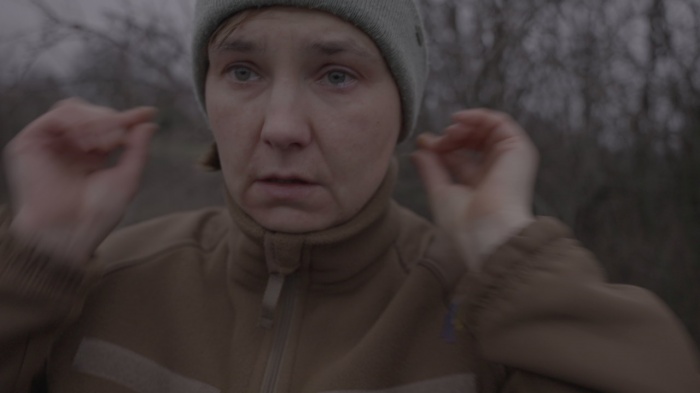
A still from the film Don’t Ask Me If I Killed
The title of the film immediately catches one’s attention and feels obvious in its own way. It will probably resonate differently with different people, so I’d be interested to hear your thoughts on it.
During my first leave from the military, after we had withdrawn from Bakhmut, I came to Kyiv and visited my friend, Zhanna, who is now a producer. At the time, our friend, a Lithuanian director, was staying at her place. We were drinking coffee on the balcony, smoking… and it was difficult for me to return to small talk, to try to behave “normally”.
And then he suddenly asked, “Have you killed?”
I looked at him in silence for a long time. Then, unable to withstand my gaze, he simply hugged me.
For a long time, the film’s working title was A Soldier’s Journey. That suited me — after short editing sessions I would return to the front, and it felt honest: the journey was continuing. But the producers began to doubt whether the title was truly accurate. And then I remembered this story.
That is how the new title appeared: Don’t Ask Me If I Have Killed.
Photos provided by Helena Maksyom
The 23rd Docudays UA is held with the financial support of the European Union and the Embassy of Sweden in Ukraine. The opinions, conclusions, or recommendations do not necessarily reflect the views of the European Union or the governments of these countries. Responsibility for the content of the publication lies exclusively with the authors and editors of the publication.