Simple Structures: Thematic and Visual Identity of the 23rd Docudays UA
Each year, the Docudays UA team gathers for brainstorming sessions to shape the festival’s theme — to sense what resonates most deeply with us all, with society, what feels urgent, hopeful, painful, or intriguing. From a long list of images — some light-hearted, others not — we converged on a theme that allows us to explore the very foundations, the basic values of society. Justice and democracy are widely seen as public goods. Yet corruption often sneaks in with its own immediate perks. Democracy may be declared a simple structure, but in reality it can morph into a dizzying corruption machine — one that makes illegal mansions sprout like mushrooms.
Simple Structures are not meant to be reinvented. Their purpose is simply to withstand pressure and function — like a foundation or a bicycle.
In Ukraine this winter, simple structures took the form of bricks on a gas hob, warming homes as Russia sought to collapse our energy grid. Tents in the middle of rooms. Fishing nets overhead to block enemy drones. And above all, our refusal to remain indifferent — the readiness to do what we can, here and now.
The new normal is increasingly modular: assembled from temporary fixes, autonomous light, portable heat, swift agreements, and flexible forms of co‑living. It does not appear definitive, yet it enables us to endure unpredictable pressures. Its strength lies in adaptability.
Today, human rights face a stress test. Core rights and democratic values look simple, even self‑evident as a formula. Yet that simplicity makes them fragile. Populism need not oppose them — it hijacks them, bending their meaning for manipulation.
Equality is twisted into a weapon against equality policy. The rights of “our own” outweigh the universal protections meant for everyone. Democracy becomes the majority’s licence to ignore the minority. Law becomes a tool of order stripped of justice. Thus, the manipulation of a simple construction slowly compels it to act against its original intent.
In architecture, simple structure carry space: wall, beam, column, foundation, roof, support. Take the arch — it shares the weight across its shape, which makes it last for centuries.
During Docudays UA this year, we will examine the basic structures that enable us to stand firm, to resist burdens — whether heavy, unjust, unpredictable, or those that at times feel impossible to bear.
This year we will ask: which structures should stay temporary fixes, and which must turn into permanent supports — designed to bear the weight of future pressures.
By Darya Averchenko, Director of Communications at Docudays UA and Selection Council member.
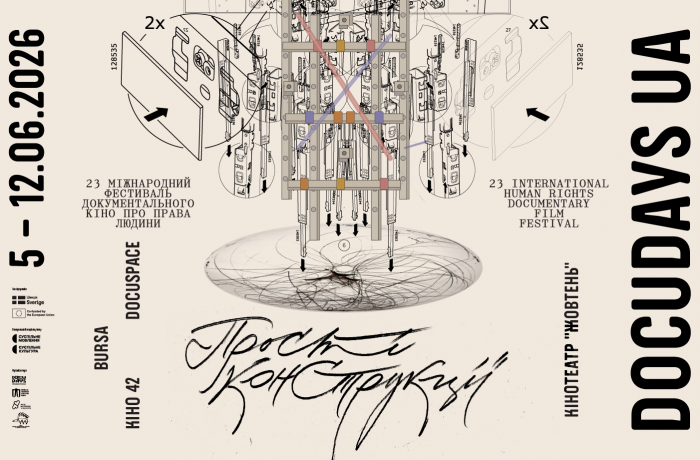
“At the core of the image lies the trace of a double pendulum: a simple mechanical construction which, through its unpredictable motion, creates a complex graphic structure.
A simple structure generates a chaotic, unpredictable pattern. Yet even chaos ultimately shapes harmony, for harmony is embedded in nature — though it resists measurement or calculation. In the pendulum’s drawing one can discern the human eye, the brain’s neurons, even an anti‑drone net or the schematic of a neural network”, comments Roman Bondarchuk, Art Director of Docudays UA, on the visual concept.
Poster designed by Dasha Podoltseva.
Calligraphy by Ann Kizima.
The 23rd Docudays UA is held with the financial support of the European Union, the Embassy of Sweden in Ukraine and the Ukrainian State Film Agency. The opinions, conclusions, or recommendations do not necessarily reflect the views of the European Union or the governments of these countries. Responsibility for the content of the publication lies exclusively with the authors and editors of the publication.