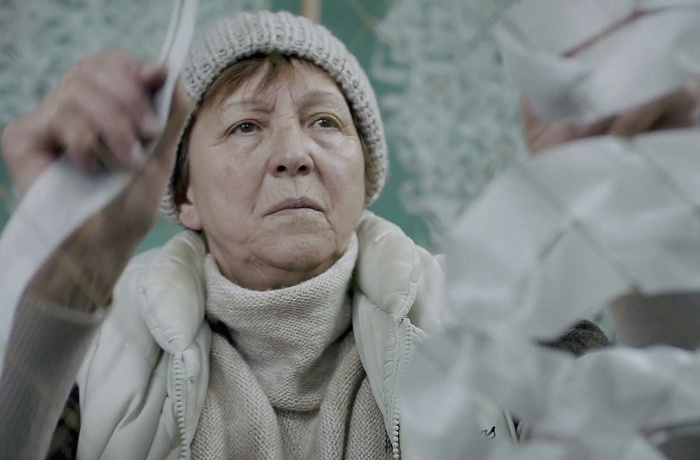
This conversation with Jeanne Dovhych, the director of Peace for Nina, continues a series of interviews with the creators of Ukrainian feature-length films. We’ll be screening her film in our main programme.
How did you meet Nina? How did your relationship evolve over the years of struggle and filming? How did this affect the work on the film?
Sometimes it happens that you have known the protagonists of a future film for many years, while the idea to start filming emerges because of circumstances life throws your way.
We had known Ms. Nina Branovytska for several decades, she is a relative of my husband. In 2014, when her son Ihor, after taking part in the Maidan protests, decided to join the army to stop the Russians in the East, Nina began gathering everything he needed. At the time, everything was in short supply: helmets, body armour, military clothing, and footwear. With the help of friends, we managed to raise money and buy a body armour vest for Ihor and several helmets. Later, in the summer of 2015, after Ihor’s death, Ihor’s comrade Ruslan Borovyk “Baghdad” returned that body armour to me in Kostiantynivka so it could be given back to Nina — at the time, there was a superstition among soldiers that if the owner of a body armour vest had been killed, no one else should wear it… When I later began working on the film, “Baghdad” gave me footage he had shot at Donetsk Airport, and as archival material, it became part of my film.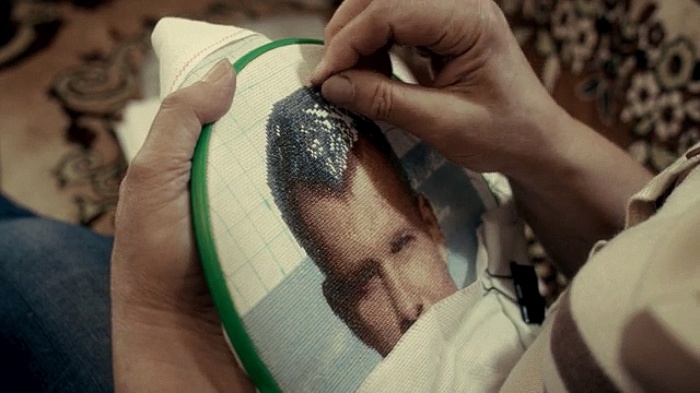
Ihor Branovytskyi took part in the defence of Donetsk Airport during its final, most dramatic months and days. After he went missing, I helped Nina search for him: we reviewed every possible photo and video from Donetsk Airport that we could find online, and when we discovered a separatist video showing Ihor among other captured “cyborgs”, we began looking for him among the prisoners of war. Later, we found out that Ihor had been killed. Then, together with Ihor’s family and Nina, we started looking for ways to recover his body. At that time, there were no registries of POWs or the dead like those that exist now. Lists with phone numbers of various people from the so-called “DPR” or intermediaries who might somehow help with the search circulated among relatives of prisoners. We tried everything, and at one point, after two and a half months of searching, Nina herself managed to identify Ihor’s body using distinguishing features among unidentified bodies in Dnipro, through volunteers. Eventually, I helped Nina organise the funeral ceremony, and it was then that I realised this needed to be filmed as a chronicle of the war. This particular episode was not included in the final version of the film, but that was when, in early 2015, I started filming.
I first wrote the story of Ihor’s search for Ukrayinska Pravda, it was published a few weeks after the funeral. Then, in the summer of 2016, I was invited to work on a film about Ihor Branovytskyi for the STB channel. It was released on Independence Day, and after that I felt internally free to make my own film specifically about the mother, about Nina, about her struggle to have her son’s death recognized as a war crime in court.
There was complete trust between Nina and me, so at some point I simply came to her home with a camera — and that was it, I started filming. In fact, trust is absolutely essential for documentary filmmaking. Without it, there is no chance of making an honest film.
How did you find the courage to speak about loss and to film moments at the cemetery, in the courtroom, among people living through similar stories?
The experience of searching for Ihor made Nina and me very close. Filming felt like a natural and logical step: Nina began fighting to have Ihor’s killing recognized as a war crime, while I started filming, I wanted to cry out to the whole world that we were at war, that Russians were systematically committing war crimes, and that these crimes had to be condemned.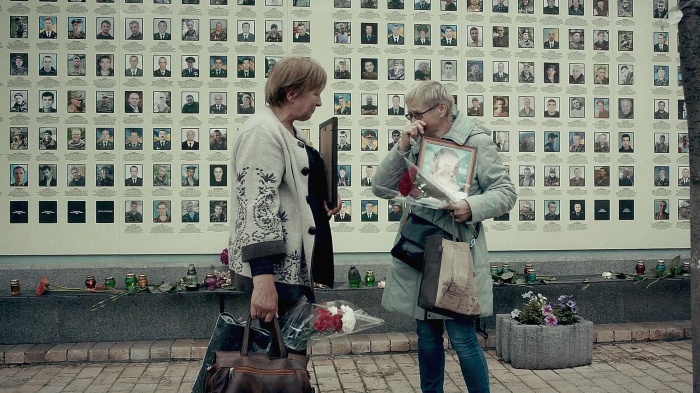
I had no difficulties filming either at the cemetery or in court. People from Nina’s circle — mothers, volunteers, Ihor’s fellow soldiers — saw it as a matter of course. Probably because of the trust that had developed between me and some of them even before I started filming. Others saw that I was filming Nina and simply accepted it as a given. I was not a stranger to them because I had met some during the search for Ihor, others at the funeral, and still others during several trips to the Ukrainian East with volunteer friends.
Where is the line between the personal and what is important to capture for the film?
I think you set the boundaries yourself. The experience I shared with Ms. Nina turned into a desire to tell her story, and she supported me in that. It is a rare stroke of luck for a documentary filmmaker when you make a film in complete trust. That is why I think Peace for Nina turned out to be very honest, on the one hand. When I was recording her message to audiences in France, she said, “we made this film,” and that is true. It is a shared work, it is openness that is not easy to find the courage to show. But this film is also, in a way, a summary of the journey we went through together, and for me it was also, to some extent, healing through action, through filming.
How does the mechanism for prosecuting war criminals such as “Givi” function in Ukraine today? What can we consider fair punishment?
There are several aspects to this. On the one hand, Ukraine has ratified the Rome Statute, which makes it possible to join the system of the International Criminal Court and more fully investigate international war crimes committed in Ukraine. On the other hand, not all the necessary secondary legislation has been adopted, and the Law on war criminals is undergoing yet another revision because there had been no political will to pass it earlier.
As for “Givi” and people like him: Mykhailo Tolstykh, also known as “Givi”, was a Ukrainian citizen, and he was eliminated there even before the full-scale phase of the war. Ukraine does not recognize any documents issued by such so-called republics, so this legal contradiction made it possible to try him as if he were alive in absentia. This is exactly the trial process we see in the film. But the courts kept passing the case around in circles until the full-scale invasion, and afterwards almost all cases opened before 2022 were effectively put on the back burner.
As for Arsen Pavlov, better known as “Motorola,” the Russian mercenary who killed Ihor Branovytskyi, after his death (he, like “Givi”, was also eliminated by Ukrainian special services), it is unfortunately impossible to designate him a war criminal in court, because only the living can be tried.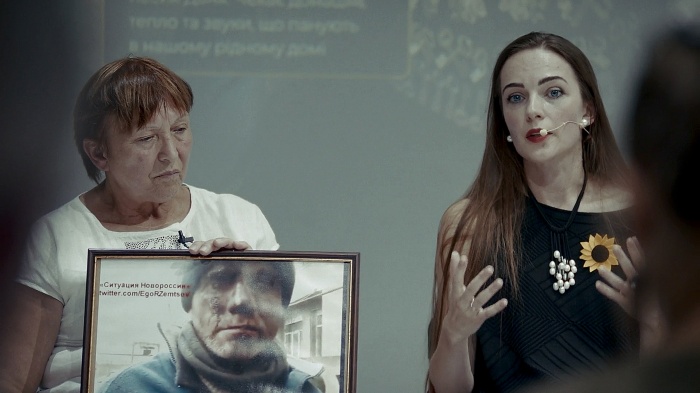
As for crimes committed after the full-scale invasion, the situation is better. Cases are being considered, and some have already resulted in verdicts. If the proceedings are held in person, convicted Russian soldiers (if they have been identified and their guilt proven), along with those convicted of treason who have expressed a wish to be exchanged, become part of the prisoner exchange pool to help bring back Ukrainians, both military personnel and civilians, held in Russian prisons and in temporarily occupied territories.
Fair punishment means, first and foremost, calling war criminals what they are in court: war criminals. Ideally, they should face life imprisonment. But if there is an opportunity to save the lives of our prisoners and bring them back to Ukraine, that opportunity must be used.
How did your vision of the story and editing transform during the filming process? How did you choose the moment when the film should be completed? How did the editing change?
After Ihor’s body had been returned and identified, and Ms. Nina was finally able to bury her son, I began filming it as a chronicle. Back then, in the spring of 2015, I was not thinking of it as a future film. I simply felt it was important to document Ihor’s funeral, Nina herself, Ihor’s brothers-in-arms. It was only in 2016, after I had written a series of articles about the search for the body, about the 90th Airmobile Battalion, and a screenplay for a television film about Ihor Branovytskyi for STB, while at the same time witnessing how desperately Nina was fighting to have her son’s killing in captivity by a Russian mercenary recognized, that I began filming Nina herself. It seemed to me that the story of a woman, a mother who refuses to give up despite her loss, had to be told.
In 2017, the film received funding from the Ukrainian State Film Agency, and from 2018 onwards I began filming systematically, accompanying Nina in her everyday life, in her search for evidence and for truth.
The editing of the film changed, of course. There were several versions, I worked with several editors, and naturally, after the full-scale invasion, it became clear that more filming was needed and that the film had to be re-edited. The hardest part of editing is letting go of scenes you love but which, for one reason or another, do not work for the story. In its current form, Peace for Nina is the result of my collaboration with editor Svitlana Zaloha, who, I believe, felt exactly what I wanted to say with this film. It turned out to be, on the one hand, harsh, and on the other, a gentle, feminine perspective on war.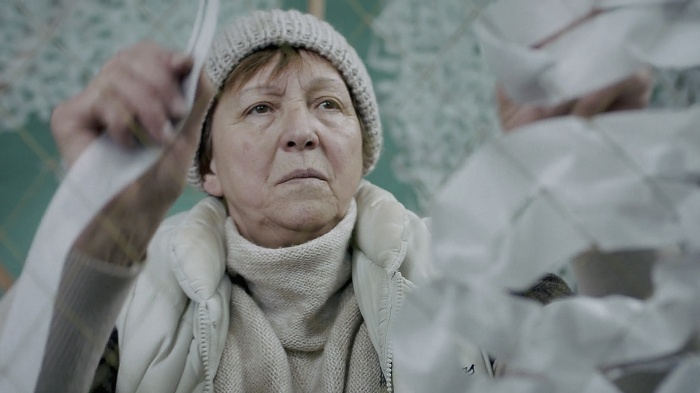
The film was created in co-production with Switzerland and already has an international life. How is this story, and the continuity of our struggle for justice and accountability, perceived abroad?