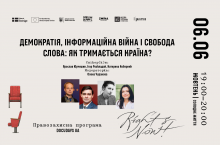
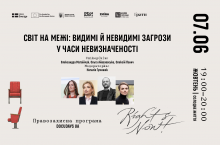
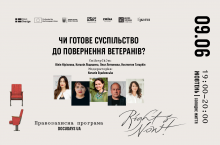
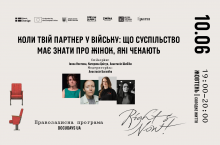
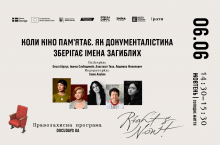
During the full-scale war, documentary filmmakers and journalists find themselves caught between two ethical imperatives: the need to bear witness to the truth for the world and the obligation not to harm the subject or their loved ones. The question of where documenting a crime ends and violating a person’s dignity begins has become critical for the professional community. This is especially acute in the context of covering Russian captivity and torture, where every word or image may have long-term consequences for survivors. Today’s viewer, too, is no longer merely a passive consumer — they become a participant in the process, either mobilised by what they see or driven to suppress excessively traumatic content.
The event will involve discussions of:
Evidence-based journalism: how visual materials become part of the evidence base, and where is the line between informing and shocking?
Respect for dignity and a trauma-informed approach: how can we work with those who have survived Russian captivity or violence without retraumatising them? How can we protect the interviewer from secondary trauma and emotional burnout when working with sensitive topics?
Psychology of perception: how does constant contact with traumatic content change society?
Final discussion: is there a line that must not be crossed, even for the sake of truth?
Speakers:
Maksym Butkevych, human rights defender, media worker, co-coordinator of CF Principle of Hope, and member of the expert council of the Centre for Civil Liberties;
Alisa Kovalenko, documentary film director, human rights activist, and board member of SEMA Ukraine;
Oksana Romaniuk, director of the Institute of Mass Information;
Oleksandr Avdieiev, psychotherapist, psychiatrist, founder of 4help Online Therapy, and author of the book Who Jokes Like That?