We present the first part of the special programme Deconstructions, dedicated to decolonial practices and optics. In her article, Dovzhenko Centre film scholar Alona Penzii, curator of the film selection, introduces the archival films digitized exclusively for this year’s series of screenings and events.
The special programme Deconstructions was initiated and is taking place with the financial support of the European Union within the FILMDECO project, in consortium with two European film festivals — One World (Slovakia) and Verzió (Hungary) — to critically reflect on the legacy of colonial policies in Central and Eastern Europe.
Afghanistan’s war — futile and blood‑soaked; the Chornobyl catastrophe, or more precisely the cover‑up of its aftermath; the Crimean Tatars, who after decades of exile began to return to their homeland and fight for the right to a home — all these forces in the late 1980s hastened the disintegration of the Soviet Union. The dissidents of the 1960s called ‘Sixtiers’ had already begun to chip away at this wall, though the system managed for a time to imprison and suppress the first blossoms of Ukrainian freedom that emerged after Stalin’s winter. Yet, the seed of universal folk wisdom in the Ukrainian village could not be eradicated — not during collectivization, famine, war, nor the bleak routine of the kolkhoz. 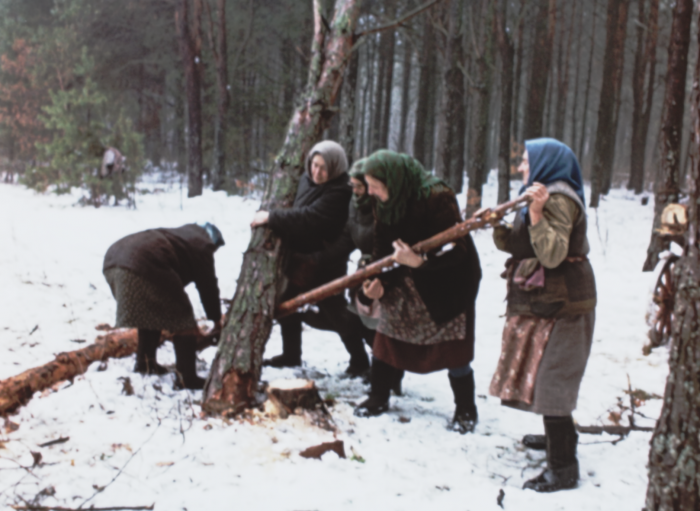
A still from the film Sunday Morning…
Ukrainian villagers, especially women, bore heavy burdens. They could even carry an entire tree on their shoulders, like the protagonists of Murad Mamedov’s film Sunday Morning… (1987). Despite their age, they remain strong both physically and spiritually, capable of much on their own, though haunted by loneliness rather than by the fear of death. None of them, of course, wishes to die. These women hold a critical view of life and of the Soviet system, yet at the same time display a stoic acceptance of all that befalls them. Perhaps it is the sense of community that makes even cutting down the forest seem less of a challenge.
Murad Mamedov shapes another powerful female figure in his film Wound (1988), a work that speaks of Afghanistan’s war and its aftermath. The soldiers’ homecoming carries neither triumph nor joy. Scarred and broken, veterans find themselves abandoned by a disintegrating state, left to wrestle with post‑traumatic syndromes and disability in solitude. Speaking of their experience is hard — not only because only fellow soldiers can grasp it, but because society refuses to listen. In a decade of operations, 160,000 Ukrainians served; some 3,000 never returned. Yet when the troops were withdrawn, the authorities did everything possible to conceal the consequences of this neo‑colonial war. In the film, it is mostly the mothers who speak for the men, turning the personal tragedy of their sons’ broken lives into a demand to voice their right to truth.
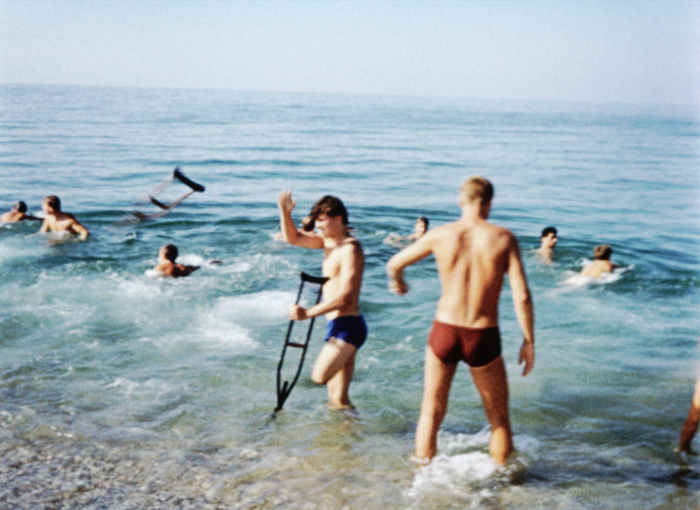
A still from the film Wound
By the late 1980s, Ukrainians were no longer simply voicing concerns — they were proclaiming them at ecological demonstrations. The Chornobyl catastrophe shook the pillars of the Soviet order, sparking conversations about the colonial character of Russia’s relationship with Ukraine and the exploitation of both natural and human resources for Moscow’s benefit. The silencing of Chornobyl’s consequences shook society so profoundly that the protests became the first unsanctioned demonstrations in the Soviet Union. One such event was the mass gathering of ten thousand at Kyiv’s Dynamo Stadium on the disaster’s anniversary, captured in Heorhiy Shkliarevskyi’s Right to the Truth (1989). These demonstrations marked the starting point of Ukraine’s path to Independence, as ecological demands swiftly gave way to social and national ones. 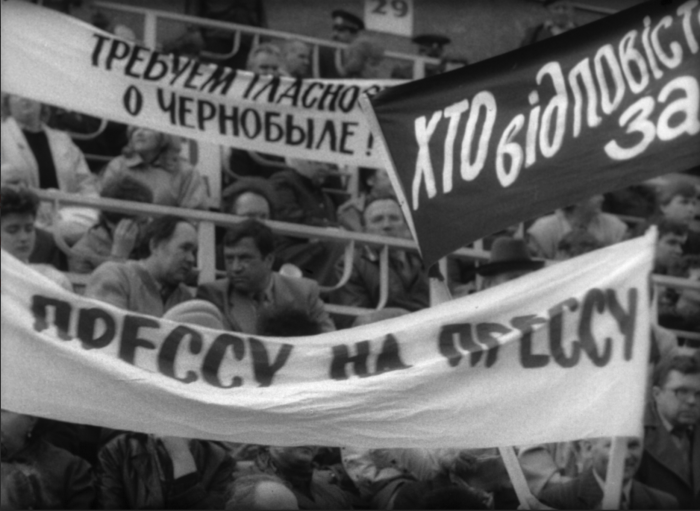
A still from the film Right to the Truth
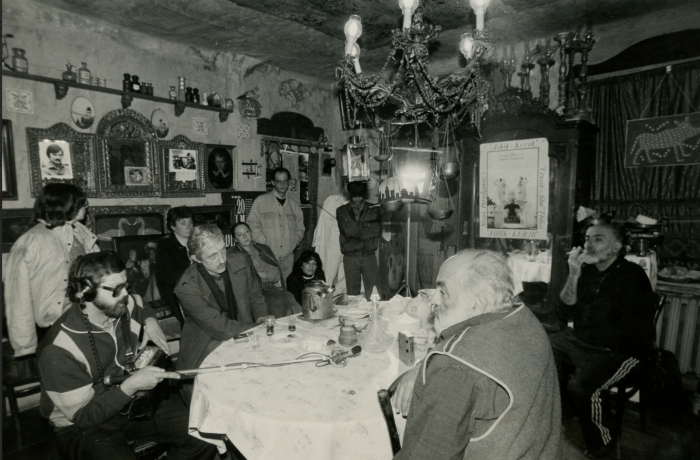
In independent Ukraine, Sergei Paradzhanov is confidently regarded as one of the country’s most renowned directors, and Shadows of Forgotten Ancestors (1964) as one of the most significant Ukrainian films. His elevation to the pantheon of national heroes came only after his death — just as he, offended and ill, had foretold at the end of his life in Anatolii Syrykh’s film Sergei Paradzhanov. Visits (1994). Paradzhanov was too free a spirit to escape the system’s restraints. He dared to speak the truth at all times, and even the years of imprisonment could not silence him. In the film, his voice sounds bitter and wounded, yet calls us to reflect on Ukraine’s complicity in the Soviet colonial policies. 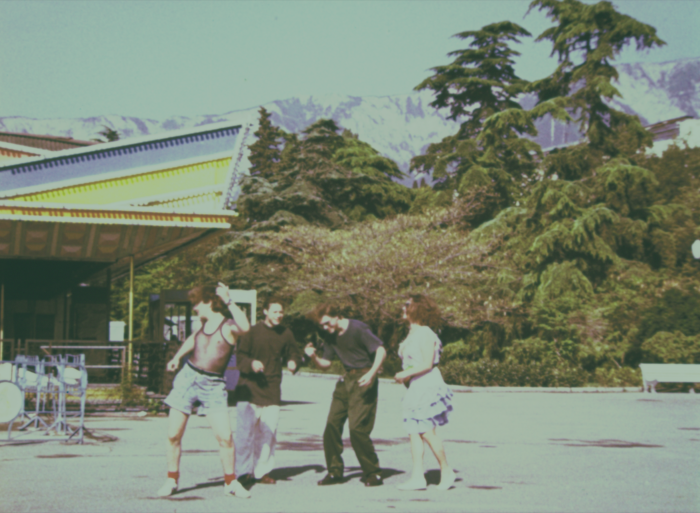
A still from the film The Past?...
Rafail Nakhmanovych, the director of the last film in the programme, stood as one of the most prominent and active ‘Sixtiers’ in Ukrainian cinema. In 1966, his team captured on film the unsanctioned gathering at Babyn Yar with Ivan Dziuba and Viktor Nekrasov, an act that brought KGB persecution. It curtailed his opportunities for creation, yet not the profoundness or prophetic force of his art. In his last film The Past?... (1995), the Crimean Tatar activist Besibe (Bella) Aksakova gives voice to those silenced. She speaks of ancestral graves ruined and profaned, of loved ones abandoned along the railway during deportation, of those crushed by fascist and Soviet systems alike. Her testimony defends the right of the living to claim their right to a home in their native land. The question mark in the title of Nakhamovych’s Peoples of Ukraine cycle is both bitter and prophetic. The history of the Crimean Tatars’ deportation and return home has not faded into the past; instead, it has acquired an even more piercing and tragic resonance today.
By the late 1980s and 1990s, people increasingly demanded their right to truth, to humane treatment, to home, memory, and freedom. Contemporary documentary cinema not only captured and recorded this tendency, but at times became itself a driver of systemic change. Truth became oxygen for the living — and a corrosive agent against the steel grip of the system.
Main photo: a still from the film Sergei Paradzhanov. Visits