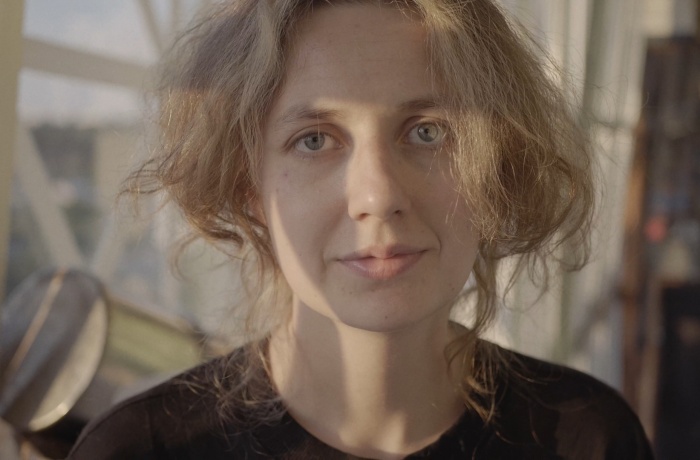
We continue our series of interviews with Ukrainian feature film directors with a conversation with Maryna Nikolcheva, the author of One Day I Wish to See You Happy. The film is part of the special program Strong Structures.
On the cinematic language of love in your film: How did you search for a visual language to convey intimacy and love between you? Or did it emerge on its own?
I am very glad that love can be felt in this film. But I did not set out to find a cinematic language to convey it. I believe that if I had tried to do so deliberately, it would not have worked. In fact, it was the opposite. At the beginning of the project, I did not imagine myself as an active protagonist in the film. I tried to quietly, almost invisibly, film Maksym. The realization that I needed to be present in the film came later, and quite by chance. When the full-scale invasion began, I found myself in Prague. The only way to continue filming was to record our video calls. That was how I appeared on screen. While editing this material, I realized I needed to search for cinematic means to express my own perspective on events. And, as I imagine it, the sense of love began to emerge at the moment when this perspective entered the film. More than that: one of the most important aspects in constructing this film was to avoid indulging in feelings. Had we done so, it would have turned into a flat melodrama. Instead, we created a drama with a genre that is very difficult to define.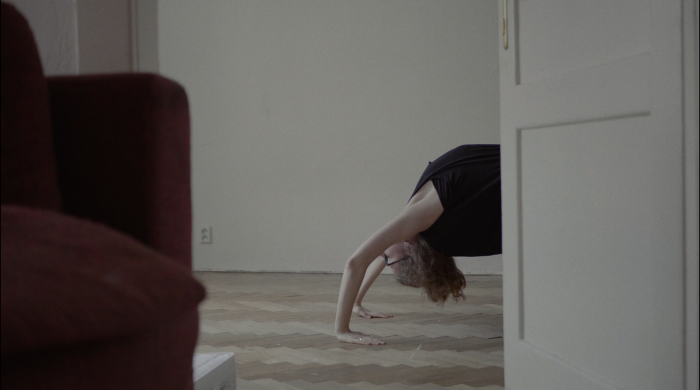
Intimacy. In the film, the camera has wide access to the intimate, the hidden, the emotional. Where did you draw the line — the boundary you were not ready to let outsiders cross? Or was there such a boundary at all?
This film is told from my perspective. Yet more than eighty percent of what appears on screen is another person — Maksym. So the space of intimacy was not defined by me, but by him: wherever he was willing to let me in with the camera, that is where I went. I had only two tasks before me. The first I formulated as follows: to shoot the most intimate film possible — otherwise it would not be an ‘honest’ film about the life of a couple — but at the same time not to hurt Maksym. I chose not to turn on the camera at moments that Maksym might interpret as a ‘moral betrayal for the sake of the film’s future success.’ The subtlety lay in the fact that, since Maksym is a director, he always understood in the moment what I was doing and why. That is why, for example, there are no explicit scenes of our quarrels in the film — such moments are shown in other ways. The second task I set for myself was not to spoil the candid material Maksym gave me by editing it into an overly artificial construction. I sincerely hope I succeeded. 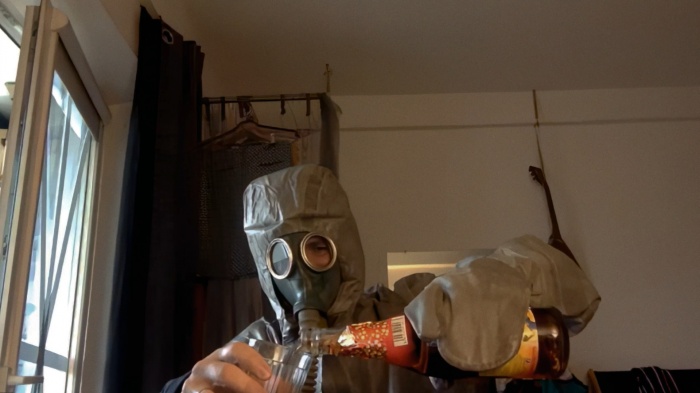
How did you realize when the film was complete and it was time to stop shooting?
This is direct cinema, telling the story of the characters in chronological order. With such a project, it is quite easy to know when filming has ended — you simply wait until most of the narrative lines have reached their conclusion. That is exactly what happened, almost in a single moment. I won’t give more specifics, as that would be a major spoiler.
At what stage did you begin editing the film — during the shooting process or only after it was completed?
During the shooting stage. I always edit while filming — it helps to better understand what has been captured: what works and what doesn’t. What kind of material is missing for the story to come together. Which visual solutions succeed, and which fail. What the film’s story is really about. Editing during production allows you to see more clearly which scenes to look for in the real lives of the characters. 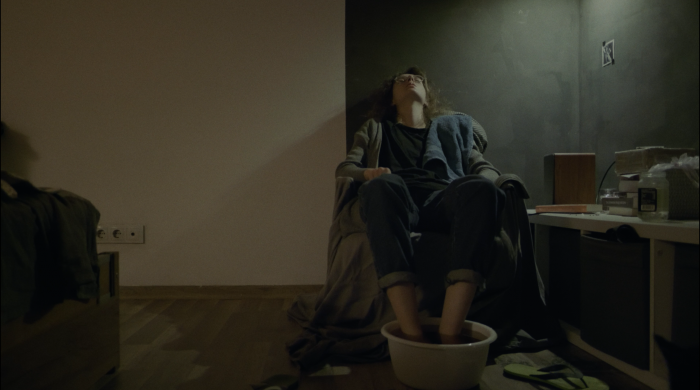
Which of your favorite moments did not make it into the final cut of the film?
The film once had an alternative opening — a scene intended to briefly introduce the audience to me and Maksym, and in some way explain that we are both documentary filmmakers and a couple. I searched for such a scene for a long time but couldn’t find it. At one point, I came up with a provocation: I filmed myself coming home, opening the door, and walking to the bathroom. I heard Maksym in the shower. I asked his permission to come in to use the toilet. I entered, sat down, and filmed what was in front of me — the shower curtain behind which Maksym was bathing. At a certain moment, he pulled back the curtain, realized the situation, and reacted emotionally. It was an uproarious scene. We once pitched the film by showing it, and that evening turned into my directorial triumph — I had never seen an audience react so wildly to material. People were literally sliding off their chairs with laughter. Yet the scene never made it into the finished film. The film no longer plays with provocation or flirtation with the body. To include it would have felt manipulative towards the viewer. So we let it go.
Photos: stills from the film One Day I Wish to See You Happy
The 23rd Docudays UA is held with the financial support of the European Union, the Embassy of Sweden in Ukraine, and the Ukrainian State Film Agency. The opinions, conclusions, or recommendations do not necessarily reflect the views of the European Union or the governments of these countries. Responsibility for the content of the publication lies exclusively with the authors and editors of the publication.